

 Tweet
Tweet
The heavier and longer the pull the more time it usually takes to master it. The Glock does have about twice the pull of the 1911. Little things like taking advantage of the short trigger reset does help. And it is considerably easier to master than DA/SA handguns.
The 1911 has a considerably lighter trigger. But it also has a thumb safety. So when all things are equal in the dead of the night and you have to draw from a holster and put 2 or more rounds center mass into a mugger a few feet away before he cuts your throat the two guns are even with regards to speed and shot placement. It is in that enviorment in which a Glock thrives.
On a shooting range, sitting or standing at a bench, the Glock is not really in its element and it is really easy to stack the deck in the 1911's favor. For one thing, you can take your time. So the time needed to flip off the 1911's thumb safety becomes entirely irrellevant. Not to mention you can take forever and day between your shots. So if you are struggling with the recoil of the 45ACP most 1911s come in, you might not even know it because you don't have the time pressure you would in real life. You are also not drawing from a holster from under concealment. So the two scenerios are radically different.
However, if you force the shooter to use the 1911 thumb safety inbetween every 2-3 shots and only give the shooter a two seconds or less to make thoses shots before the target turns away, and have the shooter work from a holster under concealment and suddently things between the two guns begin to even out. With the Glock you pull and shoot. With the 1911 you would be surprised how often people who think they are totally used to that weapon system struggle to get the safety off, and even back on, when they need to. The speed at which things are happening throws them. With time they improve. My point is, most people who think they know what they are doing, don't know as much as they think they do.
If you think the Glock is harder for you to master than a 1911, you would REALLY struggle with a DA/SA trigger which adds the further complexity of a VERY heavy first pull followed buy a lighter pull. But again, if you are just plinking on the range you can stack things in the DA/SAs favor buy cheating and cocking the hammer so you skip the DA pull. Something you can't do in a gunfight because you won't have time. Just like you can cheat on your 1911's safety in a gunfight but you can on a range.
I am not trying to make the 1911's thumb safety sound like an impossible to overcome challenge. I am simply saying it is equal to the challenge of mastering the Glocks medium pull weight. No more, no less.
So why do you like your 1911 so much better? Why do you do better with it? Probably because it is what you know. It is what you are used to. It has probably become muscle memory. New things, no matter how small, require you to re-train your muscle memory. Doing that is a lot tougher than we like to think.
As for your training question, the same things you do to master a 1911 trigger you do with a Glock. Trigger control drills are trigger control drills. Trigger reset is trigger reset (though different distances on different guns). Dry fire is dry fire. Taking a basic defensive pistol course, or two, or three, or more is a great way to master any system. 1911, Glock, Sig, or otherwise.
The 1911 has a considerably lighter trigger. But it also has a thumb safety. So when all things are equal in the dead of the night and you have to draw from a holster and put 2 or more rounds center mass into a mugger a few feet away before he cuts your throat the two guns are even with regards to speed and shot placement. It is in that enviorment in which a Glock thrives.
On a shooting range, sitting or standing at a bench, the Glock is not really in its element and it is really easy to stack the deck in the 1911's favor. For one thing, you can take your time. So the time needed to flip off the 1911's thumb safety becomes entirely irrellevant. Not to mention you can take forever and day between your shots. So if you are struggling with the recoil of the 45ACP most 1911s come in, you might not even know it because you don't have the time pressure you would in real life. You are also not drawing from a holster from under concealment. So the two scenerios are radically different.
However, if you force the shooter to use the 1911 thumb safety inbetween every 2-3 shots and only give the shooter a two seconds or less to make thoses shots before the target turns away, and have the shooter work from a holster under concealment and suddently things between the two guns begin to even out. With the Glock you pull and shoot. With the 1911 you would be surprised how often people who think they are totally used to that weapon system struggle to get the safety off, and even back on, when they need to. The speed at which things are happening throws them. With time they improve. My point is, most people who think they know what they are doing, don't know as much as they think they do.
If you think the Glock is harder for you to master than a 1911, you would REALLY struggle with a DA/SA trigger which adds the further complexity of a VERY heavy first pull followed buy a lighter pull. But again, if you are just plinking on the range you can stack things in the DA/SAs favor buy cheating and cocking the hammer so you skip the DA pull. Something you can't do in a gunfight because you won't have time. Just like you can cheat on your 1911's safety in a gunfight but you can on a range.
I am not trying to make the 1911's thumb safety sound like an impossible to overcome challenge. I am simply saying it is equal to the challenge of mastering the Glocks medium pull weight. No more, no less.
So why do you like your 1911 so much better? Why do you do better with it? Probably because it is what you know. It is what you are used to. It has probably become muscle memory. New things, no matter how small, require you to re-train your muscle memory. Doing that is a lot tougher than we like to think.
As for your training question, the same things you do to master a 1911 trigger you do with a Glock. Trigger control drills are trigger control drills. Trigger reset is trigger reset (though different distances on different guns). Dry fire is dry fire. Taking a basic defensive pistol course, or two, or three, or more is a great way to master any system. 1911, Glock, Sig, or otherwise.





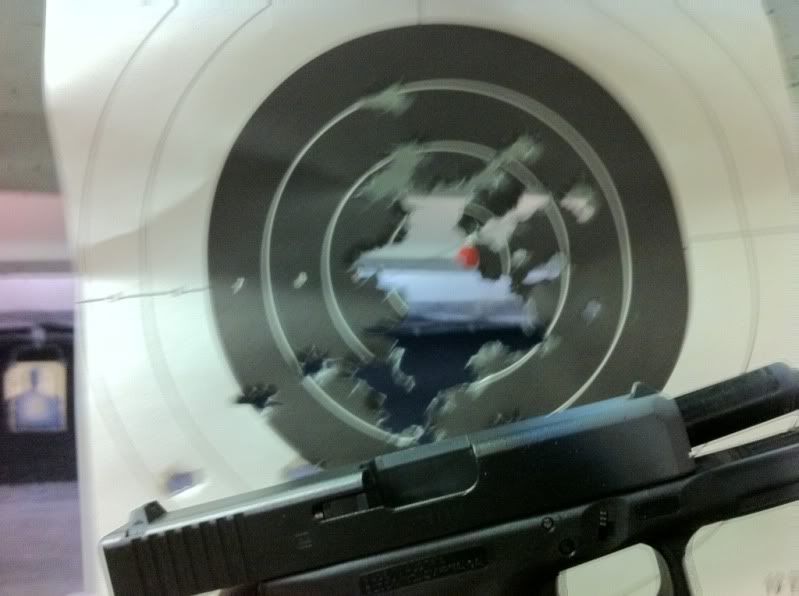


 There are lots of variables that can affect your accuracy and all of them have already been mentioned. I actually shoot the G30SF better than any other Glock. I absolutely love it, but it may not fit you as well as a full size or even a 19/23.


Comment