

 Tweet
Tweet
The "Blue" in question is a Dillon 650 that was gifted to me by an acquaintence who lost interest in reloading. I don't think he used it a lot, but I believe he acquired it second hand himself and is possibly the 3rd or 4th owner, as several parts on it were older versions which Dillon has updated in the intervening years.
After setting it up and trying to get it running, I experienced a number of problems - some of which were things wrong with the press - which dampened my enthusiasm for reloading. Dillon was great on the phone, talking me through some things, and shipping some parts to them for inspection and repair/replacement. I can't complain about the company.
Anyway, after all that, it seemed I was still having some problems. The press wasn't working consistently, and wasn't producing consistent ammo. So I kind of gave up in disgust. And the press has sat idle for months now. That's just a darn shame.
Anyway, I have eventually decided to dial things back a bit and focus on the fundamentals. So I am working some quality time with my Hornady LnL single stage press now, doing one round at a time, one stage at a time.
In doing so, I am discovering some things. I'm discovering that the polished/tumbled brass is a lot more irregular than I'd thought. I found a lot of 9mm cases stuck inside of .40's. I even came across a couple of 10mm's. Oh, and a few .38 specials stuck inside .40's too. Some of the primers are a lot more "stuck" than others. And some of the cases are a little deformed - some of which straighten out just fine. And some of which, just don't turn out right, for instance in the lip of the case area.
So it occurs to me that the big variable in this equation is the fired brass. One thing I learned working in the auto sales industry (years ago) is that while two new cars can be identical, no two used cars ever are the same. Even if they started out back to back identical at the factory, one was driven by a little old lady who never got the engine warmed up, and the other by a teenage boy who never let the tires cool down. One got oil changed on a schedule, the other only went in the shop when a light came on. And so on. Range brass is like that, I think.
So, I am taking my time, going through a whole gallon ziploc of tumbled .40 range brass, and sizing/de-priming it single-stage fashion. It's amazing how much variation there is in force of the lever. I suppose no two chambers on any gun are the same. And the makers use different formulas or methods. Or some were fired with a light load, while others were loaded near (or above) max. Some might have sealed primers. Regardless of the cause, when you hit a case with extra resistance, the lever hesitates on that stroke, or in the case of some obstruction, blocks it altogether. It makes sense that that hesitation or bump/stop on the resizing stroke would affect three or four other operations on a multi-stage press. And that would lead to inconsistency. I've already got quite a pile of what I'm calling "irregular" brass, ones that didn't quite pass inspection after the resizing operation. My goal is to try to get all the brass for the 650 to be as identical as possible. Maybe I'll still have trouble. Maybe not. But if I do still have problems, maybe it will be easier to track down the source of the trouble, having eliminated case inconsistency from the equation.
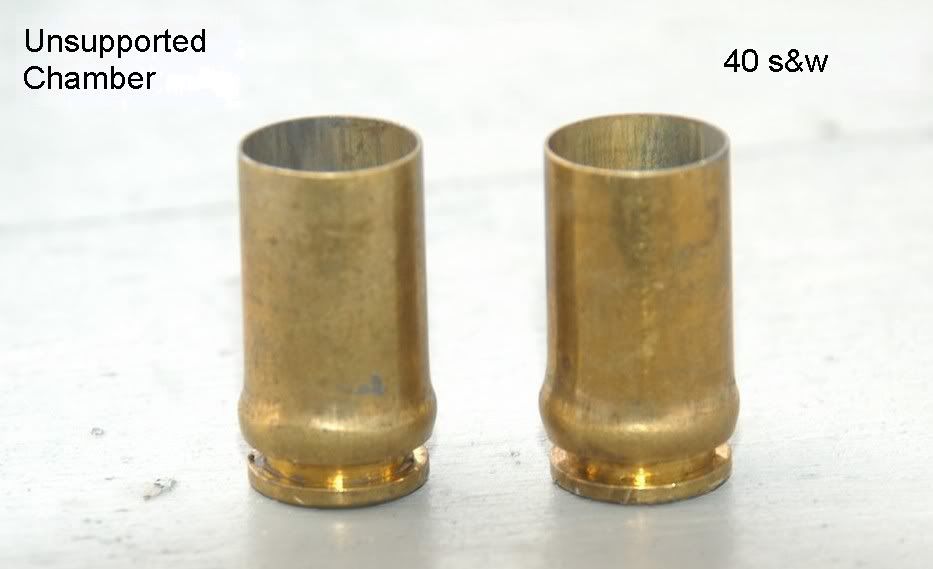
After I'm through resizing this batch, I'm going to run it through a de-glocker die to eliminate possibility of a case bulge from the unsupported chamber. That's about as close as I can get to making the cases identical. Sure, it's tedious, but I am enjoying seeing a bucket of polished, resized and deprimed brass, knowing it's all in really good shape to go through the press. I know you are supposed to "inspect" brass before the press, but how many people sit down and go through a bucket of 500 brass one piece at a time and really squint at the details of it? I'd wager, not a lot of people. We dump it in the tumbler, screen the media out after, give it a quick blink/glimpse as we toss it in the feeder tube... and then we have problems when it turns out we overlooked something the casual glance missed. I really don't have patience to break out a magnifying glass and squint at every piece of brass.... but putting it through the single stage tells me a lot, just by feel, and lets me feel like I'm doing something constructive while handling that brass instead of just zoning out, looking but not seeing, at around case number 322 of a batch of 500.
Maybe others do something different to ensure case uniformity, avoid problems on the multi-stage? I'd enjoy hearing what others do.
After setting it up and trying to get it running, I experienced a number of problems - some of which were things wrong with the press - which dampened my enthusiasm for reloading. Dillon was great on the phone, talking me through some things, and shipping some parts to them for inspection and repair/replacement. I can't complain about the company.
Anyway, after all that, it seemed I was still having some problems. The press wasn't working consistently, and wasn't producing consistent ammo. So I kind of gave up in disgust. And the press has sat idle for months now. That's just a darn shame.
Anyway, I have eventually decided to dial things back a bit and focus on the fundamentals. So I am working some quality time with my Hornady LnL single stage press now, doing one round at a time, one stage at a time.
In doing so, I am discovering some things. I'm discovering that the polished/tumbled brass is a lot more irregular than I'd thought. I found a lot of 9mm cases stuck inside of .40's. I even came across a couple of 10mm's. Oh, and a few .38 specials stuck inside .40's too. Some of the primers are a lot more "stuck" than others. And some of the cases are a little deformed - some of which straighten out just fine. And some of which, just don't turn out right, for instance in the lip of the case area.
So it occurs to me that the big variable in this equation is the fired brass. One thing I learned working in the auto sales industry (years ago) is that while two new cars can be identical, no two used cars ever are the same. Even if they started out back to back identical at the factory, one was driven by a little old lady who never got the engine warmed up, and the other by a teenage boy who never let the tires cool down. One got oil changed on a schedule, the other only went in the shop when a light came on. And so on. Range brass is like that, I think.
So, I am taking my time, going through a whole gallon ziploc of tumbled .40 range brass, and sizing/de-priming it single-stage fashion. It's amazing how much variation there is in force of the lever. I suppose no two chambers on any gun are the same. And the makers use different formulas or methods. Or some were fired with a light load, while others were loaded near (or above) max. Some might have sealed primers. Regardless of the cause, when you hit a case with extra resistance, the lever hesitates on that stroke, or in the case of some obstruction, blocks it altogether. It makes sense that that hesitation or bump/stop on the resizing stroke would affect three or four other operations on a multi-stage press. And that would lead to inconsistency. I've already got quite a pile of what I'm calling "irregular" brass, ones that didn't quite pass inspection after the resizing operation. My goal is to try to get all the brass for the 650 to be as identical as possible. Maybe I'll still have trouble. Maybe not. But if I do still have problems, maybe it will be easier to track down the source of the trouble, having eliminated case inconsistency from the equation.
After I'm through resizing this batch, I'm going to run it through a de-glocker die to eliminate possibility of a case bulge from the unsupported chamber. That's about as close as I can get to making the cases identical. Sure, it's tedious, but I am enjoying seeing a bucket of polished, resized and deprimed brass, knowing it's all in really good shape to go through the press. I know you are supposed to "inspect" brass before the press, but how many people sit down and go through a bucket of 500 brass one piece at a time and really squint at the details of it? I'd wager, not a lot of people. We dump it in the tumbler, screen the media out after, give it a quick blink/glimpse as we toss it in the feeder tube... and then we have problems when it turns out we overlooked something the casual glance missed. I really don't have patience to break out a magnifying glass and squint at every piece of brass.... but putting it through the single stage tells me a lot, just by feel, and lets me feel like I'm doing something constructive while handling that brass instead of just zoning out, looking but not seeing, at around case number 322 of a batch of 500.
Maybe others do something different to ensure case uniformity, avoid problems on the multi-stage? I'd enjoy hearing what others do.




 I am smiling because it would be a GREAT deal for me, but then again, I will prolly never own a dillon if I have to go buy one. They are just too much money and I believe in giving the underdogs a shot. (pun intended).


Comment