

 Tweet
Tweet
I would stop trolling if I were you.
-
-
It's kinda funny , I sometimes wonder if people posting are actually reading what's been written .Like Eric said if your brass has 0.005 variation something is major wrong with your set up. I load 14 Flea to 50BMG and never see that much inconsistency. I throw out brass that bad.
Lets start with you never see that much inconsistency . I'm not going to quote my self here but I will explain what I said . I said I had seen as much as a .005 swing . I did not say that was my avg difference . I was quite clear that much difference did not happen much but did rarely . I did say I was trying to size all cases to the exact same size . I also explain that before I started using comp shell holders I checked EVERY single case with my comparator , EVERY SINGLE ONE equaling thousands of cases . Not many people do/did that and is how I know there can be that much of a difference from case to case . That .005 swing happened in 1 in every 3 or 400 cases measured . If you are only measuring 1 in every 5 , 10 or 20 cases you could easily miss that one uber bad case .
Now for my setup having something very wrong with it . Well I kinda conceded that point by showing how much my Hornady press deflects . I also explained how I fixed the problem with competition shell holders .
I still stand by everything I wrote .
Please see post # 8 that shows that very thing .People don't believe that the press is being sprung by the brass alone.
This is easy to observe though if you were to only adjust the die down tight against the shellholder WITHOUT a case and then size a case and check the gap between the shellholder and the die while the case is being sized.
The thickness of the gap is the press being stretched BY THE BRASS.Last edited by Metal God; 06-16-2015, 5:48 PM.Tolerate
allow the existence, occurrence, or practice of (something that one does not necessarily like or agree with) without interference.
Anyone else find it sad that those who preach tolerance CAN'T allow the existence, occurrence, or practice of (something that they do not necessarily like or agree with) without interference.
I write almost everything in a jovial manner regardless of content . If that's not how you took it please try again
Comment
-
Randall Rausch
AR work: www.ar15barrels.com
Handguns: www.handgunbarrels.com
Bolt actions: www.700barrels.com
Foreign Semi Autos: www.akbarrels.com
Most work done while you wait on a scheduled shop visit.Comment
-
This is absolutely true.
And what you posted earlier about the brass causing a gap is exactly what metalgod was pointing out. I call that gap pre-loading the press.
What I don't see is the huge variation MetalGod sees in his brass with my brass that doesn't pre load the press be it a Pacific Partner Lee Corbin or even a arbor press and I have loaded more ammo than most and everything gets measured. I would imagine he is using multiple brands of brass all mixed togetherLast edited by LynnJr; 06-16-2015, 5:46 PM.Lynn Dragoman, Jr.
Southwest Regional Director
Unlimited Range Shooters Association (URSA)
www.unlimitedrange.org
Not a commercial business.
URSA - Competition starts at 2000 yards!Comment
-
The goal is to size the case minimally for 100% reliability. In a bolt action rifle this means bumping the shoulder .002" so the bolt closes easily yet the case is worked minimally. Cases sized that way last a long time.
Setting up a FL die like shown in Lee's video may bump the shoulder as much as .010" and sizing that much will cause premature case failure. But if your rifle is chambered in a way such that setting up your die as shown in Lee's video results in a minimal amount of shoulder bump, then go for it.Comment
-
I separate my brass by headstamp and year but can't say there was not some other thing going on . Maybe a case that had been fired 5 times was put in the pile that had just been annealed or vise versa . I load in 50rd lots and I've observed in the past that for what ever reason I had a loaded odd brand of brass in that lot . I try real hard to keep track and label everything but things happen . It has been awhile since I observed that large of a swing happen so I could not tell you what I was sizing . I do use a lot of NATO brass . If I were to guess I'd say it was 308 WCC-06 brass . I now have 10 loads on that 200+ piece lot of brass FWTW . That reminds me I need to anneal those before loading again .I would imagine he is using multiple brands of brass all mixed togetherLast edited by Metal God; 06-16-2015, 6:09 PM.Tolerate
allow the existence, occurrence, or practice of (something that one does not necessarily like or agree with) without interference.
Anyone else find it sad that those who preach tolerance CAN'T allow the existence, occurrence, or practice of (something that they do not necessarily like or agree with) without interference.
I write almost everything in a jovial manner regardless of content . If that's not how you took it please try againComment
-
Ok and this may be where I am not understanding something. My situation was an odd situation but if you can humor a guy who is new to bottleneck resizing. Lets pretend all tools, dies and chambers are as they should be. then by sizing the brass as Lee shows it will be taking the brass to the absolute minimum (short end of tolerance) spec, correct? If so, why are they recommending that reloaders set up and press brass in this fashion? I tend to gravitate more towards in person instruction and video instruction because I am more of a visual learner, I can say that the majority of online presence is instructing in the same fashion. Why would they not talk about tolerance spreads in this aspect of the die?
Which brings me to another item of curiosity, if any part of the equipment is off in any direction it may become important to make adjustments to the equipment, does it become very necessary to, in your experience to take measurement on every aspect of the equipment involved or simply to adjust the part of the equipment where it makes the most sense to do so?Semper Fi and long live the Hornady red monster!
Sent from my ship of right, while I float by all of you swimming in the sea of wrong.Comment
-
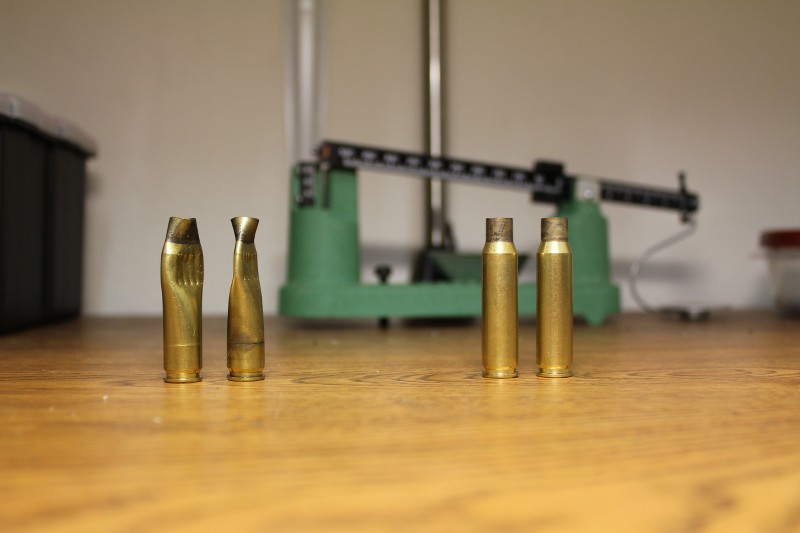
Manufactures like lee and others like Redding suggest setting up your die this way to ensure no matter what rifle you have the cartridge will chamber in it . I can tell you first hand if you size a case every time you reload it like that you will get case head separation in 3 or so firings .
Cases on the left fired 3 times and sized per Reddings directions . I smashed the cases with pliers to be sure I don't use them again but you can see the split just above the head in one of the cases and the other is showing the pressure ring where it will let go if loaded again . Cases on the right fired 8 times annealed once sized doing my feeler gage thing bumping the shoulders back .002 each time .
 Tolerate
allow the existence, occurrence, or practice of (something that one does not necessarily like or agree with) without interference.
Anyone else find it sad that those who preach tolerance CAN'T allow the existence, occurrence, or practice of (something that they do not necessarily like or agree with) without interference.
I write almost everything in a jovial manner regardless of content . If that's not how you took it please try againComment
-
Most people screw the die down until it touches the shellholder WITHOUT a case in the shellholder.
Then, they go about sizing cases.
SOMETIMES, this works just fine.
SOMETIMES, they get more press frame stretch than they can tolerate and the ammo will not fit their guns.
We see threads about the 2nd problem all the time.
These types of people are completely oblivious to press frame stretch during sizing.
Most of them don't even have tools to measure shoulder length or understand the importance of minimal sizing.
The more advanced/competent reloader will have a method to measure shoulder lengths and will likely understand the advantages of minimal shoulder bump.
This is the person who can benefit from more advanced techniques like shimming cases in the shellholder or using Redding comp shellholders.
No amount of measuring everything else will matter when the only easy adjustment is the die.Randall Rausch
AR work: www.ar15barrels.com
Handguns: www.handgunbarrels.com
Bolt actions: www.700barrels.com
Foreign Semi Autos: www.akbarrels.com
Most work done while you wait on a scheduled shop visit.Comment
-
You adjust the die or the shell holder so the case fits your rifle with minimum headspace. To do this you can screw the die up or down, play with competition shell holders, grind a standard shell holder, grind the die, or a combination thereof.
I prefer to have a die that bumps my shoulder a lot and use it in conjunction with a competition shell holder where a hard contact will result in a .002" shoulder bump. For example, to get .002" of shoulder bump in my .308 I use a Redding die with a +.006" competition shell holder. However, with my Forster die, I need to use a standard shell holder to get the same .002" of shoulder bump. Why? Cuz it is cut deeper than the Redding.Comment
-
In my instance it should only be necessary for me to do this the first time on this brass since it was likely semiauto fired previously and is running a bit long in the shoulder. But I can certainly see how reforming the shoulder every time on every firing would cause that. After the brass is fireformed it should only be necessary to size the neck as the shoulder will be fireformed to my chamber.
That is my understanding. Do you agree with me there or am I missing anything?
Ok, all of that makes sense. It is only obvious that the press will stretch, all metals have stretch and sheer ratings.
"SOMETIMES, they get more press frame stretch than they can tolerate and the ammo will not fit their guns."
I suppose the way my mind works, my initial presumption would be that what you mean by the ammunition not fitting their guns is that it will cause the shoulder to run over length, is that correct?
Now there are a lot of types of case gauges so I guess my next question is going to be somewhat subjective. The type I seem most people using is the gnurled aluminum cylinder that you just plunk the brass into that shows you a high and low groove. Typically speaking are these machined to the minimum side or the maximum side of the shoulder tolerance spectrum? (the high spot and the low groove is the high and low end of the tolerance correct?)Last edited by Redemption; 06-16-2015, 8:11 PM.Semper Fi and long live the Hornady red monster!
Sent from my ship of right, while I float by all of you swimming in the sea of wrong.Comment
-
J-Cat and MetalGod
This is my kind of thread now.
Redding buys there resize reamers from Dave Kiff so if your using a Pacific Tool and Gauge reamer it in theory should match right up with a Redding sizing die.Lynn Dragoman, Jr.
Southwest Regional Director
Unlimited Range Shooters Association (URSA)
www.unlimitedrange.org
Not a commercial business.
URSA - Competition starts at 2000 yards!Comment
-
Here is another tidbit:
To get .002" of shoulder bump on a case previously having been fired in a HK91 I have to use a +.002" competition shell holder along with a Redding die. The Forster won't size it enough because the chamber is so large the die cannot overcome the springback.
That is where people run into problems with range brass. Sometimes this brass is fired in oversized chambers and some dies just don't have the ability to properly size this brass. It's the extra springback.Comment


There are currently 14544 users online. 75 members and 14469 guests.
Most users ever online was 239,041 at 10:39 PM on 02-14-2026.


Comment