Unconfigured Ad Widget

Collapse

First 0% rifle project

Collapse
X
 
  • Time
  • Show
Clear All
new posts
  • SteelNWalnut
    Junior Member
    • Jan 2016
    • 17

    First 0% rifle project

    I have been doodling this design for a hybrid trapdoor/rolling block rifle in .22 lr. Just wondering if anyone with more experience would have suggestions or perhaps help in realizing the design.
    Attached Files
  • #2
    ar15barrels
    I need a LIFE!!
    • Jan 2006
    • 57143

    That's a pure trapdoor action.
    What do you feel makes it a hybrid of a rolling block?

    Trapdoor:


    Rolling block:
    Last edited by ar15barrels; 01-15-2016, 12:32 AM.
    Randall Rausch

    AR work: www.ar15barrels.com
    Handguns: www.handgunbarrels.com
    Bolt actions: www.700barrels.com
    Foreign Semi Autos: www.akbarrels.com
    Most work done while you wait on a scheduled shop visit.

    Comment

    • #3
      SteelNWalnut
      Junior Member
      • Jan 2016
      • 17

      Originally posted by ar15barrels
      That's a pure trapdoor action.
      What do you feel makes it a hybrid of a rolling block?

      Trapdoor:


      Rolling block:
      The design I'm using does not have a release latch like an 1870's trapdoor, it uses the hammer falling to lock the bolt like a rolling block. I'm still new to this so I'm just using different designs to influence it rather than one in particular.

      Comment

      • #4
        ar15barrels
        I need a LIFE!!
        • Jan 2006
        • 57143

        First 0% rifle project

        You need something to hold the trapdoor shut while the hammer is cocked.
        A couple rare earth magnets would work.

        You need something to hold the trapdoor shut while you are walking around too.
        If your plan is to only use the hammer for that, make sure you use an inertial firing pin so that the hammer is not resting on the pin and the pin resting on the cartridge.
        A non-inertial firing pin and a hammer resting on the cartridge is a recipe for a gun that is not safe to be dropped.
        Last edited by ar15barrels; 01-15-2016, 10:18 AM.
        Randall Rausch

        AR work: www.ar15barrels.com
        Handguns: www.handgunbarrels.com
        Bolt actions: www.700barrels.com
        Foreign Semi Autos: www.akbarrels.com
        Most work done while you wait on a scheduled shop visit.

        Comment

        • #5
          kendog4570
          Calguns Addict
          • Dec 2008
          • 5180

          What is going to absorb the bolt thrust? The fallen hammer? That would require a pretty hefty spring, even with a .22 RF. In the trapdoor section that Randall posted, the bolt (D) is locked at the tang (C), and the rear of the bolt should abut here.The cutaway doesn't illustrate this. The hole at the hinge pin (E) should be slightly elliptical in order for the thrust of firing to be transferred to the tang. The pin serves as a hinge only, and the tangs were selected and fitted for proper lockup so head space was correct and no bearing on the hinge. The rolling block pins do take some of the thrust, but they are massive and the parts are quite hard, and the breech is mechanically locked as the hammer falls.
          Gotta come up with some way to mechanically lock the bolt.

          Comment

          • #6
            ar15barrels
            I need a LIFE!!
            • Jan 2006
            • 57143

            Originally posted by kendog4570
            What is going to absorb the bolt thrust? The fallen hammer?
            It looks like his hammer has a "nose" that overlaps the trapdoor.
            That would put the trapdoor opening force across the hammer, not against it.
            The fitting of those angles will be super critical to keep the gun locked.
            I don't like it.
            Randall Rausch

            AR work: www.ar15barrels.com
            Handguns: www.handgunbarrels.com
            Bolt actions: www.700barrels.com
            Foreign Semi Autos: www.akbarrels.com
            Most work done while you wait on a scheduled shop visit.

            Comment

            • #7
              TKM
              Onward through the fog!
              CGN Contributor
              • Jul 2002
              • 10657

              Time for an homage....

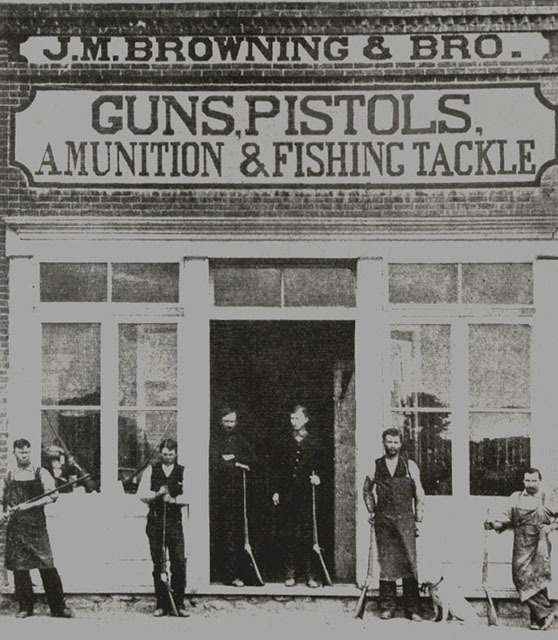
              Browning’s First Rifle: Winchester Model 1885 John Moses Browning’s developed his first rifle design in 1878 (the same year Edison unveiled the phonograph and Alexander Graham Bell patented the telephone). Browning had been running his father, Jonathan Browning’s, shop since 1877 and when his father died in 1879 Browning took over ownership of the business. He had previously limited himself to repairing firearms and tinkering with ideas but with his father’s death he and his brother Matthew decided to manufacture and sell John’s first design. (John & Matthew can be seen standing in the doorway of their Ogden factory in image #1, note the misspelling of ‘ammunition’.) In October 1879, Browning aged 24, was granted his first patent for a single-shot breech-loading rifle capable of firing powerful hunting rounds. The rifle would eventually be chambered in dozens calibres everything from .22 short to .45-70 and .50 Express and even a 20-gauge shotgun version was briefly made. It followed Browning’s mantra of building a gun’s action twice as strong as he felt it needed to be. The rifle’s action was very simple used a falling block which was lowered by depressing the trigger guard-lever. This opened the breech by dropping the breechblock through the receiver and allowed a round to be loaded into the chamber, the rifle’s exposed hammer dropped down with the breechblock and was cocked automatically on closing of the breech readying the rifle to fire (see patent drawing below). The Browning brothers opened a small factory in Ogden, Utah and began to produce the new rifle (see image #1). Selling the rifle for $25, an impressive 25 were sold the first week of production. The simple but robust rifle became popular locally and in 1883 came to the attention of a Winchester salesman, Andrew McAusland, who purchased a second-hand Browning rifle for evaluation for $15. While orders for his new rifle were initially promising Browning expected business to slow instead the orders for his single-shot rifle continued steadily. While successful the Browning’s lacked the capital to expand and advertise their rifle, relying instead on word of mouth. John Browning’s first patent granted in October 1879 (source) Winchester evaluated the rifle and were impressed, their Vice President and General Manager T.G. Bennett decided to meet the designer of this impressive new hunting rifle. Bennett traveled to the Browning’s shop in Ogden, a mammoth journey of over 2,000 miles from Winchester’s headquarters in New Haven, Connecticut, to negotiate the purchase of the single-shot design. That Winchester’s General Manager would travel so far to meet with Browning shows how much potential Bennett saw in the rifle. Winchester were in need of a strong-actioned rifle to compete with rifles like the Sharps, Remington and Ballard. When Bennett arrived unannounced he found the Browning brothers at work with John behind a lathe. Surprised by how young the brothers were, a brief but to the point conversation followed and a deal was made. Bennett bought the production rights to the rifle for $8,000 ($200,000 today), Browning had asked for $10,000 but Bennett had promised to put more work his way. This was the beginning of a 19-year partnership began which would see Winchester purchase 44 Browning gun designs, albeit only manufacturing and marketing a quarter of them. By the time Bennett had purchased the manufacturing right in 1883 the Browning factory had hand produced almost 600 rifles. Winchester sold the rifle as the Model 1885 and it was extremely popular with two types of the rifle made, the ‘High Wall’ (image #2) firing more powerful hunting rounds and the ‘Low Wall’ (image #3)for lower power calibres. The difference between the two is the height of the receiver walls behind the breechblock (see photograph below). Photograph showing the difference in the wall heights of the actions of the High & Low Wall rifles (source) Winchester would go on to produce 140,325 Model 1885 single-shot rifles between 1885 and 1920. In ignorance of what the contract agreed with Winchester meant the Brownings continued making the rifle themselves for a time, fulfilling orders made before the deal. Bennett had to explain to them that after selling the rights they could no longer manufacture the rifle themselves. Various variants of the rifle were made during its long life, heavy barrelled Express rifles firing .40, .50 and .50-111 Express rounds, a large number of ornate and very accurate Schutzen-style rifles were made (see image #6), and a military ‘musket’ variant chambered in the US government’s .45-70 ammunition these were made until the Model 1895 Musket superseded it (see image #5). The importance of the Model 1885 cannot be overstated. It marked the beginning of John Browning’s unparalleled career as a firearms designer. The deal with Winchester gave him the freedom and support to go on to design some of the most important firearms in history. Sources: Image One Source Image Two Source Image Three Source Image Four Source Image Five Source John M Browning: American Gunmaker, J. Browning & C. Gentry (1964) The History of Browning Firearms, D. Miller (2014) Mr Single Shot’s Guns - Idea Book, F. De Haas (1983)
              It's not PTSD, it's nostalgia.

              Comment

              • #8
                Toxic Shock
                Member
                • Dec 2012
                • 162

                I agree with the others that you will need an inertia firing pin and a locking mechanism for the breech block. The idea of using a shoulder on the hammer for additional support on the breech block is interesting, and worthy of further refinement. The pivot pin position on the breech block should be moved closer to the chamber to lessen the angular moment of the bolt thrust. In your design the bulk of the force from the bolt thrust which will be trying to rotate the breech block open will be resisted by the hammer pivot pin. You will need to make this pivot pin more substantial.
                The fitment of the relationship between the locking shoulder on the hammer, its mating surface on the breech block, and the engagement with the firing pin will require hand fitting, but not more so than on any other home build. If you refine your designs a little better this could be a very do-able action.
                Now for the $20,000 question: Do you live in California? If so, you should look up the "zip gun law". You are free to design anything that you want - you just can't actually build it. In California you are only allowed to build copies of firearms (that means the receiver) that were made by someone with an 07FFL. This idiotic law applies to long arms as well as handguns, but there are even more flaming hoops to jump through to make a handgun. Hopefully you live in the United States of America, and not Kommiefornia, because you can build your own designs everywhere else except here.

                Comment

                • #9
                  kendog4570
                  Calguns Addict
                  • Dec 2008
                  • 5180

                  Ha ha. By that law we would not have the best zip gun on the planet. The AR 15.

                  Comment

                  • #10
                    kendog4570
                    Calguns Addict
                    • Dec 2008
                    • 5180

                    Originally posted by SteelNWalnut
                    I have been doodling this design for a hybrid trapdoor/rolling block rifle in .22 lr. Just wondering if anyone with more experience would have suggestions or perhaps help in realizing the design.

                    Keep doodling. Big oaks come from little bitty acorns.

                    Comment

                    • #11
                      SteelNWalnut
                      Junior Member
                      • Jan 2016
                      • 17

                      Well unfortunately I wont build it because I'd rather not break the law. But I'll keep designing and maybe see if someone out of state wants to try building it themselves. And thanks to everyone who commented.

                      Comment

                      • #12
                        ar15barrels
                        I need a LIFE!!
                        • Jan 2006
                        • 57143

                        Originally posted by SteelNWalnut
                        Well unfortunately I wont build it because I'd rather not break the law.
                        Build a 22 LR "copy" of an 1871, scaled down accordingly...
                        Randall Rausch

                        AR work: www.ar15barrels.com
                        Handguns: www.handgunbarrels.com
                        Bolt actions: www.700barrels.com
                        Foreign Semi Autos: www.akbarrels.com
                        Most work done while you wait on a scheduled shop visit.

                        Comment

                        • #13
                          SteelNWalnut
                          Junior Member
                          • Jan 2016
                          • 17

                          Originally posted by ar15barrels
                          Build a 22 LR "copy" of an 1871, scaled down accordingly...
                          I did some research and found some plans and will builda copy in .22lr. This may take some time but I'll try to post pics with progress.

                          Comment

                          • #14
                            Toxic Shock
                            Member
                            • Dec 2012
                            • 162

                            That's the spirit! When you build your own firearm from scratch you get a lot of satisfaction out of it, and learn a lot of useful skills too. Another suggestion: for a beginner building their first rifle, a copy of the Remington model 6 is about as easy as it gets. A guy named Jerry Lindsey wrote a short tutorial called "A Rifle that Anyone Can Build" a couple of years ago, and there are multiple copies and pdf's floating around on the web. This is a fairly simple 22 single shot to make, and it can be built with a minimal of tools. The finished rifle can be as fancy or as crude as the builders skills and patience will allow. This is just a suggestion. A scaled down trap door would also be a good build. If you can, you should find a copy of the Frank DeHaas book "Single Shot Rifles and Actions". This would be a very good study resource.

                            Comment

                            • #15
                              SteelNWalnut
                              Junior Member
                              • Jan 2016
                              • 17

                              How far can I deviate from the original plans?

                              Comment

                              Working...
                              UA-8071174-1