Unconfigured Ad Widget

Collapse

D-Day planning question.

Collapse
X
 
  • Time
  • Show
Clear All
new posts
  • Tacit Blue
    Veteran Member
    • Feb 2009
    • 4134

    D-Day planning question.

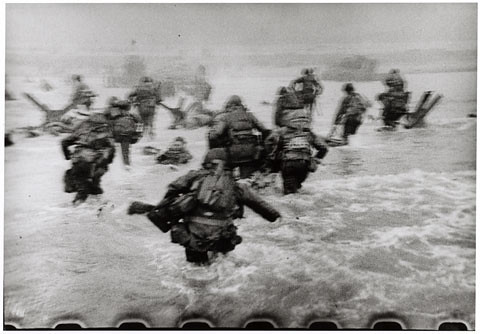
    Me and my friend were discussing the operational planning behind " Operation Overlord" and it dawned on us, why did they land the infantry in front of the seawall?

    I know Airborne dropped in behind the bunker to flank them from the rear, which in my opinion makes alot more sense. As opposed to using brute strength to push through the German's defenses. The soldiers from the landing craft had virtually no cover, other than the ' tank traps' and fallen soldiers to hide behind. Wouldn't it have made more sense to use Airborne to clear the bunkers out first? Then allow the infantry to land on the beach?

    I read that a German Soldier named Heinrich Severloh killed 1,000-2000 soldiers in " Omaha sector" and fired an estimated 12,000 rds. from his MG42 and Mauser 98K. It's just mind blowing...




    Last edited by Tacit Blue; 03-24-2012, 5:01 PM.
    "All that is complex is not useful. All that is useful is simple."
    Mikhail Kalashnikov *...
  • #2
    CAHighSierra
    Senior Member
    • Dec 2011
    • 799

    They were supposed to get air support, but the cloud cover screwed that leg of the assault up.
    You shoot me in a dream, you better wake up and apologize.

    Comment

    • #3
      Tacit Blue
      Veteran Member
      • Feb 2009
      • 4134

      Originally posted by CAHighSierra
      They were supposed to get air support, but the cloud cover screwed that leg of the assault up.
      Well that makes sense, if visibility was bad then air support would have resulted in friendly fire. I know they also used naval guns before the assault.
      "All that is complex is not useful. All that is useful is simple."
      Mikhail Kalashnikov *...

      Comment

      • #4
        Gryff
        I need a LIFE!!
        • May 2006
        • 12693

        Airborne is light infantry. I believe that they didn't have the firepower to engage the entrenched forces Wehrmacht/Heer forces and their reinforced emplacements. We dropped 23,000 allied paratroopers, and less than half of them formed up into functional units in the first 24 hours. You just can't mount coordinated assaults against fixed positions with the type of chaos that results from a 1940s nighttime airborne drop.
        Last edited by Gryff; 03-24-2012, 5:59 PM.
        My friends and family disavow all knowledge of my existence, let alone my opinions.

        Comment

        • #5
          Tacit Blue
          Veteran Member
          • Feb 2009
          • 4134

          Originally posted by Gryff
          Airborne is light infantry. I believe that they didn't have the firepower to engage the entrenched forces Wehrmacht/Heer forces and their reinforced emplacements. We dropped 23,000 allied paratroopers, and less than half of them formed up into functional units in the first 24 hours.
          This is what I've learned also. They missed half of their drop zones like you said and alot of them were mixed up into different squads/units. 82nd or 101st. Anti Aircraft Flak was an issue so I know they assaulted at night before the D-DAY invasion. But they were dropped in the coastal inland area I believe.
          "All that is complex is not useful. All that is useful is simple."
          Mikhail Kalashnikov *...

          Comment

          • #6
            SuperSet
            Calguns Addict
            • Feb 2007
            • 9048

            Right on, Gryff. There's no way widely-scattered, lightly armed paratroopers could have assaulted a fixed position manned by veteran, fresh troops. One of the reasons paratroopers are dropped behind the lines is that the opposing troops there are usually resting and recuperating from the front lines.

            Comment

            • #7
              Tacit Blue
              Veteran Member
              • Feb 2009
              • 4134

              Murphy's law really screwed up the operation planning for them. It seems like alot of things went wrong, yet we prevailed. Amazing...!!
              "All that is complex is not useful. All that is useful is simple."
              Mikhail Kalashnikov *...

              Comment

              • #8
                223556
                Veteran Member
                • Sep 2009
                • 3345

                Reading this brings back the begining sceane of Saving Private Ryan...
                "A well regulated militia, being necessary to the security of a free state, the right of the people to keep and bear arms, shall not be infringed."

                "Between your faith and my Glock 9mm I'll take the Glock."
                - Arnold Schawarzenegger (End of Days)

                Comment

                • #9
                  segfault
                  Member
                  • Jan 2012
                  • 145

                  and also Ike: Countdown to D-Day (2004)

                  Comment

                  • #10
                    Squid
                    Senior Member
                    • Oct 2010
                    • 1041

                    I'm don't see why they couldn't have directed heavy bombers with

                    either radio or signal rocket triangulation once they ships in the channel and close to the beach.

                    Radio triangulation might have been iffy when the bombers are 100s miles away inside Germany, but if you had ships up and down the coast a few miles off shore and targets are few yards to a couple miles inland I'd think it would be easy to get bombs dropping within 100 yard of targets.

                    Comment

                    • #11
                      Snoopy47
                      Veteran Member
                      • Aug 2010
                      • 3921

                      Also keep in mind that the seas were extremely volatile and landing craft were not all going where they were supposed to go, and not even a hand full of those floating tanks made it to shore before getting flooded by high waves.
                      Before there was Polymer there was Accuracy.

                      Comment

                      • #12
                        Snoopy47
                        Veteran Member
                        • Aug 2010
                        • 3921

                        Originally posted by Squid
                        either radio or signal rocket triangulation once they ships in the channel and close to the beach.

                        Radio triangulation might have been iffy when the bombers are 100s miles away inside Germany, but if you had ships up and down the coast a few miles off shore and targets are few yards to a couple miles inland I'd think it would be easy to get bombs dropping within 100 yard of targets.
                        There's a US navy Destroyer skipper that took his destroyer in danger close to engage the guns to support the landings. his ship and name elude me right now
                        Before there was Polymer there was Accuracy.

                        Comment

                        • #13
                          jmsenk
                          Senior Member
                          • Jan 2011
                          • 504

                          landing at that place and time was the best option that they had. Nowhere else on the coast offered a better place to attack, and their feints toward the Pas de Calais drew a hugh amount of the potential counter attacking force away from Normandy. The Paratroopers did their job valiently, but were never intended to fight on the beaches. Their job was to take and hold bridges inland and prevent a counter attack in force. If they had moved to the coast to "Flank the bunkers" as you say, then the Panzer divisions would have thrown the attacking force back into the sea. There was an admirable amount of air support and naval gunfire on the entrenched positions - having been there myself, the coastline still bears the scars of the bombardment, but there was no chance to decimate the defenses enough to storm the beaches unopposed. remember that Hitler spent millions of dollars and hundreds of thousands of men to fortify his coastlines. there is a reason it was called "Fortress Europe."

                          My grandfather was a CPT in 4th ID, and received the Bronze Star and Purple Heart at Utah Beach, Normandy. I was a US Army paratrooper and many think of Normandy as our finest hour. Having gone to a military college, I studied the invasion extensively, and it is generally regarded as one of the finest planned and executed operations in American military history. I have been to the beaches, and though a daunting task, it was the only option available at the time. Armchair generals can potshot the operation all they like, but there was no way to get into Europe but through raw courage.

                          I will have to do some reasearch, but the idea of one German soldier killing 1-2000 Americans from one gun position is ridiculous. There were around 3000 American casualties at Omaha Beach, and they were spread between both the 1st and 29th Infantry Divisions, as well as 9 companies from the 2nd Ranger Battalion.
                          My Blog: Here I Stand
                          sigpic

                          Comment

                          • #14
                            dalriaden
                            Veteran Member
                            • Jun 2011
                            • 4556

                            Originally posted by SuperSet
                            Right on, Gryff. There's no way widely-scattered, lightly armed paratroopers could have assaulted a fixed position manned by veteran, fresh troops. One of the reasons paratroopers are dropped behind the lines is that the opposing troops there are usually resting and recuperating from the front lines.
                            IF thats true then why were the paratroopers jobs to seize key bridges and hold them until allied reinforcements arrived? Take a look at 82nd airborne these days...light infantry whose job is to seize airfields with fixed and mobile AA and implaced infantry.

                            After the demise of the best Airborne plan, a most terrifying effect occurs on the battlefield. This effect is known as the rule of the LGOPs. This is, in its purest form, small groups of pissed-off 19 year old American paratroopers. They are well-trained, armed to the teeth and lack serious adult supervision. They collectively remember the Commander's intent as "March to the sound of the guns and kill anyone who is not dressed like you..." or something like that. Happily they go about the day's work.....

                            Comment

                            • #15
                              tanksoldier
                              Member
                              • Aug 2011
                              • 207

                              IF thats true then why were the paratroopers jobs to seize key bridges and hold them until allied reinforcements arrived? Take a look at 82nd airborne these days...light infantry whose job is to seize airfields with fixed and mobile AA and implaced infantry.
                              No.

                              Most airfields are not heavily defended against conventional attack.

                              Even if there are troops nearby, they are not dug in the way the Germans were at the Atlantic Wall... and if surprise is utilized properly, they will mostly not be in their defensive positions when our troops arrive.

                              Also, modern weaponry has advanced significantly. LAWs and other weapons provide light troops firepower much more capable of dealing with fortifications than they were in 1944.

                              Operation Overlord relied foremost upon deception. Heavy pre-bombardment would have sacrificed that, and while the beach landings might have been easier, moving inland would not have been. Hitler's refusal to release his mobile reserve was based almost entirely on his belief that the real Allied attack would be made at Calais.

                              The only place the deception plan didn't really pan out was Omaha Beach, and that was due more to Omaha's geography. It was simply well suited to defense. It certainly worked with regard to the mobile reserve and reinforcement of the landing beaches. All the other landing sites besides Omaha were relative pushovers:

                              A researched guide to non GamStop casinos for UK readers: Curaçao licensing checks, bonus wagering maths, payment options, withdrawal rules and safer-gambling tools.


                              Casualties on the British beaches were roughly 1000 on Gold Beach and the same number on Sword Beach. The remainder of the British losses were amongst the airborne troops: some 600 were killed or wounded, and 600 more were missing; 100 glider pilots also became casualties. The losses of 3rd Canadian Division at Juno Beach have been given as 340 killed, 574 wounded and 47 taken prisoner.

                              The breakdown of US casualties was 1465 dead, 3184 wounded, 1928 missing and 26 captured. Of the total US figure, 2499 casualties were from the US airborne troops (238 of them being deaths). The casualties at Utah Beach were relatively light: 197, including 60 missing. However, the US 1st and 29th Divisions together suffered around 2000 casualties at Omaha Beach.


                              Criticizing people who were the top experts in their field, 60+ years after the fact, is both pointless and insulting to them. Criticizing them when your own expertise is so obviously lacking is, frankly, ridiculous bordering on asinine.
                              Last edited by tanksoldier; 04-10-2012, 7:06 PM.
                              "I am a Soldier. I fight were I'm told and I win where I fight." GEN George S. Patton, Jr.

                              Comment

                              Working...
                              UA-8071174-1