

 Tweet
Tweet
...
-
-
Unless you are very experienced, using color to determine temperature is very error prone.
The temperature you need to reach, regardless of steel alloy used is called the "critical" temperature, this is the point at which steel loses it's magnetic properties and is the point at which undissolved carbon is absorbed into the the iron. An old blacksmith trick is to have a suitably small magnet handy on a section of rod and when the temperature is reached the magnet will not attract. When you quench you should swish it around in the oil with tongs or a suitable makeshift handle to make sure the surface is always in contact with the cooling medium and that there are no bubbles clinging to the surface.
Temperature control is the key to preventing warping. Despite this, you'll want to use all-thread rod or very long screws and nuts to support the receiver through the rivet, support and axis pin holes. Doing this kind of work without an oven makes doing more than the small areas of the axis holes and ejector tip very difficult to reach the correct critical temperature (without going too far or not far enough) and holding it within a tight temperature range across the whole part before quenching. Zone hardening is the better option, since the size of the parts is small and reaching critical is a whole lot easier and you really don't need to provide extra hardness for wear resistance to the majority of the receiver.
Good luck,
RMangler of loose parts into modernized boom sticks
"Your breathing should be slow and steady. It should sound like HEE HEE HOOOOOOOOooooooo!!!" - CBruce -
....Individually heat each hole to 1600 degrees(red/orange), and Immediately quench in oil or brine solution.. A magnet is a very good way to check if you're not sure on the color.
Here's a color chart
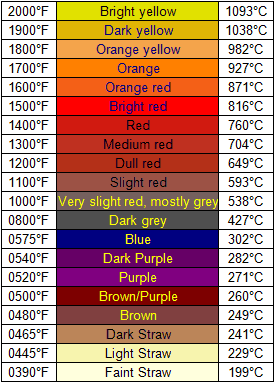
For the second step make sure you've removed all the scale from quenching(makes it easier to see the color change). Then you're heating to 750-800 degrees and letting the part air cool. Just watch the colors radiating out from the heat source you'll see the blue ring expand and as soon as you see the following grey stop. With mapp gas it will probably take 4-5 seconds to reach the correct temprature. This will relieve the stress from the previous step which made the part hard but brittle.
Whomever you spoke to was mistaken. These receiver flats are made from annealed 4130 they're actually quite soft compared to the critical areas after being heat treated.
*ETA* do your ejector first. Then weld the rails into the receiver. Drill/ream axis pin holes. Then heat treat the axis pin holes.Last edited by tujungatoes; 09-13-2011, 1:06 PM.sigpicOriginally posted by Dr. ElkyOriginally posted by CSACANNONEERComment
-
The 4130 steel that these receivers are made out of is very heat treatable. In the annealed state the steel should be around 14RC, about as soft as steel gets. To harden this steel it should be heated to 1600F and quenched as tujungatoes mentioned. In this state the steel will be very hard, in the 50-55RC range. This is a bit too hard and brittle. The ejector is the only thing that needs to be really hard and that should be in the 40-45RC range. I would shoot for 35-40RC for the pin holes. To do this you want to get the metal to 750-800F. If you go over that temperature you risk softening the metal too much so be careful when you are heat treating by hand. It takes time and patients to get it just right. For the ejector you only want to bring it to about 560F so be very careful to only heat it to the point where it just turns blue. For the pin holes you will want to go just past that to the point when the metal turns gray.
There are only three colors that are fairly easy to get when tempering, gold, blue and gray. For 4130 gold should be around 46RC, blue 43, gray 36. That being said, color is a fairly crude way of heat treating so results are bound to vary quite a bit. A computer controlled heat treating furnace would be the way to go .
.
Comment
-
If you do it the way the other guys said it will most likely crack or break the ejector.Comment
-
Yep parents can be hard headed, I have one of them.Comment
-
1. I know full well that you cannot(nor should you try to) argue with your pops. Don't even bother. Realistically the only problem he "might" have is his ejector deforming. In that case just re do the heat treat and don't rub his face in it. He's still your dad and and he'll probably kick your ***.Originally posted by Lazyme
A. I have no idea. I'm far from the king of metallurgy. I just know you get the f**ker hot and quench it which makes it hard as a mofo.
B. Yes. This is my understanding.
C. Always
Lastly. I have no idea, but I know it's not a simple process. Nor is it really necessary for a rifle that's just for giggles. The are people with multiple thousands of rounds through flat built rifles with no problems. If you insist on a fully heat treated receiver I recommend NoDak Spud 100% receivers. They are the best complete receiver on the market.sigpicOriginally posted by Dr. ElkyOriginally posted by CSACANNONEERComment
-
No, not carbon deposits left in the metal. the only time there is free interstitial carbon is when you get above o.85% (or eutectic steel). 4130 is way below that. ill explain very briefly what happens when you heat treat. you bring the metal up to 1600 and turn the steel crystals austenitic, or from a body centered cubic to a face centered cubic, causing it to rearrange the carbon locations in the crystaline lattice. when you quench you create large amounts of martensite from the austenite. martensite is very strong and hard, but way to brittle. you then need to temper by increasing temperature to break down much of the martensite into stabler/softer crystals to stress relieve and bring down to a useful strength. 1600 is a critical temperatureLast edited by 69powerwagon; 09-13-2011, 8:23 PM.Comment


There are currently 24907 users online. 105 members and 24802 guests.
Most users ever online was 239,041 at 10:39 PM on 02-14-2026.


Comment