
-
"To preserve liberty, it is essential that the whole body of the people always possess arms, and be taught alike, especially when young, how to use them" - Richard Henry Lee
sigpic -
An Optical Comparator -
Or a sine barComment
-
You could also try contour gauge.Comment
-
Poormans way, if your trying to duplicat that part, is chuck it up in the lathe, set up your tool to match that angle, then put the new part in and cut it. Don't even need to ever know the the angle.Comment
-
Take a picture with the lens lined up on center. Enlarge and measure with a protractor.Comment
-
Optical comparator would be best.
You could also put it in a lathe and use a very accurate test indicator on the compound slide.
Adjust the compound slide angle until you get no needle runout while sweeping through the angled feature with the indicator by moving only the compound slide.Randall Rausch
AR work: www.ar15barrels.com
Bolt actions: www.700barrels.com
Foreign Semi Autos: www.akbarrels.com
Barrel, sight and trigger work on most pistols and shotguns.
Most work performed while-you-wait.Comment
-
Thanks for the replies
I was hoping there was a magic tool out there that I wasn’t aware of. While the optical comparator seems like the solution I’m looking for. I wouldn’t use it enough to warrant the cost and space it would take up.
The muzzle brake pictured is just an example of what I’ve been struggling with, it also has a concave angle at the bore that is difficult to find out. I tried using a bent paper lip and comparing it to a protractor which gets me close enough… but I was hoping for a better way
It sounds like sweeping it with a dial indicator may be the most accurate, I’ll try that out next"To preserve liberty, it is essential that the whole body of the people always possess arms, and be taught alike, especially when young, how to use them" - Richard Henry Lee
sigpicComment
-
An optical comparator would be nice, but if you want to go old school a vernier angle guage might be helpful.

How much are you willing to spend?Comment
-
Starrett on Ebay for $75 or best offer

Comment
-
I picked up an older optical comparator for $200 on Craigslist
It has proven to be worth way more than I paid for it.
I use it a lot more than I thought I would.
A long internal angle is best measured by measuring run and rise.
Use a long test indicator and measure the rise over a fixed length of run.
Say you have a 0.150” rise over 1” of run, you can calculate the angle from there.
If by concave, you mean an internal radius, then the same setup will let you plot points every 0.1” and figure out what the radius is by drawing up the plotted points in a cad program and then make an arc that hits more than 3 plotted points.Last edited by ar15barrels; 10-26-2022, 9:25 AM.Randall Rausch
AR work: www.ar15barrels.com
Bolt actions: www.700barrels.com
Foreign Semi Autos: www.akbarrels.com
Barrel, sight and trigger work on most pistols and shotguns.
Most work performed while-you-wait.Comment
-
This may sound dumb, but why couldn't you take a really sharp pic of it and blow it up big enough to use a regular protractor to check it?sigpic


 Bob B.
(\__/)
(='.'=)
(")_(")Comment
-
For a unit that works you made a nice deal. Congratulations!Comment
-
You could.
That's what an optical comparator does except you usually are looking at parts in shadow which gives higher contrast than a standard photo.
It's much easier to see features in shadow than in a front lit photo.
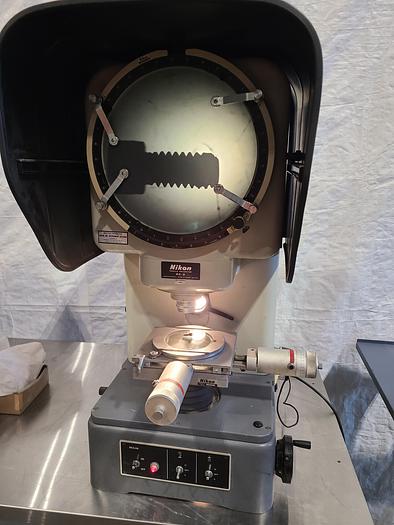
An optical comparator also has different magnification lenses to change how much magnification you get.
The picture above is about 20x.
I typically use the 50x lens.
An optical comparator also has a rotating grid overlay that you can measure angles with by rotating the grid or by directly reading off the angles on the grid.
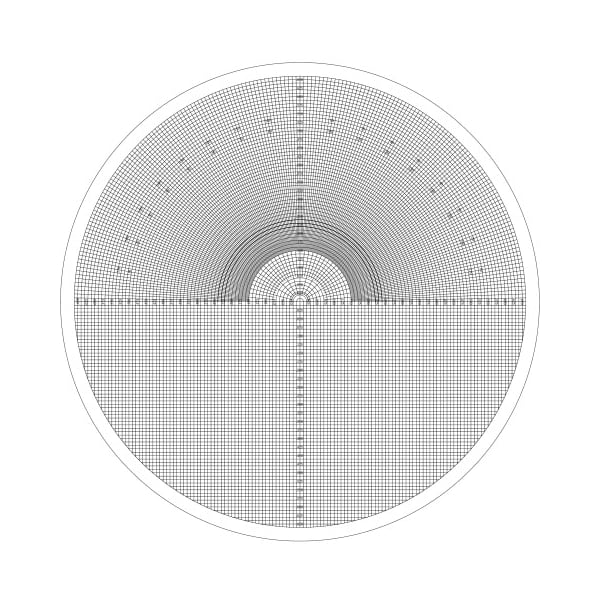
So if your reference feature is horizontal and you have to turn the grid scale 60 degrees to align to the other feature, that means the 2nd feature is 60 degrees from the reference feature.Last edited by ar15barrels; 10-27-2022, 12:25 AM.Randall Rausch
AR work: www.ar15barrels.com
Bolt actions: www.700barrels.com
Foreign Semi Autos: www.akbarrels.com
Barrel, sight and trigger work on most pistols and shotguns.
Most work performed while-you-wait.Comment
-
One could also measure the lengths of the angle segments along with the diameters and use an online angle calculator. Bet a case of GOOD beer that it will be scary close to a whole number, like 45 or 60 degrees.
If you listened in school you could also trig it and forget the calculator. I didn't.Comment

 Tweet
Tweet


There are currently 11424 users online. 124 members and 11300 guests.
Most users ever online was 239,041 at 10:39 PM on 02-14-2026.


Comment