

 Tweet
Tweet
I feel like I know how to make ammo and I know I have accurate rifles. However, I don't feel like I have come anywhere close to finding the best method to test the accuracy of a given load. What procedures and equipment have you found to be efficient and successful when it comes to consistent accuracy testing in load development?
-
For Sale: Off Roster Handgun Moving Sale
For Sale: Off Roster CZ, Browning, PTR 91 Moving Sale
Originally posted by KWalkerM -
Rifle:
Sinclair front rest/rear rabbit ear bag.
Handgun:
L-tek pistol rest. -
Front rest, or bipods mostly and a rear rabbit-eared sandbag.
My targets generally look like this one, so I write any chrono data and how the combos performed on paper, into my reloading journal, which has sections for range data and then load data.
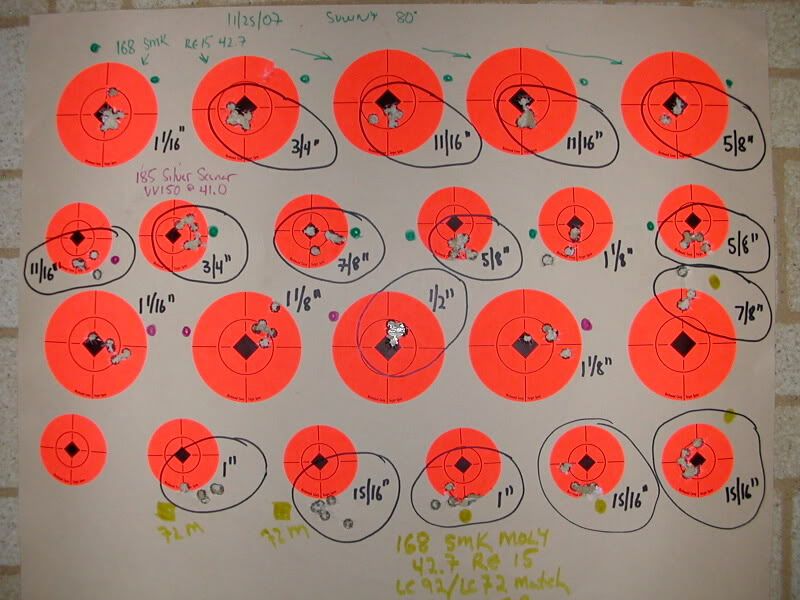
ChrisComment
-
Chronograph to verify desired velocity.
I can't shoot that good, so I'm not too worried about accuracy.
When I want to shoot well, I need to lay off the coffee for a few days.sigpic
NRA Life Member (Benefactor level)
"Those who give up some of their liberty in order to obtain a little temporary safety, deserve neither liberty, nor safety." B. Franklin
Calguns Community Chapters (C3) in Your Community
Calguns Community Chapters (C3) and Appleseed Event Calendar
The 2nd Amendment is not about hunting or competition shooting. It's all about your inalienable rights to life and liberty.Comment
-
Lots of range time and accurate notes, I scan the targets into my computer and save them on cds. Get a good rest for the weapon and practice, don't forget to record temp and humity.Comment
-
Bench rest and lots of experimentation.
A chrono would help but its a luxury i dont have right now.
I set up at 100 yards on a bench, get the rifle seated on the rest, and aim for dead center. Close my eyes, open them, if my POI has shifter i adjust the rifle so it sits aiming at dead center by itself.
Then i make sure i have good stock weld and eye relief, breath calmly, and slowly start to squeeze in cadence with the natural pause between breaths. The shot will break, and i do it again.
3 times for each load. Then compare groups when i retrieve the target.
I start with charge weight, and once i find the most accurate charge weight i start messing with OAL. Usually start by seating the bullet as close to the lands as possible, but sometimes move it back a bit if it proves to be more accurate.
Its endless experimentation really, but the only tools required are good shooting fundamentals and the ability to compare your groups.
If your unable to remove yourself significantly from the equation, you will never get good testing. The variation between groups at 100 yards isnt usually spectacular. I end up having to measure sometimes.Comment
-
If you take a rookie shooter and put them with a great gun and great ammo they generally shoot extremely well.
On the guns that are extremely accurate the trigger pull is around 2 ounces not 7 pounds like on a factory gun.You touch the trigger and it fires rather than having to pull the gun out of the bags to get it to fire.
The scope on an extremely accurate gun runs from 35 to 80 power not 3 to 9.
If you aim at the center of the zero in the number 10 on your target the crosshairs or dot look like they are in a swimming pool.With a typical 3 to 9 scope the crosshairs cover all the numbers and most of the targets center.
You simply can't aim the gun to the same point so accuracy naturally suffers.
On a extremely accurate gun the stock will have a wide flat forend or it will have tracking rails.On a factory gun nothing will be flat or wide.
The flat wide forend allows the gun to sit level without the shooter having to influence it and the torque of firing ill do very little.This makes shooting free recoil possible and allows for quick follow up shots.
With a factory type stock with a large drop at the heel to help reduce felt recoil and a skinny forend the gun jumps out of the bags during recoil and requires the shooter to reset it each time slowing the shooting pace.The lack of repeatable tracking means the rest or bags need constant fiddling with taking time away from watching conditions.
The tracking rails if so equipped allow the accurate rifle to slide rearward without tugging on the bag or rest.They also offer enough support so the weight and recoiling of the rifle doesn't cause the gun to settle deeper into the bags between shots.Lynn Dragoman, Jr.
Southwest Regional Director
Unlimited Range Shooters Association (URSA)
www.unlimitedrange.org
Not a commercial business.
URSA - Competition starts at 2000 yards!Comment
-
When it comes to equipment, I use a Caldwell front rest and a Protektor rabbit ear rear bag. I got both off Amazon.com for around $100.00. I also use a chronograph, to see how consistent the velocity is of my loads. This also helps establish estimates and drop tables.
For procedures, select the bullet for your needs. Then look up an accurate load (case, primer, powder) as a starting point. To determine powder charge and seating depth look up ladder test on 6mmbr.com. Spend some time reading about the procedures so you understand what you are doing.
I also establish a zero wind setting on my rifles by setting a target up at 25 yards, drawing a vertical line on the paper (use a carpenter's level), then place my vertical scope hair on the line and shoot until the bullets hit the line.sigpicComment
-
I prefer group shooting from prone, with a bipod and a rear bag. The type of target used makes a difference. Standard bullseye black center do not allow for precise holding easily. My favorite is the cross/circle type. Aligns very well with crosshairs and allows a very consistent hold even at low mag.
Remember, the longer you hold, the worse you hold Get the shot off soon or take a rest and come back at it when you are ready. Don't hurry it, don't delay it.
Trigger quality is most everything to start. Most folks having trouble shooting good groups have crappy triggers holding them back. It doesn't have to be in ounces, but is should only be a couple of pounds at most and break clean with no staginess unless it's a two stage type.
The ergonomics of the rifle and scope/sight position also play a big role. You have to be able to have a comfortable and consistent head position and proper eye alignment with sights or this will play havoc with your groups too. Inconsistent eye position can cause scope parallax to throw your POA off from shot to shot. If the scope is not where it needs to be when you have a consistent cheek weld on stock, move scope or get a cheek piece that puts your head (and eye) in the right position naturally AND comfortably.
Attached here is a version of the cross/circle you can print and use.Last edited by GeoffLinder; 07-17-2013, 1:44 AM.Comment
-
Tools to make you better or tools to help you work up loads?
I run ladder tests at 300+ yds when working up loads, and then use a version of OCW to refine my accurcy nodes. Link:http://optimalchargeweight.embarqspace.com/
To run 300+ ladders, you have to be comfortable about your ability to hold on your target and not mess up your data with poor trigger management, flinching, or other marksmenship errors. So, for beginners, I would recommending borrowing or buying a Caldwell Lead Sled. It's expensive but as your markmenship skills improve, you can always find a buyer on Ebay.
the best way to improve your ability is to make sure you have a very good trigger, and then dry fire practice more often then you shoot.Comment
-
I love the word 'procedure'. Equipment is important but more important is knowing how to use them correctly and consistently. Most important is your methods for which you develop your skills. I've been at it for over 20 years and still learning...
here is the least i'd recommend for equipment:
1. front rest - use a solid tripod type rifle rest with wide stance, adjustable ears, heavier metal construction, can be adjusted and solidly locked.
2. Solid heavy rear bag that hugs the rifle stock. like many above suggested bunny ear type bags. I prefer leather for non-slip contact.
3. known good magnified optics and solid mounting system. Even if you don't plan on using a scope on that rifle, accuracy test it with one. preferably one with parallex adjustment.
4. use a bubble level to ensure your gun is always leveled the same way. don't let canting ruin your groups.
method:
1. Seating, natural body positioning, hand/palm/finger placement, cheek weld. there are a lot of info on the web. try and find one that works best for you in the most natural way.
2. Dry fire (except rim fire guns) rifle on front rest and rear bag exactly as you'd live firing until recticle stays exactly where you aimed after trigger breaks. I made dummy rounds and mix 1 or 2 with live rounds so I know i'm not flinching.
3. Return the rifle to exact same spot on front rest for every shot. I adjust my rear bag to line up the shots. Some do the opposite, adjust front rest and not the rear bag but it'll need elevation and windage adjustable front rest.
4. sight in the rifle/load so the POI is 1" or 2" lower than the POA. this way you're not shooting out what you're aiming at. and you can focus on the aim rather than psyching yourself out trying to put them all together.
5. Aim small miss small. shoot small targets. At 100 yards, I aim at 1" squares with 1/4" boarders. this way I can see the 4 quadrants evenly split by the cross hair. helps me make sure every shot is aimed exactly the same. Relax, shoot slow and pay attention. Don't shoot if you find yourself anticipating the shot to break. Make every shot count!
tips:
1. Velocity - if you don't have a chrono. Find the differences in drop between your 100 yard and 200 yard (300 yards is even better) groups of the same aim. use free ballistic programs and websites out there and plug in different velocities till you get the same drop measurements. that's your ammo velocity. it's actually pretty accurate.
2. Ammo - consistency is key. same brass, same bullet, same powder charge, same primer. the more uniformed the better. bullet quality matters most. use match grade stuff. shoot at least 2 or 3 groups of at least 3 shots from each ammo combo.
3. make sure all screws, bolts on action, mount, rings are torqued/tightened properly. I've seen too many loose action screws or scope rings/mounts that ruined the day.
4. get a note book and document everything. this will help if you're serious about precision shooting.Last edited by huckberry668; 07-17-2013, 11:33 PM.GCC
NRA Certified Pistol Instructor
Don't count your hits and congratulate yourself, count your misses and know why.Comment
-
Your ultimate test is 1000 yard matches for large calibers, 600 yard matches for 5.56x45.
If you don't have a chrony how can you "test" a load??? You can't. They only cost $100.00 for an accurate one.
If the load doesn't shoot less than 3/4 moa at 100 yards (5 shots) in a good AR its not a good load, and to be a good load in 308 or 7mm it needs to be below 0.35 moa (100 yards 5 shots)
I use a eagle front rest and solid bunny ear rear rest, tests done early on a heavy bench at either angeles on concrete or the heavy pipe benches at Burro.
Also, the load must not show any pressure signs.I love America for the rights and freedoms we used to have.Comment
-
Velocity doesn't make an accurate load unless it's for long range (600yd and beyond). I load from published data which is mostly safe when I do my part.
I went 15 years reloading, hunting, competition shooting for accuracy w/o a chrono. I watch for pressure signs religiously in load dev. I believe if a load ain't accurate velocity don't mean squat.
Velocity comes in play for drop and drift at longer ranges. Most people rarely shoot beyond 100 or 200 yards anyway. It's a good load in my book so long as it's accurate and no pressure signs.
I eventually broke down and bought a chrono a few years back. It's great at giving you exact data. It does show the differences between primers, case capacities, temperature and seating depth. But nothing on accuracy. Velocity data only benefited me for loads beyond 600yds. And the ballistic tables derived from the velocity data has never been exact.
I try to make shooting, reloading fun, easy and affordable for newbies by showing them how to make-do. Calculating velocity from drop is a legitimate way of estimating velocity. In fact, if you think about it, it's the best way to calculate drop since you already know it.Last edited by huckberry668; 07-19-2013, 9:54 PM.GCC
NRA Certified Pistol Instructor
Don't count your hits and congratulate yourself, count your misses and know why.Comment
-
K.I.S.S.
Lots of good advice. It also depends on if your goal is Camp Perry or a trophy elk.
100 yards and five shots on a target. When you get good you can call flyers. EXAMPLE, when I squeeze one off and it is a bad one I say, "KIMCHI!" The ones I do not comment on, should all be in the bullseye.
Comment
-
What about barrel cleaning between groups and time between groups to let the barrel cool?
Say I'm testing 10 increments, 5 shots each for a ladder test; for discussion sake.Comment


There are currently 28950 users online. 28 members and 28922 guests.
Most users ever online was 239,041 at 10:39 PM on 02-14-2026.


Comment