Unconfigured Ad Widget

Collapse

Need help with Redding Type S Match Die Set

Collapse
X
 
  • Time
  • Show
Clear All
new posts
  • cqbdude
    Senior Member
    • Jul 2008
    • 854

    Need help with Redding Type S Match Die Set

    Hello There,

    I bought a set pf Redding Type S Match Dies for 308 winchester a long time ago.
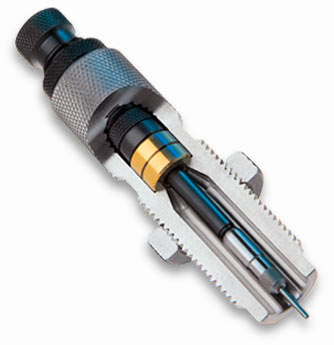
    I finally started using it and I am having problems with the Bushing Style Full Length sizing die.

    First time using it, I kept crushing the brass. I started adjusting it and I was finally able to resize the brass, but then I noticed that the neck is not being sized. I found that out when I was seating the bullet, the bullet just fell right in.

    What am I doing wrong? was I supposed to order bushings as well?
    I'm not trying to be fancy, I just wanted to resize the brass.

    Here are the pictures..


    I would appreciate the help, I had to use my dillon dies to resize my brass.

    Thanks..
  • #2
    Bill Steele
    Calguns Addict
    • Sep 2010
    • 5028

    You need a bushing to size the neck. You need to measure a finished round to get to the bushing size you want to buy (subtract the neck tension you desire).
    When asked what qualities he most valued in his generals, Napoleon said, "give me lucky ones."

    Comment

    • #3
      G-forceJunkie
      Calguns Addict
      • Jul 2010
      • 6502

      Do you have a bushing in there? The neck will not be sized if you do not have a bushing in there. If your crushing stuff, its adjusted wrong. First, set up the die body so it sizes the brass to the headspace you want. Then install the primer decapper and screw it down untill it just pops the the primers out at the bottom of the stroke.

      Comment

      • #4
        afrancke
        Member
        • Jul 2004
        • 147

        It's crushing because you don't have a bushing and your die is adjusted incorrectly; you must have a bushing installed, full stop. Measure a loaded cartridge to get the outer diameter around the bullet in the neck. You want to order a bushing that is 0.001 - 0.004 or so less than your loaded measurement. -0.001 if you are loading for a bolt gun and tighter if you are loading for a semi-automatic (though I have not had any obvious problems with just 0.001 less and an AR). -0.001 is what you will read in the instructions for the die, but it doesn't differentiate among gun types.

        You might consider just buying a small range of bushings to accommodate different brass and desires to neck tension to certain amounts, but that's pretty expensive if you are buying the Titanium Nitride bushings.
        Last edited by afrancke; 10-25-2012, 1:20 AM.

        Comment

        • #5
          problemchild
          Banned
          • Oct 2005
          • 6959


          F16 of dies better make sure you are a good pilot. This die is for precision bolt gun shooters. For the cost of just one the bushings you could buy a "normal" die. These dies are for guys who want total control of their necks. They usually trim to uniformity and concentricity. There is a bunch of voodoo magic involved.
          Last edited by problemchild; 10-25-2012, 4:38 AM.

          Comment

          • #6
            afrancke
            Member
            • Jul 2004
            • 147

            Originally posted by problemchild
            There is a bunch of voodoo magic involved.
            There's nothing voodoo about controlling neck tension, which is the simplest adjustment one can make with bushing dies. I suppose it's fully debatable for many shooters and guns whether getting a specific and consistent neck tension is a major upgrade from simply getting consistent neck tension alone (which any die would give you with the same brass in the same state of work hardness).

            Still where can one find a good sizing die for $16, which is the cost of one of the TiN bushings from Bruno's? Only Lee comes to mind - and I suppose that's an option for many. Still, OP already laid out the cash for this die, so I think a bushing is a better buy at this point than a Lee.

            Comment

            • #7
              problemchild
              Banned
              • Oct 2005
              • 6959

              No voodoo if you have been reloading for 20 years. If you are new at it and dont even know you need a bushing.......well......

              I would not consider this a simple die to use at all. Problems that "might" arise are:

              Mixed brass tolerances
              Year of brass tolerances from same manuf
              Neck turning (does he own a neck turning device?)
              Neck wall thickness
              Neck wall uniformity
              Semi or auto loading
              Ramp angle and bolt force
              Brass hardness
              Brass stretch rebounding


              I could go on for another 15 lines. So please dont tell me there isnt ANY voodoo involved. I hope the op wants a PITA die to use because he owns it now. Every time he uses a different headstamp he needs a new bushing. If it was me I would just buy a nice carbide sizer and call it a day. Sell the voodoo magic die and I have been loading for 30 years+. Never had an issue with a carbide sizer whatsoever!


              Originally posted by afrancke
              There's nothing voodoo about controlling neck tension, which is the simplest adjustment one can make with bushing dies. I suppose it's fully debatable for many shooters and guns whether getting a specific and consistent neck tension is a major upgrade from simply getting consistent neck tension alone (which any die would give you with the same brass in the same state of work hardness).

              Still where can one find a good sizing die for $16, which is the cost of one of the TiN bushings from Bruno's? Only Lee comes to mind - and I suppose that's an option for many. Still, OP already laid out the cash for this die, so I think a bushing is a better buy at this point than a Lee.
              Last edited by problemchild; 10-25-2012, 3:21 PM.

              Comment

              • #8
                afrancke
                Member
                • Jul 2004
                • 147

                Originally posted by problemchild
                I would not consider this a simple die to use at all. Problems that "might" arise are:

                Mixed brass tolerances
                Year of brass tolerances from same manuf
                Neck turning (does he own a neck turning device?)
                Neck wall thickness
                Neck wall uniformity
                Semi or auto loading
                Ramp angle and bolt force
                Brass hardness
                Brass stretch rebounding
                I think this is a bit hyperbolic. If you start by picking a small enough bushing - just one - and screwing the micrometer all the way down so there is little to no play of the bushing, then the die is for all intents and purposes functionality identical to a non-bushing die. You can then proceed from there to pick other bushings, decide whether to partial neck size, etc. and confront the other challenges individually you enumerate, but there is no voodoo involved - only a decision that you are not going to use a single stock neck setting that you get when using a regular die.

                Having a range of bushings, measurement tools to judge the results you're getting are mandatory for sure (or you might as well stick with regular dies). You do have to know what you are trying to achieve when configuring the die and its bushing, and that seems to be the first newbie sin of the OP - being in over his head - but it's not an irredeemable mistake. Everybody has to start somewhere, and not everybody is content staying with the same techniques for multiple decades.

                Comment

                • #9
                  FLIGHT762
                  Veteran Member
                  • Mar 2009
                  • 3072

                  Originally posted by afrancke
                  I think this is a bit hyperbolic. If you start by picking a small enough bushing - just one - and screwing the micrometer all the way down so there is little to no play of the bushing, then the die is for all intents and purposes functionality identical to a non-bushing die. You can then proceed from there to pick other bushings, decide whether to partial neck size, etc. and confront the other challenges individually you enumerate, but there is no voodoo involved - only a decision that you are not going to use a single stock neck setting that you get when using a regular die.

                  Having a range of bushings, measurement tools to judge the results you're getting are mandatory for sure (or you might as well stick with regular dies). You do have to know what you are trying to achieve when configuring the die and its bushing, and that seems to be the first newbie sin of the OP - being in over his head - but it's not an irredeemable mistake. Everybody has to start somewhere, and not everybody is content staying with the same techniques for multiple decades.
                  I don't think the comment was too much of an exaggeration when using bushing dies, I do agree with what you're saying. I didn't start using bushings until I had a number of years of reloading experience. They are not for the novice without a good guide or a mentor to help understand why you do what you do. After learning how to use a mic, digital caliper and shoulder bump gauges, a whole new world opened up. Being able to gauge and see the numbers, it all started to make sense for reloading for precision ammunition, but at about $23.00 a pop for the TiN bushings, it gets a little spendy.

                  As far as bushings for 308 Winchester, I've found I need a .337" for Federal brass, .335" for Remington brass, .333 for Hornady brass, .331" for Winchester brass and a .329" if I'm going to neck turn Winchester brass. The 5 bushings give me a good array to use with just about any brass and I can tweak as necessary if I want to get a little more tension when loading for a gas gun.

                  For a novice getting into reloading for more accurate ammunition, I'd recommend Zediker's book on reloading for competition. It gives a good explanation of what tools are out there and the several ways to reload for accuracy.

                  The O/P's post is a good example of getting in a bit over your head before understanding what is needed with some of the more advanced reloading tools out there.

                  After all I've learned over the past few years, a good way to load accurate ammo can be done with a Lee neck collet die and a Redding body die when you need to F/L size. This combo makes very accurate ammo at a cost much less than the bushing die route. A good seating die is also worth the $$$.

                  While some of the other posters who have said you don't need gauges, this is true if you're loading for just one rifle, you can use the old trial and error of smoking a case, but you are just guessing at how much bump or sizing you're doing. I reload for several rifles of the same calibers:
                  .223 Rem.(4), 308 Win. (8) and 30/06 (6). Having gauges give me the ability to see the numbers and adjust sizing to each rifle's chambers if I want to.

                  Another reloader said something which I believe is very true:
                  "Reloading without mics, guages and chrono's is like flying without nav gear. You spend a good portion of the time not knowing where you are."

                  Comment

                  • #10
                    afrancke
                    Member
                    • Jul 2004
                    • 147

                    Originally posted by FLIGHT762
                    Having gauges give me the ability to see the numbers and adjust sizing to each rifle's chambers if I want to.

                    Another reloader said something which I believe is very true:
                    "Reloading without mics, guages and chrono's is like flying without nav gear. You spend a good portion of the time not knowing where you are."
                    Completely agreed. There is enough trial and error when using gauges and other tools as it is; not having precise measuring tools either means giving up measuring altogether or a lot slower and less precise trial and error altogether.

                    The usual argument against such things is not to care about the details if overall things "shoot well," which is fine as far as it goes, but part of the fun of the hobby of reloading is to find out what kinds of things make a difference and putting them into practice.

                    For those who just want some ammunition to shoot that works "good enough," then I suppose the view is that measuring things and tweaking wastes time better spent shooting (or dry firing, or doing some other activity totally unrelated and more fun to the reloader in question).

                    Comment

                    Working...
                    UA-8071174-1