Unconfigured Ad Widget

Collapse

Calculating velocity

Collapse
X
 
  • Time
  • Show
Clear All
new posts
  • #16
    justMike
    Senior Member
    • Sep 2009
    • 796

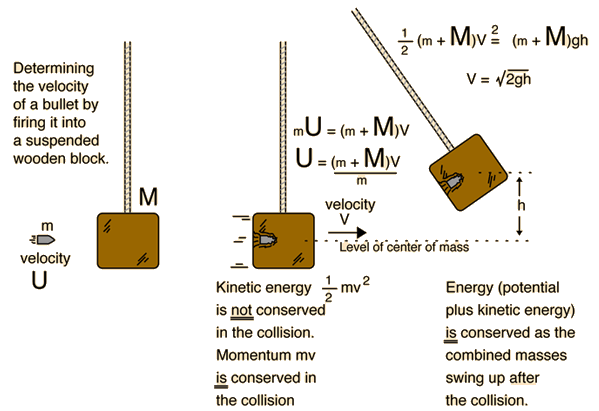
    As I understand it, how it was done in the way old days was to have a target of a known mass on a pivot and a setup to record the degree of motion imparted by the impact of the bullet. The resultant foot pounds of energy number was then used to calculate the velocity. If you like to tinker I'm sure you could replicate this process.

    Comment

    • #17
      krfresno
      Member
      • Aug 2010
      • 119

      Who sells refurbished chronys? Been wanting a chronograph for a long time. Just not willing to shell out the dollars yet. Thanks for the input.

      Comment

      • #18
        mroels
        Senior Member
        • Apr 2008
        • 912

        Originally posted by Munk
        Now that i bother to think about it, we can eliminate the worries about angle at time of shot by using a bore-laser to find where it's pointed exactly, and then measure down from that point to the POI.

        For another example, I put 2" into wolfram, it spit out a time of .1 (unexpectedly simple and easy to work with). 300ft/.1second = 3000 FPS average speed on a 100 yard shot. Based on what I know of .223, this is damn accurate.
        I thought about the bore-laser but, although I've never used one, I'd imagine that at a 100yds it would be a pretty big dot which would mess up your angle calculation.

        Ok I guess i'm gonna have to space out targets at 50yd intervals, attach a string to them so I can pull them down to move on to the next one, all the while keep my rifle level and measure drop in POI, then do math and....Jeez that's too much work. Chrono it is!


        Good discussion though. I feel like I learned something today. What I'm not sure but I'm feeling smarter.

        Comment

        • #19
          walmart_ar15
          Senior Member
          • Oct 2006
          • 2344

          friction

          Don't forget friction. Muzzle velocity and impact velocity will be different.

          Comment

          • #20
            TimRB
            Senior Member
            • Jul 2009
            • 920

            Originally posted by justMike
            As I understand it, how it was done in the way old days was to have a target of a known mass on a pivot and a setup to record the degree of motion imparted by the impact of the bullet. The resultant foot pounds of energy number was then used to calculate the velocity. If you like to tinker I'm sure you could replicate this process.
            I like it. Another way I have heard of is to shoot through a spinning paper cylinder. If the spin rate and cylinder diameter are known, one can calculate bullet speed based on the distance between the two bullet holes.

            Tim

            Comment

            • #21
              HighLander51
              Banned
              • Feb 2010
              • 5144

              Originally posted by justMike
              As I understand it, how it was done in the way old days was to have a target of a known mass on a pivot and a setup to record the degree of motion imparted by the impact of the bullet. The resultant foot pounds of energy number was then used to calculate the velocity. If you like to tinker I'm sure you could replicate this process.
              called a ballistic pendulum

              Comment

              • #22
                HighLander51
                Banned
                • Feb 2010
                • 5144

                Originally posted by Munk
                few rifles on a completely horizontal trajectory will only drop 1" at 100 yards. Most drop more than that. the 1" was used for simplicity of example. Very few rifles will hit over 4000 FPS.

                Even your .223 will drop almost 2" at 100 yards, and the slow lumbering .45-70 will drop much farther. Neither of which contradicts my loose estimator.
                Calculating velocity using height as the dependent variable to yield a time value will result in a time of flight average, that is over that distance. But it is not use full for calculating muzzle velocity because the projectile is loosing energy after it leaves the barrel. So you could use the 3,000 fps average and guess the muzzle velocity to be 3,400 fps and velocity at 100 yards to be 2,600 fps, or 3,240 and 2,760, you still don't know what the muzzle velocity is.

                Comment

                • #23
                  Munk
                  Senior Member
                  • Jun 2010
                  • 2124

                  Originally posted by HighLander51
                  Calculating velocity using height as the dependent variable to yield a time value will result in a time of flight average, that is over that distance. But it is not use full for calculating muzzle velocity because the projectile is loosing energy after it leaves the barrel. So you could use the 3,000 fps average and guess the muzzle velocity to be 3,400 fps and velocity at 100 yards to be 2,600 fps, or 3,240 and 2,760, you still don't know what the muzzle velocity is.
                  If you do a few strings of shots at 25, 50, 75, and 100 you can estimate. Heck, you can probably even plot a graph in excel using the figures you get.

                  This is all just estimation for people too cheap to blow 100-180 on a chronometer.
                  Originally posted by greasemonkey
                  1911's instill fairy dust in the bullets, making them more deadly.

                  Comment

                  • #24
                    rsrocket1
                    Veteran Member
                    • Feb 2010
                    • 2772

                    Go get the demo for QuickLoad. It contains the demo for QuickTarget which is the exterior ballistic program. You can play with it to your heart's content. If you do your research and really get into the QuickLoad program, you'll probably buy it. It's a little pricey at $152, but if you really know how to work it, it is well worth it for the "nerdy handloader". You'll see that you have an endless combination of bullet types, powders, cartridges, muzzle lengths and you can do batch runs to see how changing load affects pressure, velocity and completeness of burn.

                    It is not a guaranteed foolproof substitute for real load development, but it comes awfully close to any load I've actually developed using real components and an actual chrony.

                    Comment

                    Working...
                    UA-8071174-1