

 Tweet
Tweet
I am new to reloading (did my first six test rounds today) and I am running into a slight problem. I need your vast wisdom, if you don't mind. I am reloading .38 Spl on a Lee Challenger with the 4 die set. I am using LSWCs from SNS Casting. My Lyman manual tells me OAL should be 1.445. This, however, puts the case mouth over the shoulder of the bullet, thus my crimp is not in the cannelure of the bullet, but rather in the shoulder. I did 5 bullets like this, and the sixth with the case mouth JUST below the shoulder. This latter provided an OAL of 1.461 (almost 0.02 over Lyman's recommendation). After reading through several forums and looking at several examples, I am still completely confused. Some people say the OAL is less important than where the crimp is, others the opposite. I can say that the 6th round looks like most of the examples I saw, and the OAL is within the range I saw for those examples. So my question is: Which is more important?
-
Last edited by coreymcdonald855; 03-25-2012, 9:50 PM. -
The case mouth should end right at the cannelure, where you crimp. The length should work out to 1.475" with a 158gr LSWC. Any load that specifies a shorter OAL is fine. Any load that specifies a longer OAL is probably an error, but should be reduced by at least 10% and worked up cautiously with a crimp at the cannelure.
Revolver loads will usually specify an OAL that puts the crimp at the cannelure for the bullet spec'ed in the load. Not always though. Again loading longer is fine, just crimp at the cannelure.
Good luck, have fun.Last edited by Bill Steele; 03-25-2012, 9:47 PM.When asked what qualities he most valued in his generals, Napoleon said, "give me lucky ones." -
Is your brass within spec on the length? Are you sure you have .38 brass and not .357 brass? The 158 is a long bullet, but over the shoulder is very odd. Makes me think somehow your brass is way long.Comment
-
Crimp where the cannelure is.
Got pics?sigpicComment
-
If you are shooting a revolver, you have ALOT of wiggle room for OAL:
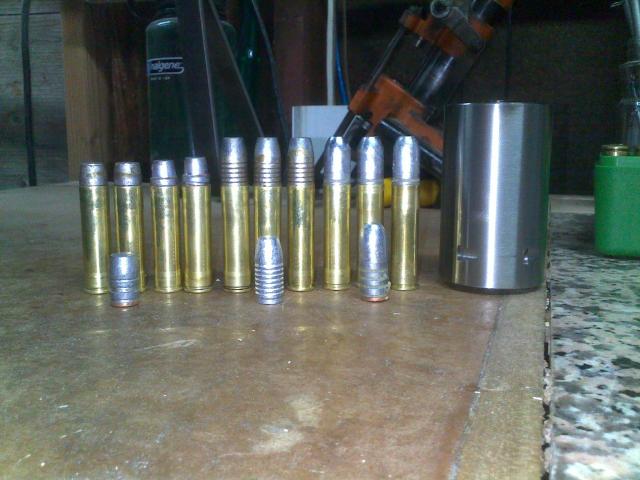
Assuming your powder can tolerate it and the round physically fits the cylinder. Noone is recommending you load an OAL of 2" for a 1.5" cylinder using H110 or W296 with 50% of the case empty!
I have a load using the big bullet above that fills the case with powder and seats the bullet .1" down. The rest sticks out into the cylinder throat.
LOTS of no-no's in the above pic if I were shooting a semiautomatic or even a bolt rifle. Here are the questions I ask when I want to change OAL:
#1. is it safe? changing OAL means I am changing the fill density of the cartridge (base of the bullet relative to top of powder). Can the powder I am using tolerate the extra free space, or the compression? Am I anywhere near pressure limits and must tread with extreme care? Safety first!
#2. will the round fit? am I gonna hit the lands? max out the cylinder? do I have a ton and a half of free movement as the bullet travels down the chamber throat?
#3. Will it feed. Just kidding, I don't shoot guns that require that. Good luck to all the other poor folks who have to care about such things!
----------
Here's food for thought. Do you even need to crimp at all? The picture above is 460S&W, a cartridge people say recoils like CRAZY. Therefore, I should have to worry alot about bullets jumping crimp, right? Right? Well, the reality is that the bullet typically sits .8" below the case mouth. In other words, case tension is enough. Those bullets aren't going ANYWHERE no matter what the recoil is.
And how do I know? I didn't guess. I measured one and loaded in the cylinder, then fired the rest of the revolver chambers a few times, then extracted the round and measured OAL. No jumped crimp. So I don't crimp my 460's.
Nice thing about OAL is that common sense rules, and hypotheses are usually easily tested safely.Comment
-
Brass is trimmed to spec. Whiterabbit, you just made me a hell-of-alot more comfortable about OAL. The bullets are seated fairly deep (I will measure today) and I think I will use that method to see if I get any jump. Thanks for the advice!Comment
-
FYI I did get measurable bullet jump once. I was shooting a GC bullet without the GC and pushing it as hard as I could. So I might be a "special case", where bullets stay in place from case tension alone only because I use gas checks.
So if you don't use jacketed, plated, or gas checked bullets, and push them hard, you might need a stronger crimp. Maybe. Or you know, crimp at all .
.
Comment


There are currently 14106 users online. 120 members and 13986 guests.
Most users ever online was 239,041 at 10:39 PM on 02-14-2026.


Comment