Unconfigured Ad Widget

Collapse

223 /556 first timer

Collapse
X
 
  • Time
  • Show
Clear All
new posts
  • browndude
    Member
    • Aug 2018
    • 261

    223 /556 first timer

    Have a new .223 die set from lee.
    Question for load data vs my Pic of range brass
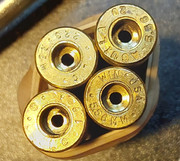

    The no name piece is what brand? And as far as load data between the two types vs my Wylde barrel?

    My lyman 51st edition doesn't have data for 556, but the shooters choice guide does.
    Shooters says
    223 w/ 55gr fmj /24gr of powder starting
    556 w 55gr hor. Fmj-bt /20.7 gr starting load
    Lyman is
    223 w/ 55gr Sierra spt /H335 23gr starting load
  • #2
    Divernhunter
    Calguns Addict
    • May 2010
    • 8753

    I just load my mil surplus brass the same as my 223 labeled brass. I have done so since 1970 without any problems. I have loaded enough that I wore out a Rem 700 heavy barrel 223 varmint rifle barrel.
    I hope you know that all of those need the crimp removed. I have tried many cutters/swaggers and the Dillon Super Swagger is the best and it is fast
    A 30cal will reach out and touch them. A 50cal will kick their butt.
    NRA Life Member, NRA certified RSO & Basic Pistol Instructor, Hunter, shooter, reloader
    SCI, Manteca Sportsmen Club, Coalinga Rifle Club, Escalon Sportsmans Club, Waterford Sportsman Club & NAHA Member, Madison Society member

    Comment

    • #3
      smoothy8500
      Veteran Member
      • Sep 2009
      • 3846

      Yes, remove the primer crimps. No real difference between GI brass and commercial Win, Fed, Aguila, etc, as long as you are loading somewhere in the middle.

      Comment

      • #4
        TomReloaded
        Senior Member
        • Nov 2013
        • 1637

        For reloading purposes, 556 doesn't really exist. It's all "223" reloading.

        Hodgdon lists 23.0-25.3gr for a 55gr sp. You can use that data for regular 55gr fmjs. 25.3 is only 49kpsi, so you actually have some room. Quite a bit room really.

        If this is for an AR, you can safely start at 25.0gr. Everyone will freak out about "working up" despite AR's dropping pressure in the jump, and the min load possibly being so light your gun doesn't run.

        Comment

        • #5
          'ol shooter
          Veteran Member
          • Mar 2011
          • 4646

          Nobody answered the "no name brass" question. They are Lake City, see the LC? One is 5.56 NATO spec, see the circle with a cross in it, the other is .223.
          sigpic
          Bob B.
          (\__/)
          (='.'=)
          (")_(")

          Comment

          • #6
            browndude
            Member
            • Aug 2018
            • 261

            Originally posted by 'ol shooter
            Nobody answered the "no name brass" question. They are Lake City, see the LC? One is 5.56 NATO spec, see the circle with a cross in it, the other is .223.
            Thanks! I bought s couple Philips #2 bits for the crimps, how deep or hard should I drill the crimps for?
            And yes it's fud for my AR . 16" Aero and Davidson D uppers.

            Comment

            • #7
              Sailormilan2
              Veteran Member
              • Nov 2006
              • 3457

              Originally posted by TomReloaded
              For reloading purposes, 556 doesn't really exist. It's all "223" reloading.

              Hodgdon lists 23.0-25.3gr for a 55gr sp. You can use that data for regular 55gr fmjs. 25.3 is only 49kpsi, so you actually have some room. Quite a bit room really.

              If this is for an AR, you can safely start at 25.0gr. Everyone will freak out about "working up" despite AR's dropping pressure in the jump, and the min load possibly being so light your gun doesn't run.
              Agreed. "Working up" just wastes a lot expensive primers and powder. Unless you are loading for the absolutely smallest group possible. But for most things, working up, or laddering up, is not necessary.
              FWIW, I load for about 5 ARs, and my go to load for H335 powder and 55 FMJ bullet is 25.3 gr. Safe in all my guns. If I need more power, or range, I'll go bigger. Not hotter.

              Regarding your brass. The "LC" is military brass, and is NATO Spec, as shown by the cross in a circle, and was made in 2019. You have Aguila, made in 2020. Winchester, and the 4th piece looks like it has an "LC". But, it's got a commercial caliber stamp on it, so it may have been some form of overrun.
              Last edited by Sailormilan2; 03-13-2023, 5:44 AM.

              Comment

              • #8
                anyracoon
                Veteran Member
                • May 2006
                • 3694

                My go to plinking load is 25gr H335, SRP and 55gr FMJ bullets.

                Comment

                • #9
                  smoothy8500
                  Veteran Member
                  • Sep 2009
                  • 3846

                  Originally posted by browndude
                  Thanks! I bought s couple Philips #2 bits for the crimps, how deep or hard should I drill the crimps for?
                  I use a countersink bit to clean out the crimps. The Phillips will work, but slower. Just enough to remove the crimp, don't go too far.

                  Comment

                  • #10
                    tabascoz28
                    Veteran Member
                    • Mar 2016
                    • 3364

                    Some of these cases might have been loaded hot from the factory so even if your second load is moderate and safe it could still crack the neck, vertically. From then on you'll have to constantly check for cracked cases. I have never invested in brand new 223 cases but potentially a better investment for time with less prep and longer life as it would not have a crimp either. Notes: I have not tested to see if this because of extraction scratch. I have never done this because I'm cheap.

                    Comment

                    • #11
                      kcheung2
                      Veteran Member
                      • Aug 2012
                      • 4387

                      When I used Philips head screwdriver bit on a power drill. I got about 500 cases before it dulled. Then I set it for counterclockwise & got another 500 before I relegated it to regular screwdriver use. Now I use a countersink like above, it’s done a few thousand cases & still going strong.

                      You don’t need to remove much material, just half a second on a power drill. Just enough to make a small bevel on the rim.
                      Last edited by kcheung2; 03-13-2023, 12:57 PM.
                      ---------------------
                      "There is no "best." If there was, everyone here would own that one, and no other." - DSB

                      Comment

                      • #12
                        divingin
                        Veteran Member
                        • Jul 2015
                        • 2522

                        Originally posted by browndude
                        Thanks! I bought s couple Philips #2 bits for the crimps, how deep or hard should I drill the crimps for?
                        Do you have a rocket ship deburring tool? A quarter turn with mild pressure will remove the crimp. Designed to cut, so probably more efficient than repurposing screwdriver bits. Plus the tool makes sure you don't get interference at the case mouth after trimming (seating bullets, and chambering. Using the tool for what it was designed for - sacrilege, I know.)

                        The LC stuff from 2015-2020 was pretty much analogous to Federal brass (may be differences between NATO and commercial lines though.) Winchester took over LC armory in 2020.

                        Side note: the dots and circles on the LC headstamp are a code showing (depending on who you talk to) the date it was made, the machine it was made on, or the dies used.

                        Comment

                        • #13
                          mofo1111
                          Member
                          • Apr 2010
                          • 248

                          Speer, Nosler, and Hornady (to name a few)have published NATO loads(for what it's worth). I don't know if it really makes a difference when hand loading, except only shoot your rounds in a NATO barrel.

                          If swaging or reaming primer pockets, buy a Swag Gauge from Ballistic Tool. It's a go/no go gauge for primer pocket size. If you remove too much crimp/material, the new primer may have a loose fit.

                          Comment

                          • #14
                            browndude
                            Member
                            • Aug 2018
                            • 261

                            Originally posted by mofo1111
                            Speer, Nosler, and Hornady (to name a few)have published NATO loads(for what it's worth). I don't know if it really makes a difference when hand loading, except only shoot your rounds in a NATO barrel.

                            If swaging or reaming primer pockets, buy a Swag Gauge from Ballistic Tool. It's a go/no go gauge for primer pocket size. If you remove too much crimp/material, the new primer may have a loose fit.
                            I Decrimped using a HB freight drill press n #2 Phillips bit. Hand primed about 10 and they went in with a lot more force than the 30 30 win brass ive been working on also. But they went in, alittle more smooshed.

                            Comment

                            • #15
                              TFA777
                              Member
                              • Dec 2014
                              • 327

                              Originally posted by kcheung2
                              When I used Philips head screwdriver bit on a power drill. I got about 500 cases before it dulled. Then I set it for counterclockwise & got another 500 before I relegated it to regular screwdriver use. Now I use a countersink like above, it?s done a few thousand cases & still going strong.

                              You don?t need to remove much material, just half a second on a power drill. Just enough to make a small bevel on the rim.
                              I got the burstfireguns reamer, and a nut (forgot what it's correct name is, like a sleeve with an inside thread) from Home Depot to run it in a drill.

                              Problem with countersink is you might drill your primer hole wider. The burstfireguns reamer can't cut too deeply.

                              Tried swaging but had mixed results, some cases still crunch primers after swaging.

                              For plinking rounds reaming is fine.

                              Reamed 3000 cases with it and still going strong.

                              Comment

                              Working...
                              UA-8071174-1