
-
Randall Rausch
AR work: www.ar15barrels.com
Handguns: www.handgunbarrels.com
Bolt actions: www.700barrels.com
Foreign Semi Autos: www.akbarrels.com
Most work done while you wait on a scheduled shop visit. -
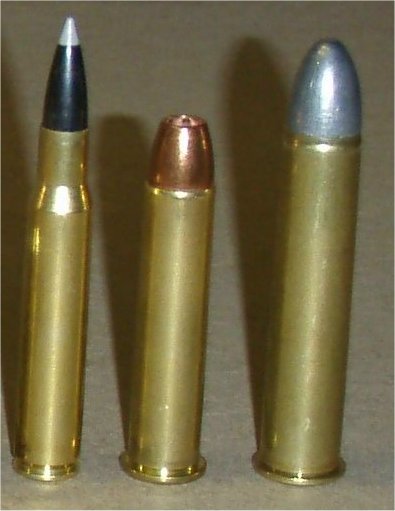
45-70 is BOTH. Yes it is a "tapered case". It is also a "straight walled case". Like many old rifle cartridges. And unlike the revolver pistol cartridges mentioned. Most, if not all, rimless and semi rimless, for semi auto pistols. Are also tapered straight walled cases.Comment
-
Tapered vs straight wall are distinctively different in how the sizing dies have to be constructed to resize them correctly.
A true straight wall cartridge can be resized with a small ring that the whole case above the rim can be pushed through while tapered cases usually need a properly tapered full length die to resize them correctly with the taper.
As you mention, some autoloader cases are tapered but sometimes the taper is so little that die makers treat them as true straight wall cases and use a simple ring to resize them.
In the case of 9mm, straight wall sizing them does leave a "waist" in the case.
25 auto, 32 magnum, 32 short colt, 32S&W, 32S&W Long, 327 federal, 357 magnum, 38 special, 38 auto, 38 super, 45 colt, 454 Casull, 460 S&W, 475 Linebaugh, 480 ruger, 500 S&W and 500 special are all SAAMI specified as "cylindrical" and only have one dimension specified from the case mouth down to the extractor groove or rim.
While many cases are slightly tapered, around 0.003" or so from the case mouth to the bottom of the case body just above the extractor groove, these cases often have a -0.006" SAAMI standard on diameters.
When the tolerance is bigger than the taper, the cases can be made completely straight and be considered in-spec and the cartridge case makers actually do it that way quite often.Randall Rausch
AR work: www.ar15barrels.com
Handguns: www.handgunbarrels.com
Bolt actions: www.700barrels.com
Foreign Semi Autos: www.akbarrels.com
Most work done while you wait on a scheduled shop visit.Comment
-
They are what they are. Which is both. Die manufacturers get away with a RING on tapered cases like 9mm pistol because they are so damn short. And the maker "gets away with it".
My newer carbide 9mm sizer has a ring. My older steel 9mm sizer has a tapered interior.
My carbide die doesn't actually "resize them correctly". It just works good enough. Even with the "waist in the case".Tapered vs straight wall are distinctively different in how the sizing dies have to be constructed to resize them correctly.
Comparatively I think 9mm para actually has MORE TAPER than 45-70 because of the case length. 9mm has a .011" dia diff in .5". Per SAAMI. Page 27 of https://saami.org/wp-content/uploads...sting-Copy.pdf Whereas the 45-70 is only .025" in 2". Per your drawing.
In reverse .... Divide the 2", 45-70's, .025" diff by 4, to match the 1/2" length of the 9mm and it is only .00625" per .5" of length.
Still both are both. Semantics don't change physical characteristic definitions.
Calling straight walled non tapered cases "cylindrical" is also correct. For the cases you mentioned. But "apples v oranges" when talking about 45-70.
Comment
-
Randall Rausch
AR work: www.ar15barrels.com
Handguns: www.handgunbarrels.com
Bolt actions: www.700barrels.com
Foreign Semi Autos: www.akbarrels.com
Most work done while you wait on a scheduled shop visit.Comment
-
The walls are constant thickness, but angled, not parallel to each other or square to the base.
Sorry, I agree with Randall. Not that it matters much. I served some of my early machinist years at Star Machines Works in San Diego. (learned a LOT there from both Elard and Bill Brenizer) Home of the Star Lubri-Sizer, and Progressive reloader, both designed long before Dillon. Elard Mock, the guy that designed both machines, called the .45-70 a tapered case, as the case tapers from bottom to top. The case walls can be constant thickness, more or less, but the case body is tapered.
I'm pretty sure the case was tapered on purpose for military field use, although I haven't looked up design history. Just seems likely.There are some people that it's just not worth engaging.
It's a muzzle BRAKE, not a muzzle break. Or is your muzzle tired?Comment
-
It's not complicated folks. It is what it is. A straight walled case, with a tapered profile.Specifications
Case type Rimmed, straight
Bullet diameter .458 in (11.6 mm)
Neck diameter .480 in (12.2 mm)
Base diameter .505 in (12.8 mm)
Rim diameter .608 in (15.4 mm)
Rim thickness .070 in (1.8 mm)
Case length 2.105 in (53.5 mm)
Overall length 2.550 in (64.8 mm)
"eaglemike" had it partially right when he said;
It was "tapered on purpose" for necessity. Not just for a martial application. Literally ALL OF THE OLD BLACK POWDER RIFLE CARTRIDGES WERE. So the rifle would be able to extract them.I'm pretty sure the case was tapered on purposefor military field use,
EM, look at a morse taper as example. It is a, STRAIGHT TAPERED PROFILE. When you clunk it home it is tight. But tap it back out, even a tiny amount. And it is loose. Even though brass cartridge cases spring back a bit when fired. The taper is insurance they would extract.
Specifications
Parent case .50 Basic
Case type Rimmed, straight-taper
Bullet diameter .512 in (13.0 mm)
Neck diameter .529 in (13.4 mm)
Shoulder diameter .529 in (13.4 mm)
Base diameter .551 in (14.0 mm)
Rim diameter .652 in (16.6 mm)
Case length 3.25 in (83 mm)
Overall length 3.95 in (100 mm)
Primer type Large rifleComment
-
Please don't use wikipedia as an absolute source. It's user maintained, and I've seen so much BS in there it's not even funny. Sorry, it's straight wall thickness, but tapered.
Yes, I know about Morse tapers. and Brown & Sharp tapers. Etc.
ETA: let's say there's an assembly needing a common #2 taper pin (doesn't matter mild steel or stainless for this discussion) are you going to ask for a tapered pin, or a straight pin that's tapered. Of course, a tapered pin.
If I was going to ream dies for a 45-70, would I use a tapered reamer, or a straight reamer? Tapered, of course. If I made the dies with straight reamer, the brass might fall into the chamber, but would fail soon due to being over-worked, if it didn't fail the first time.Last edited by eaglemike; 12-10-2022, 12:09 PM.There are some people that it's just not worth engaging.
It's a muzzle BRAKE, not a muzzle break. Or is your muzzle tired?Comment
-
Why not? You used a couple of old employers as a definitive reference. I only C&Pd wiki as a quick easy reference. Sign into BPCR and read what every member calls old black powder rifle cartridges. Or maybe just buy a dictionary.Please don't use wikipedia as an absolute source. It's user maintained, and I've seen so much BS in there it's not even funny. Sorry, it's straight wall thickness, but tapered.
straight
extending or moving uniformly in one direction only; without a curve or bend.
Does a 45-70 case have a bend or curve in its wall? Nope, of course not because it is a STRAIGHT WALLED CASE. With a TAPERED PROFILE.
Of course you would use a tapered reamer. Because the case "profile" is tapered.
I used MT as an example of reason for the taper incorporated in the STRAIGHT WALLED cases of the era. "EASY RELEASE". NOT FOR YOU TO GO OFF TWO STEPPING INTO THE WEEDS.
You're just spouting nonsense. Even in your previous post;
Even the cylindrical cases Randall mentioned, the walls are thicker at the head than the mouth/neck area.The walls are constant thickness,
The last "constant thickness" cases were made over a century ago in the 1800 hundreds. Called "balloon head" cases.Comment
-
Randall Rausch
AR work: www.ar15barrels.com
Handguns: www.handgunbarrels.com
Bolt actions: www.700barrels.com
Foreign Semi Autos: www.akbarrels.com
Most work done while you wait on a scheduled shop visit.Comment

 Tweet
Tweet



There are currently 29695 users online. 112 members and 29583 guests.
Most users ever online was 239,041 at 10:39 PM on 02-14-2026.


Comment