Unconfigured Ad Widget

Collapse

Comparator reloading information

Collapse
X
 
  • Time
  • Show
Clear All
new posts
  • #16
    nedro
    Veteran Member
    • Nov 2014
    • 4130

    I use all the same calipers and indicators I used when I was a professional mechanic. Not the best names, but accurate none the less. Central and nsk from the 1990s.
    It surprised me to find out how much the tip length of common bullets actually deviate.
    When I saw a comparator for the first time, it was an ah ha moment.

    Comment

    • #17
      AGGRO
      Veteran Member
      • Oct 2009
      • 2793

      Originally posted by nedro
      I use all the same calipers and indicators I used when I was a professional mechanic. Not the best names, but accurate none the less. Central and nsk from the 1990s.
      It surprised me to find out how much the tip length of common bullets actually deviate.
      When I saw a comparator for the first time, it was an ah ha moment.
      Right? Same here. I have been reloading since 77 ya 1977 but it was always for hunting rifles or what not. Now, getting back into it and having to deal with copper and semi auto rifles like the AR things they be a changin. Fun hobby. I'm always looking to learn new stuff. Especially if it keeps you from blowing your face off

      Comment

      • #18
        nedro
        Veteran Member
        • Nov 2014
        • 4130

        I agree.

        Comment

        • #19
          Dirtlaw
          CGN/CGSSA Contributor - Lifetime
          CGN Contributor - Lifetime
          • Apr 2018
          • 3480

          Originally posted by fguffey
          I use comparators, believe it or not the comparator works when comparing. The Hornady/Sinclair tool that is used with a dial indicator is a comparator; it does not match SAAMI specifications.

          I find the best use for a comparator is measure before and again after. Example; measure the length of a case from the datum to the case head and then fire. After firing measure the same case from the datum to the case head, after measuring the fired case compare the two lengths.

          The Hornady gage was first introduced as a head space gage. And then I told them the case did not have head space, and that locked them up. Years later someone started labeling the Hornady/Sinclair tool as a comparator. And then there had to be a reason, the reason the Hornady/Sinclair tool never agreed with any specifications was caused by the radius at what they called a datum. All they had to do was zero the tool or take lessons from L.E. Wilson on making tools with datums with a radius.

          F. Guffey

          I generally agree though the problem I have with the Hornady tool is the variation you get with respect to the "measurements." That involves two issues. The first is the prospect of the round "canting" which slightly changes the measurement. And the second is the possibility that the base or possibly another reference point is not precisely at a right angle with the axis (this seems to be more often a problem that occurs when measuring overall length due to trimming inaccuracies). What I have just said is important because the Golden Rule of measurement is repeatability. You know something is amiss if your answer keeps changing (either the measurement methodology or the measurement tool itself).


          With respect to canting the best solution I have to date is a fixture that holds the round precisely in place with respect to the measuring tool. The fixture is typically used on a surface plate with a height guage, but also can be used in a more arbitrary fashion with a dial indicator to act as a comparator for greater speed. Again, however, it is important to minimize variations so you actually have a standard and that means being careful to measure from the highest point.


          100% agree on the usefulness of comparing pre-discharge with post-discharge measurements.

          Comment

          • #20
            fguffey
            Senior Member
            • Mar 2010
            • 1408

            With respect to canting the best solution I have to date is a fixture that holds the round precisely in place with respect to the measuring tool. The fixture is typically used on a surface plate with a height guage, but also can be used in a more arbitrary fashion with a dial indicator to act as a comparator for greater speed. Again, however, it is important to minimize variations so you actually have a standard and that means being careful to measure from the highest point.
            Standards and Transfers are foreign terms to reloaders. The problem is caused by the reloader, in the beginning there was an effort to make instructions fool proof; problem, fools do not read.

            In about 1938 L.E. Wilson designed a case gage complete with instructions' reloaders, close to 80 years later were referring to the Wilson case gage as a DROP in GAGE. It is not easy to overcome that many years of ignorance.

            F. Guffey

            Comment

            • #21
              divingin
              Veteran Member
              • Jul 2015
              • 2522

              Originally posted by AGGRO
              Looking for some charts that have all cartridge overall length, to shoulder, setback, etc. without looking up each single ogive using the proper bushing and caliper. This tool (comparator) is new to me and looking for all information available.
              You probably won't find the chart.

              The comparator is not a gauge in the sense that it doesn't give you a solid measurement.

              Your calipers, for example, are (theoretically) calibrated to a standard, so measurements taken with those calipers are an absolute: What it measures is how it compares to the standard.

              The comparator is not based on a standard, but is used to compare item one to item 2, with no other relation. You can say that Bullet A's base to ogive is 1 thousandth shorter than Bullet B's is , but that's about it. The absolute value of that measurement is dependent on what the actual ogive value is used for your comparator, how the corner of the hole is relieved, etc.

              The whole thrust of this explanation is that different comparators will yield different absolute measurement results, which is why, when trying to compare cartridges, cases or bullets using a comparator, you have to use the same tool for all measurements. And since you have to use the same tool, you won't find a chart of how things measure, since your tool doesn't necessarily match anyone else's.

              Comment

              • #22
                Dirtlaw
                CGN/CGSSA Contributor - Lifetime
                CGN Contributor - Lifetime
                • Apr 2018
                • 3480

                Originally posted by AGGRO
                Looking for some charts that have all cartridge overall length, to shoulder, setback, etc. without looking up each single ogive using the proper bushing and caliper. This tool (comparator) is new to me and looking for all information available. Been reloading for a long time but this is something new to me. Mostly interested in those that use this for the AR, specifically 6.5 Grendel and using copper. Also using an analog caliper.

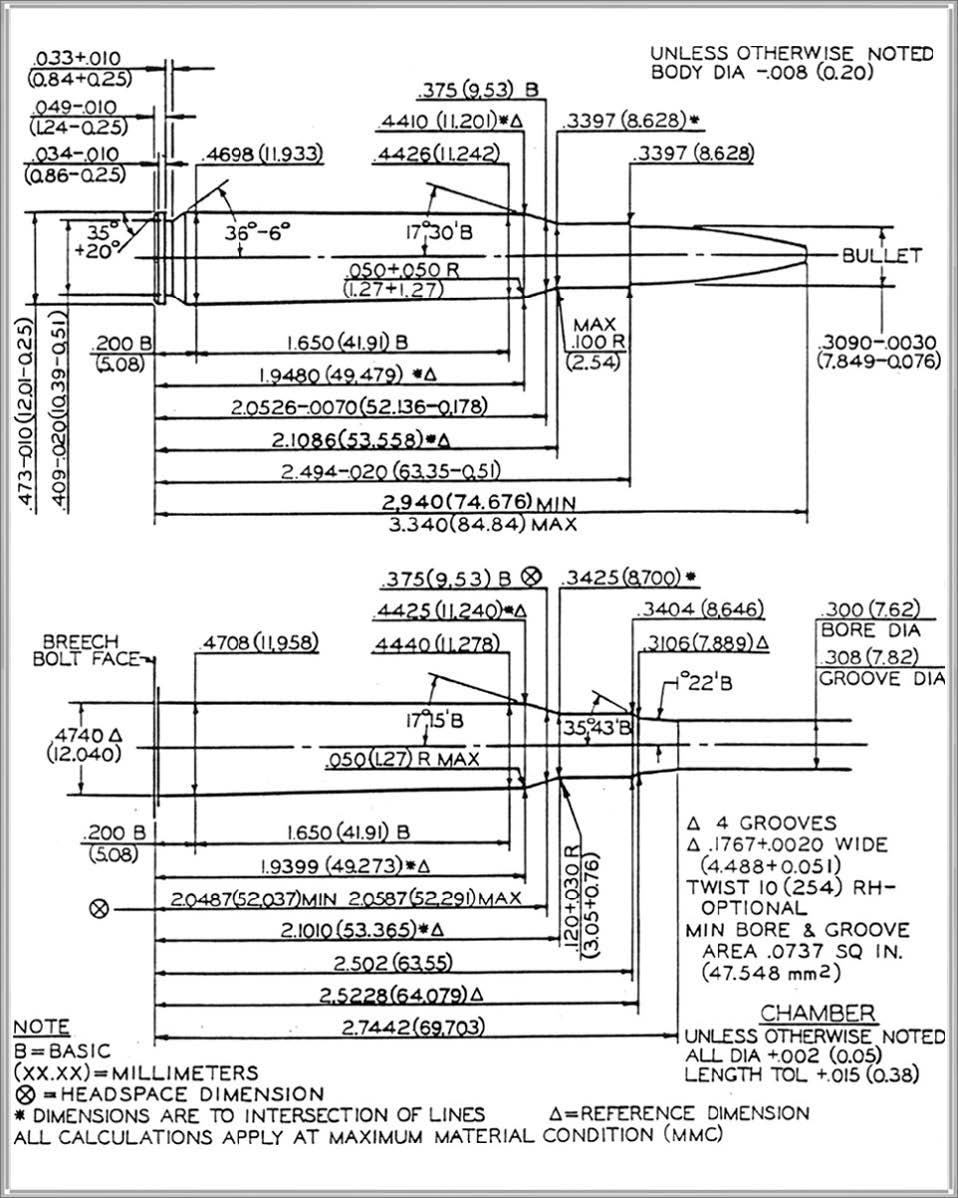
                This is a useful place to start:


                But what the "proper" measurements are is only part of the puzzle.


                The other parts are:


                1. The actual measurements of your assembled components and


                2. The actual measurements of your specific chamber.


                Just because there is a published "standard" doesn't mean your round is correct; nor does it mean that your chamber is correct (though odds are the chamber is within specs).


                The goal is to make sure the round you fire in your specific chamber is within a certain margin of error. If it is not, bad things can happen.

                Comment

                • #23
                  nedro
                  Veteran Member
                  • Nov 2014
                  • 4130

                  Dirtlaw, you make a lot of sense.
                  My questions for Mr. Guffey were because my interpretation of his comment was that a bullet comparator is useless and that seasoned reloaders don't need them at all.
                  I own both a case comparator and a bullet comparator.
                  The case comparator is the LE wilson case gage.
                  The bullet Comparator is a Hornady Bullet Comparator.

                  When I talk about Ogive, it is for bullets, obviously.
                  But for the life of me, I still can't figure out how our Mr. Guffey uses his exalted Wilson Case gage to compare seated bullets.

                  But like I said, I'm just an amateur, ignorant reloader. A newbie as it were. I consider 100% success to be my minimum standard in reloading. 100% success with precise accuracy is what I aim for (pun intended).

                  I truly came here to learn something.
                  Laugh at me. Make fun of me. Insult me. I don't care, as long as I learn something.
                  Thanks.

                  Comment

                  • #24
                    AGGRO
                    Veteran Member
                    • Oct 2009
                    • 2793

                    Originally posted by Dirtlaw
                    This is a useful place to start:

                    But what the "proper" measurements are is only part of the puzzle.
                    The other parts are:
                    1. The actual measurements of your assembled components and
                    2. The actual measurements of your specific chamber.
                    Just because there is a published "standard" doesn't mean your round is correct; nor does it mean that your chamber is correct (though odds are the chamber is within specs).
                    The goal is to make sure the round you fire in your specific chamber is within a certain margin of error. If it is not, bad things can happen.
                    That looks pretty tidy and some one stop shopping. Thank you.

                    Comment

                    • #25
                      fguffey
                      Senior Member
                      • Mar 2010
                      • 1408

                      Originally posted by nedro
                      Dirtlaw, you make a lot of sense.
                      My questions for Mr. Guffey were because my interpretation of his comment was that a bullet comparator is useless and that seasoned reloaders don't need them at all.
                      I own both a case comparator and a bullet comparator.
                      The case comparator is the LE wilson case gage.
                      The bullet Comparator is a Hornady Bullet Comparator.

                      When I talk about Ogive, it is for bullets, obviously.
                      But for the life of me, I still can't figure out how our Mr. Guffey uses his exalted Wilson Case gage to compare seated bullets.

                      But like I said, I'm just an amateur, ignorant reloader. A newbie as it were. I consider 100% success to be my minimum standard in reloading. 100% success with precise accuracy is what I aim for (pun intended).

                      I truly came here to learn something.
                      Laugh at me. Make fun of me. Insult me. I don't care, as long as I learn something.
                      Thanks.

                      But for the life of me, I still can't figure out how our Mr. Guffey uses his exalted Wilson Case gage to compare seated bullets.

                      Comment

                      • #26
                        divingin
                        Veteran Member
                        • Jul 2015
                        • 2522

                        Originally posted by nedro
                        I own both a case comparator and a bullet comparator.
                        The case comparator is the LE wilson case gage.
                        While I guess you could call a case gauge a comparator, that was not what I was referring to.

                        In my opinion, a comparator (in shooting terms) is something that allows you to measure to a given point on a conical surface.

                        So you take a bullet, and the comparator allows you to place a bullet in to the point where a given diameter lies. In essence, it's hole in a block. Since every bullet you measure will go into the same hole, you compare the exposed part of each bullet measured (exposed bullet plus the length of the device), and since the hole and the tool is the same for each measurement, you're comparing apples to apples.

                        The same thing can be done to cases (or cartridges, if they're already loaded.) You simply need a bigger hole that will fall on the case shoulder (and the tool may need to be longer if you're measuring a case with a bullet seated.)

                        So the normal case comparator is exactly like your bullet comparator, only larger.

                        Comment

                        • #27
                          Dirtlaw
                          CGN/CGSSA Contributor - Lifetime
                          CGN Contributor - Lifetime
                          • Apr 2018
                          • 3480

                          Confusion often arises from the terminology we use and the fact that sometimes we give different names to the same thing or concept.


                          Here, I think the words "comparator" and "standard" may be generating some confusion. A "comparator" (as used here) is simply a measuring device and a "standard" can be any measurement you want it to be.


                          Thus, in simple terms what we are really talking about is using the measurements of a specific chamber as our standard and "comparing" that standard with the rounds we are making in order to ensure that we have the proper fit. Proper fit means that the round will load, fire and eject in a safe manner and that we are able to achieve the accuracy level we desire.


                          There are additional considerations of course, but I do believe that starting with the basics and moving on from there is the easiest way for most people to learn.

                          Comment

                          • #28
                            Dirtlaw
                            CGN/CGSSA Contributor - Lifetime
                            CGN Contributor - Lifetime
                            • Apr 2018
                            • 3480

                            The problem we have in handloading is that there are some measurements we need that are somewhat difficult to obtain. Hornady and other manufacturers have therefore developed attachments, etc. for our measuring tools to allow those measurements to be made.

                            Comment

                            • #29
                              fguffey
                              Senior Member
                              • Mar 2010
                              • 1408

                              The problem we have in handloading is that there are some measurements we need that are somewhat difficult to obtain. Hornady and other manufacturers have therefore developed attachments, etc. for our measuring tools to allow those measurements to be made.
                              Difficult to obtain? And then there is Sinclair/Hornady with a radius on the datum and reloaders without a standard.

                              To start with I want a tool that can be zeroed , if the tool will not zero it requires a standard, after that it really gets complicated.

                              F. Guffey

                              Comment

                              • #30
                                Dirtlaw
                                CGN/CGSSA Contributor - Lifetime
                                CGN Contributor - Lifetime
                                • Apr 2018
                                • 3480

                                Originally posted by fguffey
                                Difficult to obtain? And then there is Sinclair/Hornady with a radius on the datum and reloaders without a standard.

                                To start with I want a tool that can be zeroed , if the tool will not zero it requires a standard, after that it really gets complicated.

                                F. Guffey

                                By difficult to obtain what I am referring to are the tools we most commonly use. In that regard, we most commonly measure length from end to end. Measuring length to a specific point on a taper is more difficult because we need to locate that point first (the purpose behind the Hornady attachments) before we can measure a distance to or from that point.


                                I am unclear on the discussion of standards and zero. Zero itself can be a standard. Zero can be referenced to a surface (as it would be on a 0 to one inch micrometer, but it can also be referenced at some other spot as in the case of a mechanical comparator or a larger micrometer where you have a dial indicator set at zero above the fixed measuring surface. But we may be saying the same thing because whether we use guage blocks or one of Hornady's caliper adapters we are placing the starting point at some defined location and I agree that doing so requires additional effort.

                                Comment

                                Working...
                                UA-8071174-1