

 Tweet
Tweet
This Marlin 336 is really kicking my butt. I took it out again today----took thge stock front site hood off and could actually see the brass pin on the front. Thought I'd do better. I had 6 rounds, 30 grains varget under a missouri 168 grain and 6 rounds with 28 grains of IMR489 same bullet. Target was an IDPA carboard with a 6 inch shoot and see at 35 yards. I never got closure than 6 inches to the shoot and see and half the rounds never even hit the carboard. Now before I get flamed I got out my 102 year old 1903 with peep sites and had an inch and a half group with 20 rounds so I may not be a sharp shooter but I can shoot. Called a friend who has the same weapon same age and he said he had the same problem unless he shot factory Hornaday ammo. I have ordered the skinner rear sight but that clearly is not the problem here. I guess I can wait till I get the skinner peep sight and look for some factory ammo and give it a try. I have shot factory winchester and can hit the 6 inch shoot and see 50 % of the time. This is the only weapon I have ever owned that has given me issues. Thoughts??
-
-
Missouri coated or plain... gas-checked? I don't have my book laying around but those seem a bit hot for lead.
you really should slug the bore but if not the .311 bullet works better in the marlin -
Start here I guess:

Maybe try some fmj bullets? Or lower velocities with lead?
Is the barrel clean and "lead free"?
Is the barrel firmly attached to the receiver?
Is the bore consistent all the way through (no bore bulges)?Tire kickers gonna kick,
Nose pickers gonna pick
I and others know the realComment
-
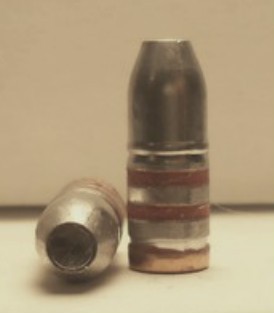
I found a picture of the Missouri 165 grain cast bullet that you may be using.
I tried a similar bullet and they would keyhole out of my Marlin 336.
It was apparent that there was not enough bearing surface to properly stabilize that long nose bullet.
The 336 likes long heavy bullets with a lot of bearing surface. At least mine does.
Suggested bullets #31141 a 173 grain flat nose.
irhComment
-
With that bullet, especially if it's the non-coated wax lubed bullet, you're probably driving it way too hard.
I would guess your barrel is well leaded up as you likely ran out of lube in the first few inches of barrel travel and heat and pressure would have been vaporizing the plain lead on the base of bullet depositing it all along your bore.
Wrap some strands of copper (has to be copper, NOT steel, just to be sure even if the steel shouldn't hurt anything) Chore Boy around a bronze brush and clean your bore. Use a pull through if you can. I bet ribbons of lead come out.
With that bullet you'll probably want to stick to 1500 fps +/- for supersonic loads.
What I've found with that bullet was it transitions VERY poorly, so if you're only just above supersonic you'll get poor results past 50 yards or so.
I don't recall, is this the .311 or the .309 sized bullet from Missouri? They make the 165 RNFP in both diameters. You'll need the .311 at the very least.
There is also the possibility that the .311 is still undersized for your bore. You can clean your bore, lube up a fishing weight, and pound it through then measure it to get a sense of what your actual bore diameter is. You want to shoot a cast lead bullet of 0.001 or 0.002 over your actual bore diameter.
Otherwise you might have an easier time shooting jacketed bullets, even the little 110 grain .30 carbine bullets can often be made to shoot well and are a lot of fun.
I generally get good results with Sierra bullets (as well as others, but Sierras have always shot well for me) though I've not loaded up any jacketed bullets for my own .30-30.
I know you already have the bullets, so it'll take some work to find a load that works for you. But if I were you and if I wanted to start from scratch, I'd start with a 170 Sierra FN over 30 grains of Varget or 28 grains of IMR 4895 (working up to 32 and 30 respectively).Calguns.net, where everyone responding to your post is a Navy Force Delta Recon 6 Sniperator.Comment
-
If you've shot a bunch of cast bullets and haven't cleaned the gun, my guess is that you have some serious leading going on. I've seen otherwise accurate lever guns shoot like smooth bores when the barrel gets leaded up. Switch to jacketed 150gr bullets and do a test.
28grs of H4895 is a lower to mid-end load for the jacketed bullet..... I use 30grs for both 150 and 170gr jacketed. I'll bet that either your load is skidding the bullet down the barrel, or else it isn't getting stabilized as Ironhorse1 suggests. Also (as NapalmCheese mentions), the 110gr carbine bullets are accurate and inexpensive.Last edited by bigbossman; 11-04-2020, 12:14 PM.Always looking for vintage Winchester and Marlin lever action rifles. Looking to sell? Know of one for sale? Drop me a line!
"Give a conservative a pile of bricks and you get a beautiful city. Give a leftist a city and you get a pile of bricks."Comment
-
OK---the missouri 165 gr cast bullets are coated and .309 The Hornady FTX 160 gr are .308. The winchester factory ammo is .308.
Ironhorse---what brand 173 grain??? And what is the diameter of those?
Gun is pristine with hardly any rounds through it. No bulges, loose etc etc. Checked the bore and see no lead build up. Ran a brush through multiple times and a bore snake several times. Looks like new.Comment
-
Those particular bullets are most likely undersized for your microgroove barrel and may never shoot well in that gun. Without slugging your bore it's a safe bet that you ought to be using the .311 sized 165 RNFP Coated from Missouri. Slugging your bore is the only way to be sure.
Jacketed bullets get away with being undersized by being loaded on top of full power charges of powder helping them obturate and grip the rifling. Lead bullets are pushed slower, don't obturate the same, and more easily shear out of the rifling.
That they are coated explains your lack of leading I'd guess.
The 173 Ironhorse mentions is a Lyman mold, you might find some for sale but they are most often hand cast by DIYers. They usually drop around .311 or .312 and are sized to 0.001 or 0.002 over bore diameter. Cast lead is a slightly different ball game than shooting jacketed bullets.Calguns.net, where everyone responding to your post is a Navy Force Delta Recon 6 Sniperator.Comment
-
In my Lyman book they have a small window for IMR 4895----27.5 to 29. 28 grains on varget is low end. I've got a few rounds of FTX 160 grain over 28 grains of IMR 4895 I was going to try but at .308 diameter I'm wondering if I'm spinning my wheels. I was going to shoot a few factory winchester rounds to see where I am at with those. What I am hearing is diameter is an issue, one person says faster on missouri one says slower? For jacketed I have FTX. I'll have to see if I can find some flat nose jacketed in a .311.Comment
-
I have not tried Varget so I don't know what the velocity you might be getting with that load.
Here is what I do know. The Marlin has a 20" barrel and my reloads range from 1500 fps to 2000 fps. Factory 170 JSP 2246,2253 2310 fps
I run 10 grains of Unique with the 180 grain cast lead bullet which runs around 1500 fps.
IMR 4198 at 20 grains with a cast bullet gives inconsistent velocity readings but outstanding accuracy. Go figure. 1685,1928,1799,1661 fps
Most consistent load 32 grains of WW748 170 fn Sierra. 2050,2055,2056 fps
Current load 30 grains of 3031 170 Sierra fn 1982, 1952, 2031 fps
Previous loads
31 grains IMR 4895 Sierra 170 fn 2001,2010,2032 fps
24 grains IMR 4198 Sierra 170 fn 1893, 1893, 1984 fps
25 grains IMR 4198 Sierra 170 fn 1994, 2000
With the right bullet the Marlin is an outstanding performer in the accuracy department.
Posting this data may be helpful to anyone trying to develop loads for the 30-30.
irh
Check out the 170 cast fn on this page. The large front driving band is what my Marlin likes.
Last edited by ironhorse1; 11-04-2020, 12:46 PM.Comment
-
Sorry if I promote further confusion!
TL;DR - Use .308 sized JACKETED bullets in your Marlin, use .311 sized LEAD bullets in your Marlin, load to velocities under 1100 fps or over 1300ish fps for 100 yard loads to avoid the transonic area.
In jacketed you don't have to worry about bore diameter so much, most .308 jacketed bullets should be able to shoot reasonably well in your microgroove barrel. Your 160 FTX ought to be fine and you should be able to find a reasonable load for it.
In cast lead you have to worry about your bore diameter and you'll need something closer to .311 than .309 in your Marlin. The bullets you currently have from Missouri are .309 (they are the same bullet I shoot in my Winchester). I just checked their website and it seems like they are only listing bullets they currently have in stock. They list no 165 RNFPs at all. Once they are back up and running and making stock you should be able to get a .311 sized 165 RNFP Coated bullet from them, it is a normally stocked item for them as the need for .311 sized bullets for Marlin rifles is well known.
As for velocity with the Missouri bullets: I shoot both the plain wax-lubed and coated bullets. I reserve the plain bullets for light plinking loads (5.6 grains Red Dot moving them at 1050) and get good accuracy and no leading. If I try to get more velocity out of them with that powder I get leading in my bore. That particular load is subsonic and reasonably accurate to 100 yards. At velocities of 1100, 1200, or so with the plain wax-lubed bullets I start getting keyholing as the not very aerodynamic 165 RNFPs lose velocity quickly and transition from supersonic to subsonic within 50 yards or so (that is my theory anyway).
Knowing that those bullets don't transition from supersonic to subsonic well I try to shoot the coated bullets faster. The coated bullets have less friction than the wax-lubed bullets and create lower pressures overall such that when I shoot them with a reduced load of H-4895 I get unburned powder in my bore. I have some loaded up that are over the book max for lead bullets and under the book minimum for jacketed bullets and am planning on doing load dev for the coated bullets running all the way up to jacketed bullet powder charges. The idea there is that I'd like to get something supersonic that won't transition to subsonic within 150 yards.Calguns.net, where everyone responding to your post is a Navy Force Delta Recon 6 Sniperator.Comment
-
Napalm---ok. What I am hearing is if I speed up the FTX a little I should be ok And If I speed up the coated missouri I should be ok. I was loading everything at the bottom end and running .308 and .309 diameter. Being I have about 900 of the missouri and 125 FTX left I might as well start stepping them up and see what I get as if I am tracking right small diameter and low end loads I am creating my issue. I pulled the FTX 28 grain and reloaded to 30 grain of IMR 4895. I will take those out tomorrow and see what I get. Thanks everyone!!Comment
-
I'm not sure you'll ever be able to get those Missouri bullets to shoot since, as non-jacketed polymer coated cast lead bullets they are undersized for your bore. If you really want to shoot polymer coated cast lead you might try selling them and purchasing the .311 sized ones from Missouri or another outfit. If you give Chey Cast a call (https://cheycastbullets-com.3dcartstores.com/) they might size some of their 165 RNFPs to .311 for you. They use the same Magma Engineering bullet mold Missouri uses and the same coating.Calguns.net, where everyone responding to your post is a Navy Force Delta Recon 6 Sniperator.Comment
-
Always looking for vintage Winchester and Marlin lever action rifles. Looking to sell? Know of one for sale? Drop me a line!
"Give a conservative a pile of bricks and you get a beautiful city. Give a leftist a city and you get a pile of bricks."Comment
-
Got it----speed up the jacketed, sell the Missouri----FS----800 rounds of Missouri cast coated 30 cal projectiles!! Or trade---I really need some SMK 168 grain HPBT. Guys----thanks for the input. I feel pretty confident I can turn the corner with this. First time I've come across something this fickle Finding some good jacketed bullets right now may be an issue but I still have 100+ FTX bullets I can play with. Cheers gunners!!!Last edited by bhilliker@comcast.net; 11-04-2020, 3:04 PM.Comment


There are currently 7637 users online. 87 members and 7550 guests.
Most users ever online was 239,041 at 10:39 PM on 02-14-2026.


Comment