

 Tweet
Tweet
If you're going to use your reloads for competition, do the drop check in your barrel of all your reloads or get yourself a gauge if you don't want to pull your barrel every time you reload. Glock bulges are the bane of 40S&W and will either prevent a round from fully seating in your chamber or, even worse, can rupture if the bulge is a smilely face. I visually inspect every 40S&W reload I do after it has been reloaded to check for bulges I may have missed or cracks in the case. If I find either one, I disassemble the round. Not worth the risk.
-
-
Here are the adjustment instructions from Lee:
I found that much smaller adjustment increments are needed instead of the 1/2 turn Lee suggests. I would make adjustments in the 1/8 turn range til I got it right. Balmo's dimensions of .001" to .002" diameter reduction at the mouth are correct, but I sometimes had difficulty getting the caliper blades right on the end of the case. Instead, I look for a very small shiny ring at the case mouth where the crimp bushing burnishes the brass in the crimping process. A very very narrow visible ring indicates a good crimp. Use the calipers the first few times to get it right, and then once you see what a good crimp looks like, the visible ring width works.Screw the Lee Carbide Factory Crimp Die in, until it just
touches the shell holder and back out the adjusting screw.
With the loaded round in the die, turn the adjusting screw
in until you can feel it just touch the case mouth. Then
move the cartridge out of the die slightly and screw the
adjusting screw in 1/2
I have observed that the crimp die is sensitive to case length. I only reload my own factory brass, and from one lot to the next the case length is very uniform. One loading session I noticed that a particular case took more force on the lever in the crimp. Pulled it out and looked, and noticed that the crimp was substantially more than others in that batch. Checked the head stamp and determined that a "rogue" Winchester case had gotten into the batch of aguila cases. Found another un-processed win case in there and compared case lengths to the aguila. The win was about .004" longer than the aguila. So this is something to be aware of if you are reloading pick-ups or mixed head stamp lots.
Lee says:
and while technically true, the crimp die can cause the brass to put a deep bite into the projectile wall if adjusted too deep into the die.The crimper cannot be misadjusted to make a case mouth too small to properly head-space.
YMMV.Tire kickers gonna kick,
Nose pickers gonna pick
I and others know the realComment
-
Of course the reality in competition is that people load hot all the time. There are plenty of guys in F-Class/FTR & Palma that get one or two firings from their brass due to hot loads. Does that mean a brand new reloader (as OP stated) should do the same? Just saying it might be prudent to walk before you run.
Here is a good read about the risks of the 180gr bullet in .40: http://www.greent.com/40Page/ammo/40/180gr.htm
Can it be loaded safely & make major as stated? Absolutely. Is there less margin for error than say something like a .45? Absolutely.
Bottom line OP, just tread carefully & double check your work. Maybe either have an experienced reloader watch over you, or if you haven't already, take a reloading class and make the first batch there.Last edited by Mike402; 05-18-2016, 10:34 AM.Comment
-
Be sure to ask your doctor if depression, rectal bleeding, and suicide are right for you.
In the United States a person's expertise on a subject is inversely proportional to their knowledge of the subject: The less they know about something, the more they become an expert on it.
I am being held hostage in a giant insane asylum called Earth.Comment
-
>Ive heard that 40sw is a sensitive round. I will be using titegroup and plan to use about 4.3 grains of the stuff with 180 grain berrys bullets.
To me, when I dissected a couple of .40 S&W cases, I found the web did not go up the case as far and was not as wide as the web of 9x19 cases. Since both cartridges load to the same max pressure, the web should be the same. So, you have a case that can't handle ANY over-pressure as well as the lowly 9x19 can, so you have to AVOID any possibility of over-pressure. This means very tight control of powder charges and COL and using well-behaved powders.
First rule: you can't KNOW what load will work until you work it up. Since plated bullets use lead data, and in .40 I really prefer to start with the lowest starting load I can, this means you start at about 3.4gn of TiteGroup (2.8gn is the lowest starting load I found, but I think that is too low even for super cautious loading) and work up. MAX loads range from 4.3-4.8gn, depending on the gun used for testing, the lot of powder, the exact bullet used, the exact COL used, and other component variations. Thus, DON'T start at 4.3gn.
Second rule: if you want safe .40 loads, use slow powders--slower than AA5. Silhouette is excellent. True Blue can handle light to near-max loads quite well.
Third rule: if you want safe, avoid ANY powder known to produce pressure spikes--such as TiteGroup, Clays, and N310.
Fourth rule: Always look in the charged case at the powder height--always. If using a progressive, use an RCBS lock-out die
Fifth: if using plated bullets, pull one or two bullets after crimping and verify that you haven't damaged the plating (or even put a dent in it).
Just a note: usage of the Lee FCD is problematic for many. It produces a great taper or roll crimp, but I REALLY recommend everyone get the 3-die set and a STANDARD Lee Taper Crimp Die and NOT the FCD.
When you start to load, make up a couple of inert dummy rounds for die set-up using bullets, that you have already measure the actual diameter of, and establishing COL. After crimping, pull the bullets and verify that the FCD has not swaged the bullets down to a smaller diameter.
The FCD simply ensures that a round that was loaded improperly has been "ironed out" to chamber any way--and not to make the rounds more accurate. In general, it addresses the problem with bullets not being seated square and bulging out the case at the base of bullet where the bullet has pushed the case wall out.
However, if you have a bulge near the extractor groove, neither it or any other sizing die will eliminate the problem as the shell holder gets in the way.
Best use I have for the Lee .40 FCD is as part of the Bulge Buster kit which you may find you need to go to.
Finally, more expensive presses don't make more accurate loads, they are just easier to use and can produce finished rounds quicker. Some might argue this for rifles shooting less then 0.5 MOA (where the ultimate is an arbor press and handmade odes using the same chamber reamer as the barrel), but it really can't be argued regarding 12 MOA pistols.Last edited by noylj; 05-18-2016, 3:23 PM.Comment
-
OP,
I've been loading .40 S&W for USPSA for years. Here's what I learned.......In no particular order........
1) Your more likely to get a bulged case that doesn't chamber rather than a kaboom. Some call it Glock cases. I use an EGW undersize die and it solves the problem. Lee makes one too. Use Hornady One Shot. Your arms will thank you.
2) Use a case and double charge it. Then look at it and see what it looks like. Make sure this burns into your memory banks. Then dump the powder out.
3) Weigh the powder charge before and AFTER each session. I have friends that check the charge every 20 rounds or so. I check every 100.
4) Your barrel is the best case gauge made. Do the "plunk test". Your round should fall into the chamber (plunk) and you should be able to freely turn the round with your fingers. This ensures the bullet isn't rubbing against the rifling.
5) Enos Forum has entire an entire forum section on just loading .40 ca rounds. Read, digest, and learn.
6) If you use other people's reloads you are on your own.
7) Brass is easier than nickle casings to reload.
8) If you shoot USPSA get a chronograph. Your going to need it sooner or later.
9) I use Bear Creek 180's for my major rounds. They work great!
10) Ask people at the matches....we all have different recipes for different guns. This is important. What works in my STI will not work in your Glock 35.Comment
-
A bulky powder really helps, but nothing beats paying attention to your powder drops.
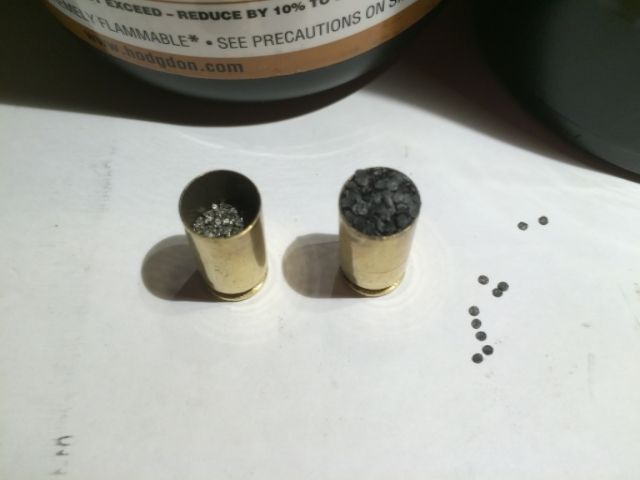
Here's a picture of a double charge of Titegroup (8.4g) vs a double charge of Unique (12g)
Comment
-
180gr risky? That's odd. My local club does bear creek group buys 2x a year. I asked which to order 200gr or 180gr and the guy putting the buy together said 90,000 180gr were ordered last year while 7,000 200gr were ordered. Most uspsa shooters are using 180gr.
Patience and the right powder is a reloaders motto.
I'd run a lock out die to warn for double or no charges.Comment
-
If your cheap Lee setup is a single stage. Get a loading block. I size & prime and place them in the loading block mouth down. That makes it easy to see that each is primed and the primer is fully seated. Next I flip them over and put in the powder (with a funnel if I'm using the Lee scoops or measuring each charge - or one by one If I'm using my RCBS powder measure). Once they are all back in the block I visually check that each has a charge and that the charges are all the same height to assure there are no doubles (a flashlight helps). Next seat, crimp and you're done. If your set-up is a progressive run it as a single stage until you learn the art of reloading. The thing most people have problems with is cycling the handle fully each time. Set your dies so you feel it cam a little over center and get use to that feel each time and your ammo will be consistant.
Yes the 40 is a "high intensity" round - but there is no load in any published book that will blow your gun up.Comment


There are currently 10473 users online. 107 members and 10366 guests.
Most users ever online was 239,041 at 10:39 PM on 02-14-2026.


Comment