Unconfigured Ad Widget

Collapse

Ammo storage and temperature fluctuations

Collapse
X
 
  • Time
  • Show
Clear All
new posts
  • gman183
    Member
    • Apr 2006
    • 295

    Ammo storage and temperature fluctuations

    Hello,

    I have run out of room in my safe and am forced to store some (lots...!) of ammunition in the garage. All ammunition is in sealed metal GI ammo cans.

    I have thousands of dollars invested in this ammo and rely on it for hunting, defense and preparedness.

    My question is, will the fluctuations in temperature and humidity effect its life span, reliability or accuracy?

    I have heard somewhere that temperature fluctuations effect the primers although have zero facts to back that up.

    If any of you have any solid facts t answer the above questions if really like your advice.

    Thanks!
  • #2
    opos
    In Memoriam
    • Oct 2009
    • 1597

    I think the question is "how long do you plan to store it"?...Milsurp ammo is still sitting in warehouses with no climate control all over the world and stuff 50 years old or older is still being shot every day...I did a little "informal research" on the internet and I store a reasonable amount of ammo in the garage in San Diego...it was well over 100 in that garage yesterday...I store it in GI ammo cans with desicant packs and also in a safe that is fireproof and insulated pretty well. I never store powder or primers in that environment.

    I've been told that humidity is the big killer of loaded ammo causing corrosion, etc...I've got some ammo that belonged to a life long reloader and when he passed his wife gave a bunch of it to me...I broke most of it down but did shoot a little...all shot fine and what I broke down was in no way damaged..powder looked and smelled fine..didn't deprime the brass...just reloaded the primed brass and it's all fired fine. YMMV but I think loaded ammo that is in containers that don't sweat and has dessicant packs in it will probably be for sale at my estate sale when I move on and be fine to shoot.
    God and the Constitution give me my rights and actions...any other input is just blabbering.

    Comment

    • #3
      highpower790
      Veteran Member
      • Jun 2013
      • 3481

      How the ammo is stored is the key.I have ammo dating back to the 30s that looks like it just came out of the factory.Take care of it for the long term,it will be ready when you are.
      Keep it simple!

      Comment

      • #4
        gman183
        Member
        • Apr 2006
        • 295

        Great info. Ok thanks

        Comment

        • #5
          baih777
          CGN/CGSSA Contributor
          CGN Contributor
          • Jul 2011
          • 5680

          Ammo in ammo cans have been good for me. Some has been stored for almost 30 years. I am now rotating it out and with new ammo. Even aluminum cased blazer cased ammo. Zero oxidation. But in our current weather conditions , I have been running a fan on 24hrs. In the garage.
          Been gone too long. It's been 15 to 20 years since i had to shelf my guns. Those early years sucked.
          I really miss the good old Pomona Gun Shows.
          I'm Back.

          Comment

          • #6
            LynnJr
            Calguns Addict
            • Jan 2013
            • 7958

            Trying not to get too specific.
            Powder out gases and loses weight over time. Primers have a cup that gets filled with a liquid priming compound.
            In both situations if you keep them at a even temperature they will last a long time.

            If they are cycled in temperature over extended periods of time the out gasing can push the bullet outwards.
            It can also break down the powder like rain does to asphalt when it freezes.

            On the primers if a air pocket gets formed during manufacturing and the temperature cycles a lot there is the possibility it will knock the priming compound away from the anvil and cause a fail to fire.
            Most ammo storage stories relate to the military where the ammo can be on a iceberg one week and in a desert the next.
            Any ammo problem that produces a squib load takes that firearm out of the battle.
            Lynn Dragoman, Jr.
            Southwest Regional Director
            Unlimited Range Shooters Association (URSA)
            www.unlimitedrange.org
            Not a commercial business.
            URSA - Competition starts at 2000 yards!

            Comment

            • #7
              M27
              Senior Member
              • Apr 2011
              • 871

              Is there anywhere in the house to store them. Bottom of closets, under beds, behind the couch?

              The worry I have with ammo cans with temp swings is that the external change can cause condensation in the can causing the bottom inch to possibly rust.
              I will share my opinion and my load data, BUT I am just a guy with too many cigars and too many guns. Whatever I say is probably wrong.

              Comment

              • #8
                highpower790
                Veteran Member
                • Jun 2013
                • 3481

                Originally posted by M27
                Is there anywhere in the house to store them. Bottom of closets, under beds, behind the couch?

                The worry I have with ammo cans with temp swings is that the external change can cause condensation in the can causing the bottom inch to possibly rust.
                Place a bag of desicant in ammo can,and keep home as temp stable as possible.
                Keep it simple!

                Comment

                • #9
                  slamfire1
                  Banned
                  • Aug 2015
                  • 794

                  My question is, will the fluctuations in temperature and humidity effect its life span, reliability or accuracy?
                  Google "Insensitive Munitions" and look at all the conferences, papers, that pop up. Gunpowder has a shelf, a very unpredictable shelf life, which is why people are shooting decades old ammunition and not having problems. There are other people who shoot decades old ammunition and have their guns blow up. By and large, the shooting community does not want to believe that old ammunition is unsafe, or could be unsafe, because there are lots of people sitting on piles of old ammunition, and their expectations were that the stuff would last forever.

                  First of all, understand that gunpowder has a shelf life. This is a high energy compound that is breaking down, from day one, to a low energy compound. Our gunpowders are either nitrocellulose or nitrocellulose & nitroglycerine. The nitroglycerine is there basically for the energy boast. Because nitroglycerine attacks the double bonds on nitrocellulose the lifetime of double based powders is less than half that of single based. Stabilizers are mixed with the nitrocellulose/nitroglycerine as a sacrificial compound: stabilizers soak up the nitric acid gas that is created when nitrocellulose deteriorates. When the stabilizer gets low , gunpowder is extremely unstable and unsafe. In quantity it will auto combust and the burn rate is irregular. Burn rate instability has and will blow up firearms.

                  A good rule of thumb is that single base powders will last 45 years and double based 20 years. Like all rules of thumb this is wrong more often than it is right.

                  This thread has really excellent pictures:

                  Has anyone else had Vihtavuori N140 corrode in loaded ammo?


                  Notice that the gunpowder is only around 25 years old and yet people are experiencing nasty corrosion due to nitric acid gas release from the gunpowder. It was not that long ago that 20 years was considered the shelf life of gunpowder.

                  Army Ordnance Magazine, May 1931, Safety Hazards, Picatinny Arsenal

                  Smokeless powder constitutes one of the greatest hazards from a storage standpoint, due to the fact that is subject to deterioration and at the best cannot be expected to have a life greater than about twenty years
                  The worst enemy of gunpowder is heat. The lifetime of gunpowder is reduced exponentially with increases in temperature. This chart came from a UN manual on ammunition inspection. Section 7.3 is well worth reading

                  Surveillance and in-service proof - the United Nations
                  Page not found The page you requested was not found. Please check the URL to make sure you entered it correctly. You can use our Search or visit the UN Home page. La page demandée n'a pas été trouvée à l'adresse indiquée. Vérifiez que l'adresse de la page est correcte. Effectuez une recherche ou aller sur la page d'accueil.


                  If you can read a table, it becomes evident that keeping gunpowder cool is the most important issue about shelf life. Heat breaks down gunpowder, the higher the storage temperature, the faster gunpowder breaks down. Exposure to water is bad, even though water is a polar covalent molecule, it acts ionic. All ionic compounds break gunpowder down.. I think that may be a reason why gunpowder now comes in plastic cans, the tin cans released rust into the powder and that accelerated powder breakdown. Water is in air, so it is best to keep gunpowder cans sealed.


                  As for what industry says the lifetime of ammunition, this comes from Federal's website:


                  What is the shelf life of ammo and storage?
                  Store reloading components and ammunition in a cool, dry place, protected from direct exposure to sunlight. If stored properly there is a 10-year shelf life on loaded ammunition.
                  Federal is being ultra conservative, but on the other hand, they have a liability in this matter. You have people storing ammunition in their hot cars, or their hot attics, either storage condition, and that greatly reduces the shelf life of gunpowder.

                  As for military surplus, people shooting military surplus don't realize that a trained Ammunition Specialist went through that pile of ammunition, tested it per procedures, and per his procedures, determined that it was either just about to become to dangerous to store, or just about to become too dangerous to shoot.

                  Ammunition Surveillance Procedures SB 742-1


                  Chapter 13 Propellant and Propelling Charges ,
                  page 13-1
                  WARNING
                  Nitrocellulose-based propellant can become thermally unstable as the age. The normal aging process of the propellants involves deterioration of the nitrocellulose with an accompanying generation of heat. At some point, the propellant may reach a state where heat is generated faster than it can be dissipated. The accumulation of heat can lead to combustion (autoignition). Chemical stabilizers are added to propellants to slow the aging process. In time, the stabilizer levels will drop to a point where the remaining effective stabilizer (RES) is not sufficient to prevent an accelerating rate of decomposition. When this point is reached, the propellant may autoignite, with possible catastrophic results to property and life. Monitoring the stability level of each propellant lot is essential for continued safe storage.

                  Page 13-5 , Table 13.2 Propellant Stability Codes.

                  Stability Category A 0.30 or more Percent Effective Stabilizer
                  Acceptable stabilizer loss: safe for continued storage

                  C 0.29-0.20 Percent Effective Stabilizer

                  Significant stabilizer loss. Lot does not represent an immediate hazard, but is approaching a potentially hazardous stability condition. Loss of stabilizer does adversely affect function in an uploaded configuration. Disposition instructions will be furnished by NAR. All stability category “C” assests on the installation must be reported in writing…
                  One year after becoming stability category “C” a sample of the bulk propellant lot or the bulk-packed component lot will be retested. If the lot has not deteriorated to category “D”, it will be retested each year until it has been expended, or it has deteriorated to category “D”, at which point it will be demilitarized within 60 days.

                  D Less than 0.20 Percent Effective Stabilizer

                  Unacceptable stabilizer loss. Lots identified as stability category “D” present a potential safety hazard and are unsafe for continued storage as bulk, bulk-packed components , or as separate loading propellant chargers. Bulk propellant, bulk –packed components and separate loading propelling charges will be demilitarized within 60 days after notification of category “D” status.

                  Comment

                  • #10
                    slamfire1
                    Banned
                    • Aug 2015
                    • 794

                    Shooters don't know, and when you poke at it, don't want to know, about the massive amount of small arms ammunition which are demilled per year. The quantities are pretty mind boggling, 100,000's of tons of the stuff per year. Militaries go through their stockpiles and get rid of the dangerous stuff. It is ironic, that the best source of data on this, is an Anti Gun and Anti War group: Small Arms Survey. Whether or not you care about their politics, the data is gained through open sources.

                    Industrial Demilitarization of Conventional Ammunition


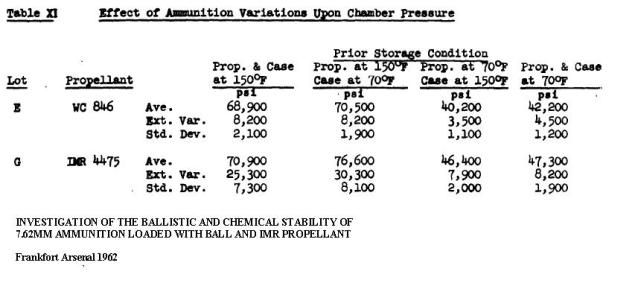
                    There is very little information on the internet about gunpowder aging and causing pressure problems because all that was ever needed to be known was determined well before WW2. However ball powders did come out at the end of WW2 and I was able to find this data showing that gunpowder at the end of its lifetime will pressure spike. Heat is used to accelerate the age of gunpowder, so what you are seeing is in fact because of “age”, not heat, but it took heat to age the powder quickly. The IMR is a single based and the WC is a double based ball powder.

                    INVESTIGATION OF THE BALLISTIC AND CHEMICAL STABILITY OF 7.62MM AMMUNITION LOADED WITH BALL AND IMR PROPELLANT

                    Frankfort Arsenal 1962

                    3. Effects of Accelerated Storage Propellant and Primer Performance

                    To determine the effect of accelerated isothermal storage upon propellant and primer performance, sixty cartridges from each of lots E (WC 846) and G (R 1475) were removed from 150F storage after 26 and 42 weeks, respectively. The bullets were then removed from half the cartridges of each lot and from an equal number of each lot previously stored at 70F. The propellants were then interchanged, the bullets re-inserted, and the cases recrimped. Thus, four variations of stored components were obtained with each lot.

                    Chamber pressures yielded by ammunition incorporating these four variations were as follows. These values represent averages of 20 firings.


                    You can google “surplus ammunition Kaboom” or the equivalent and find a surprising number of reports of firearms that have blown up with old military ammunition. Interesting Pictures in this thread: When Milsurp Ammo Goes Bad


                    Why some powder goes bad quickly and other lasts longer, heck if I know. The strangeness of this can be found in this thread at Post 61. This is Unclenick’s experience and it is worth looking at the picture:


                    Of particular interest to me was the link to the thread on N140. In the early 1990's, my dad got a 1/4 lb free sample container of N140 at Camp Perry, and gave half of it to me. That's about 20 rounds worth in .308; not enough to do serious load development with. I put it in a plastic bottle with a plated and painted steel cap with cardboard seal disc. I left it at the back of a high shelf in the basement where it was out of sight and soon out of mind. Some time later I bought a full pound of N140 to experiment with, but that original 1/4 lb continued to sit.

                    I finally re-encountered the bottle during some cleaning out activity. It looked like this:

                    The powder in it was not powder any longer. The grains were all stuck together. That was the result of the lid seal failing and letting humidity in. The acid fumes corroded the lid out. Rinse water put over it poured out yellow. At that point I cut the container open and buried the wet mass under the compost heap to let nature take its course.

                    Interestingly, the remaining 1/8 lb still at my father's place (also untouched)


                    If you have old ammunition and experience pressure issues, stop shooting the stuff. Pull the bullets, dump the powder, examine the cases. If the cases are OK, no case neck splits, no pin hole corrosion, no inside the case corrosion, then reload the things with fresh gunpowder.

                    So to summarize, powder does not get better with age, heat ages powder fast, old gunpowder will blow up your firearm. Anyone with a $100,000 dollar irreplaceable machine gun should seriously consider the practice of shooting cheap surplus military ammunition. Machine gunners shoot orders of magnitude more ammunition than most people, so as they are burning through a pallet of surplus ammunition, they are more likely to find that statistically improbable bad round. A machine gunner bud of mine told me he had “blown the top cover twice” with 50’s Yugo 8mm. After I told him about pressures and old ammunition, he said it all made sense. If however, that cheap surplus ammunition had wrecked the registered part of the machine gun, his machine gun would have been a total loss. The BATF is not your friend in this matter as the policy of the Federal Government is to reduce the number of machine guns in the hands of the public. You blow yours up, guess what, that is considered a good thing, and you have to find another to replace the one you destroyed.

                    As a postscript, primers last orders of magnitude longer than gunpowder.

                    Comment

                    • #11
                      glock_this
                      Calguns Addict
                      • Dec 2005
                      • 8225

                      All of my ammo is in (1) military grade ammo cans w/ good seals with (2) numerous desiccant packs in each can.

                      You can buy desiccant packs, but over the years, I have collected hundreds of them out of items you buy every day from pills to clothing to electronics, etc. I just keep them whenever I get them.
                      10 +1 in the chamber

                      Comment

                      • #12
                        Rickrock1
                        CGN/CGSSA Contributor
                        CGN Contributor
                        • Jan 2012
                        • 5158

                        I have been storing ammo in my garage in ammo cans for over 20 years with zero problems.
                        the key is to keep it dry, in So CA. we shouldn't have any problems
                        sigpic

                        Comment

                        • #13
                          LynnJr
                          Calguns Addict
                          • Jan 2013
                          • 7958

                          Slamfire1
                          Great post!!!
                          I didn't want to get to technical but your post should answer any questions.
                          Keep powder/ammo away from too much heat and your all set.
                          Lynn Dragoman, Jr.
                          Southwest Regional Director
                          Unlimited Range Shooters Association (URSA)
                          www.unlimitedrange.org
                          Not a commercial business.
                          URSA - Competition starts at 2000 yards!

                          Comment

                          • #14
                            slamfire1
                            Banned
                            • Aug 2015
                            • 794

                            Slamfire1
                            Great post!!!
                            I didn't want to get to technical but your post should answer any questions.
                            Keep powder/ammo away from too much heat and your all set.
                            Thanks. Until I ran into a Naval Insensitive Munitions expert I was as clueless as anyone else about ammunition lifetime and propellant thermodynamics. I, like the rest of the community, through articles in the popular press, had been lead to believe that ammunition is immortal. Well it is not so. In fact, it is far from so.

                            I do want people to be aware of the indications of aging, understand why gunpowder ages, and not to shoot old ammunition that is giving high pressure indications. Also I want to provide enough information for people to be smart shoppers. Don't pay a premium for old ammunition and old gunpowder. It is not as good as new and it won't last as long as new.

                            Comment

                            • #15
                              SonofWWIIDI
                              I need a LIFE!!
                              • Nov 2011
                              • 21583

                              If I hadn't lost all that ammo with my guns in the tragic CG boating accident, I'm pretty sure it would have outlived me...if I didn't shoot it all first. But you do still have to be careful about storage.

                              If you own a house, make your wife take her shoes and purses out of one of the closets and make it an ammo closet.

                              Indoor, temperature controlled will probably give it the longest life.
                              Sorry, not sorry.
                              🎺

                              Dear autocorrect, I'm really getting tired of your shirt!

                              Comment

                              Working...
                              UA-8071174-1