

 Tweet
Tweet
Ok people,
Here is a thought….
Air rifles can be converted into real firearms; it is regularly done in countries which have severe limitations on the ownership of firearms. Most conversions consist of taking a standard break action spring powered air rifle and converting the spring piston into a bolt with a small firing pin attached and boring a .22LR chamber using a 15/32 drill bit.
Its crude, but it works better than a standard air rifle would and puts small game on the table.
However… converting air rifles into conventional firearms is a bit of a hassle, requires decent tooling and would (in our state) qualify as a zip gun.
How then can we extract more knock down power from our air guns?
According to a study I read (sorry I don’t have a link, It was late and I didn’t save it) the accidental dieseling which occurs in standard air rifles as a result of flammable lubricants being compressed can provide up to 30% of the muzzle energy realized by the pellet. In fact a firearm platform which used this phenomenon as an ignition system was the Daisy VL, which compacted nitrocellulose against the base of a .22 bullet with no casing and used a high powered piston to compress air and ignite the propellant.
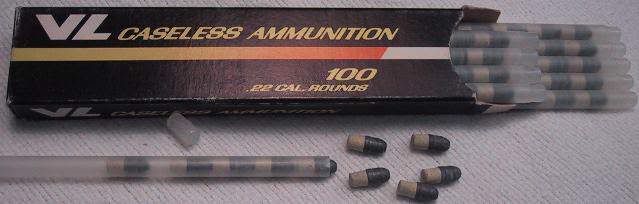
It worked great, but did not catch on and was only manufactured from the late sixties until the early 80’s (you can still buy them along with ammo but it costs a little more than standard rim fire rounds)
The purposely induced dieseling effect (as well as the resultant explosion of the propellant) in the VL system required the design to be much more robust than a standard air gun, as the sharp pressure spike of even the dieseling by itself in modern air guns can be enough to blow the seals and damage the mechanism.
It is because of the delicate internal nature that air guns cannot be simply converted to .22 VL by cramming a round of Daisy VL ammo into the bore (or reaming a chamber into the gun). The detonation would rapidly damage the rifle, and possibly injure the shooter since the gasses would be directly impinging on the piston and seals of the rifle itself. (on the .22LR converted air guns the brass of the .22LR case works along with the modified bolt to seal and contain the gasses)
So, in order for propellant to be added to a standard pellet, it would have to be slow burning, clean and relatively low pressure. This, in a standard rifle design, would mean that any improvement as a result of the propellant addition would be modest at best.
So…. We need to think outside the box… we need a low pressure slow burning propellant which can be added to the back of a lead projectile, but which will accelerate the projectile up to supersonic speeds to aid in the kinetic energy transfer at longer ranges.
We need a Gyro jet!
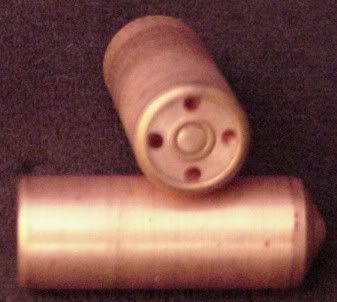
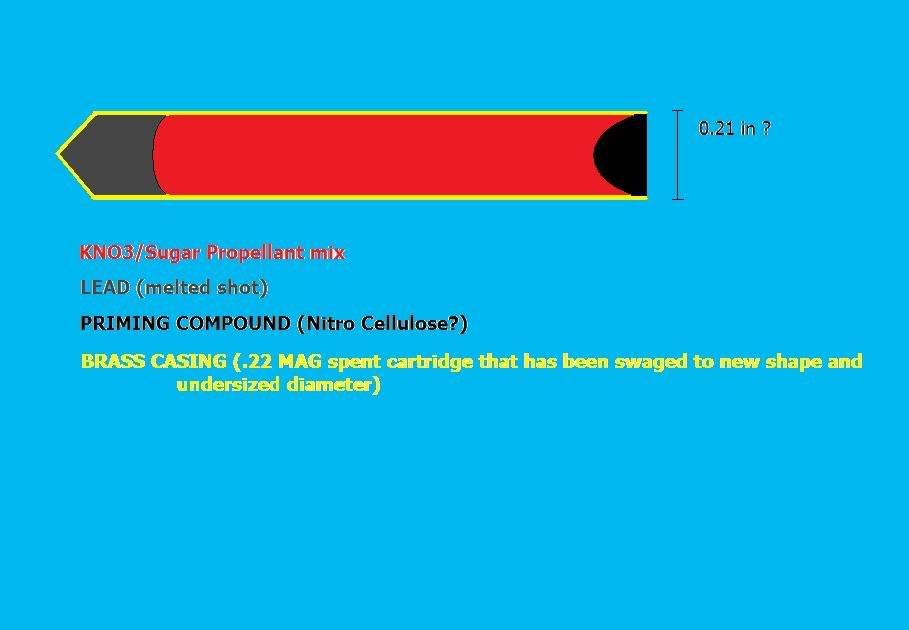
We can fashion an outer casing from an expended .22 Magnum casing and swag it into shape using a modified bullet jacket swaging tool (they make ones already which turn .22LR casings into .224 diameter casings, so with some slight modification to the shape and diameter it would be easily possible to make one which fit without issue into a standard .22 Air gun bore.
Since the brass itself is not heavy enough to inflict much damage, we can take a few balls of lead shot and put them in the swaged casing, heating them with a small torch until they melt, evenly filling the tip of the projectile.
The main portion of the casing can be packed with either a KNO3 and sugar compound (rocket fuel) or an alternative clean burning solid propellant. Once tamped in place a combination sealant and priming compound (not sure what would work best yet, possibly nitrocellulose) can be added to cap off the round and aide in ignition.
The resulting round could be loaded into a standard .22 cal air rifle (or a more specialized platform could be developed later on) and upon firing, the blast of hot air generated by the spring piston would ignite the priming compound and fuel mixture which would have the effect of both eliminating vacuum drag (like a bottom depleting tank round) and increasing acceleration past the supersonic threshold.
Unlike the gyro jet , since the actual spin would only be imparted to the round by the rifling engaging the casing, it would be able to avoid some of the problems that the original gyro jet had as a result of clogged vents sending stray rounds off course.
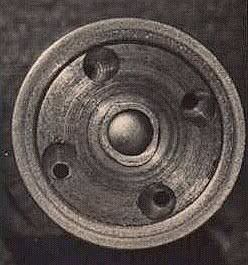
Anyone want to make a prototype? I can’t do it where I’m at… NYC would Sh*t a brick sideways if I tried to play with this stuff here.
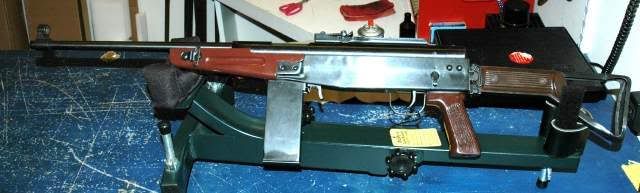
I think I can modify this pelet gun to take these rounds and feed from the magazine.
Here is a thought….
Air rifles can be converted into real firearms; it is regularly done in countries which have severe limitations on the ownership of firearms. Most conversions consist of taking a standard break action spring powered air rifle and converting the spring piston into a bolt with a small firing pin attached and boring a .22LR chamber using a 15/32 drill bit.
Its crude, but it works better than a standard air rifle would and puts small game on the table.
However… converting air rifles into conventional firearms is a bit of a hassle, requires decent tooling and would (in our state) qualify as a zip gun.
How then can we extract more knock down power from our air guns?
According to a study I read (sorry I don’t have a link, It was late and I didn’t save it) the accidental dieseling which occurs in standard air rifles as a result of flammable lubricants being compressed can provide up to 30% of the muzzle energy realized by the pellet. In fact a firearm platform which used this phenomenon as an ignition system was the Daisy VL, which compacted nitrocellulose against the base of a .22 bullet with no casing and used a high powered piston to compress air and ignite the propellant.
It worked great, but did not catch on and was only manufactured from the late sixties until the early 80’s (you can still buy them along with ammo but it costs a little more than standard rim fire rounds)
The purposely induced dieseling effect (as well as the resultant explosion of the propellant) in the VL system required the design to be much more robust than a standard air gun, as the sharp pressure spike of even the dieseling by itself in modern air guns can be enough to blow the seals and damage the mechanism.
It is because of the delicate internal nature that air guns cannot be simply converted to .22 VL by cramming a round of Daisy VL ammo into the bore (or reaming a chamber into the gun). The detonation would rapidly damage the rifle, and possibly injure the shooter since the gasses would be directly impinging on the piston and seals of the rifle itself. (on the .22LR converted air guns the brass of the .22LR case works along with the modified bolt to seal and contain the gasses)
So, in order for propellant to be added to a standard pellet, it would have to be slow burning, clean and relatively low pressure. This, in a standard rifle design, would mean that any improvement as a result of the propellant addition would be modest at best.
So…. We need to think outside the box… we need a low pressure slow burning propellant which can be added to the back of a lead projectile, but which will accelerate the projectile up to supersonic speeds to aid in the kinetic energy transfer at longer ranges.
We need a Gyro jet!
We can fashion an outer casing from an expended .22 Magnum casing and swag it into shape using a modified bullet jacket swaging tool (they make ones already which turn .22LR casings into .224 diameter casings, so with some slight modification to the shape and diameter it would be easily possible to make one which fit without issue into a standard .22 Air gun bore.
Since the brass itself is not heavy enough to inflict much damage, we can take a few balls of lead shot and put them in the swaged casing, heating them with a small torch until they melt, evenly filling the tip of the projectile.
The main portion of the casing can be packed with either a KNO3 and sugar compound (rocket fuel) or an alternative clean burning solid propellant. Once tamped in place a combination sealant and priming compound (not sure what would work best yet, possibly nitrocellulose) can be added to cap off the round and aide in ignition.
The resulting round could be loaded into a standard .22 cal air rifle (or a more specialized platform could be developed later on) and upon firing, the blast of hot air generated by the spring piston would ignite the priming compound and fuel mixture which would have the effect of both eliminating vacuum drag (like a bottom depleting tank round) and increasing acceleration past the supersonic threshold.
Unlike the gyro jet , since the actual spin would only be imparted to the round by the rifling engaging the casing, it would be able to avoid some of the problems that the original gyro jet had as a result of clogged vents sending stray rounds off course.
Anyone want to make a prototype? I can’t do it where I’m at… NYC would Sh*t a brick sideways if I tried to play with this stuff here.
I think I can modify this pelet gun to take these rounds and feed from the magazine.


Comment