

 Tweet
Well, he was alive in Martin Luther King Jr's day. In fact, he was often alongside him. That is part of the origin to his claim to fame, and there are plenty of photos to prove it. However Jackson's emoting and professing it for self generated attention, continuously cheapens it. He often feels the need to prove to people that he too was also within a few feet (below the balcony) of the famous "pointing to the the window" photo of several people standing on the second story balcony just outside room #306 of the Lorraine Motel, where King had been staying, also in the crowd that was indicating where shots originated from James Earl Ray. I admire everything about Martin Luther King Jr., and I can't stand the way Jesse Jackson uses him and his history for self-gain, like a marketing tool.
Jackson most certainly was there, as photographic proof shows he was there that day. There are other photos of him with King that same day at the hotel. It seems that is not sensational enough for Jesse Jackson. I think if it was in his power, he might wish to have pleaded the press for a photo of himself holding King as he lay dying, while Jesse mugged for the camera with blood on his own hands, striking a pose with a tragic cry to the sky - just for the photo op.
Jackson has publicly more than once reminded people "I was there too" as if he regrets he did not get a photo op to be included in the famous "pointing" photo or did not get a chance to mug for cameras at the moment of the shooting. He continues to remind everyone "he was under the balcony" in the famous pointing photo.
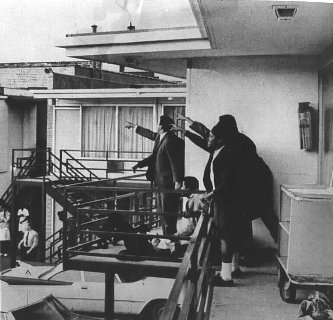
It's so sad then he felt a need to get this photo below, taken many years later, as if to re-create that horrible moment, and make people re-live the moment, all for a Jesse Jackson photo-op re-staging of the "pointing" photo, but showing himself as a "pointer". What's the point?


This sums up Jackson's association with Martin Luther King Jr. rather well, without sarcasm:
Joined King and the SCLC in 1965
Jackson most certainly was there, as photographic proof shows he was there that day. There are other photos of him with King that same day at the hotel. It seems that is not sensational enough for Jesse Jackson. I think if it was in his power, he might wish to have pleaded the press for a photo of himself holding King as he lay dying, while Jesse mugged for the camera with blood on his own hands, striking a pose with a tragic cry to the sky - just for the photo op.
Jackson has publicly more than once reminded people "I was there too" as if he regrets he did not get a photo op to be included in the famous "pointing" photo or did not get a chance to mug for cameras at the moment of the shooting. He continues to remind everyone "he was under the balcony" in the famous pointing photo.
It's so sad then he felt a need to get this photo below, taken many years later, as if to re-create that horrible moment, and make people re-live the moment, all for a Jesse Jackson photo-op re-staging of the "pointing" photo, but showing himself as a "pointer". What's the point?
This sums up Jackson's association with Martin Luther King Jr. rather well, without sarcasm:

Joined King and the SCLC in 1965
Jackson joined Martin Luther King, Jr., and his Southern Christian Leadership Conference (SCLC) in 1965 during demonstrations in Selma, Alabama, pushing for expanded voting rights for blacks. When the SCLC launched the Chicago Freedom movement in 1966, Jackson was there to put his knowledge of the city and contacts within the black community to work for King. He organized local ministers to support the movement, marched through all-white neighborhoods to push for open housing, and began work on the SCLC's economic program, Operation Breadbasket. Drawing from successful campaigns in other cities, Operation Breadbasket organized the black community to use selective buying and boycotts to support black manufacturers and retailers and to pressure white-owned businesses to stock more of their products and hire more black workers. Jackson served as Operation Breadbasket's Chicago coordinator for one year and was then named its national director. Under Jackson's leadership the Chicago group won concessions from local dairies and supermarkets to hire more blacks and stock more products from black businesses. It encouraged deposits from businesses and the government for black-owned banks and organized a Black Christmas and a Black Expo to promote black-owned manufacturers.
In addition to his SCLC activities, Jackson led a number of other campaigns in his adopted home city and state. In 1969 and 1970 he gathered Illinois's malnourished and led them on a march to the state capital to raise consciousness of hunger. He led a similar event in Chicago. The state responded by increasing funding to school lunch programs, but Mayor Richard Daley's machine in Chicago was less cooperative. The mayor's power and resistance to change, as well as an Illinois law that raised difficult barriers to independent candidates, prompted Jackson to run for mayor of Chicago in 1971. He was not successful; some believe, however, that his efforts laid the foundation for Harold Washington's successful bid to become Chicago's first black mayor in 1983.
In 1971 Jackson resigned from the SCLC to found his own organization, People United to Save Humanity (PUSH). Because of his aggressive, impatient, and commanding personality, Jackson had long irritated SCLC leadership; and, in the three and a half years after King's assassination, he had offended others with his public antics to secure a role as leader of the Civil Rights movement and his feuds with Ralph D. Abernathy, King's successor as president of the SCLC, over leadership, policy, and funding.


Comment