Unconfigured Ad Widget

Collapse

Cylinder conversion service?

Collapse
X
 
  • Time
  • Show
Clear All
new posts
  • JWil
    Member
    • Nov 2020
    • 340

    Cylinder conversion service?

    I have been carrying my 10-14 for hiking and camping since I've had it, and recently been looking at the power difference between 38spl and 357, or hell 38spl and 9mm.
    I picked up some 38 super +p, which runs the same or higher pressure than normal 357, and just got back from the range firing it, so I know it will handle it in an emergency "the chihuahua is biting me" situation.

    Buying a new pistol is out of the question for me right now.

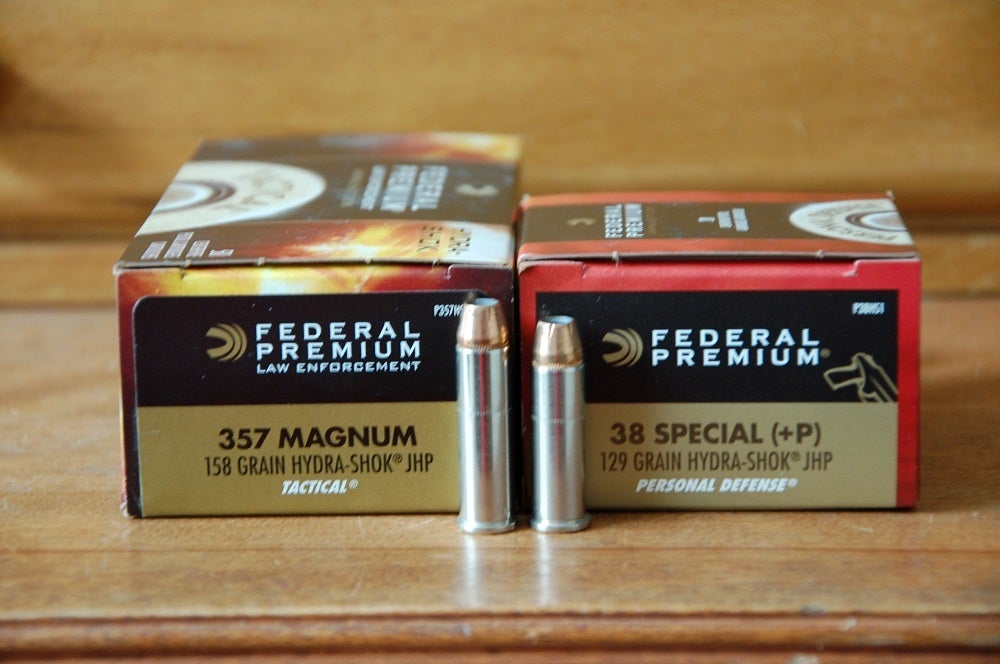
    Does anyone know anyone who is willing to ream out the chamber of my 38 a little longer to fit 357 in it? I have measured the cylinder and a 357 is shorter than the OAL.
  • #2
    ojisan
    Agent 86
    CGN Contributor
    • Apr 2008
    • 11787

    You are probably not going to find a gunsmith who will ream your chambers because of liability reasons.
    That leaves you with buying a reamer and doing it yourself.

    S&W upgraded their cylinder and frame heat treat process in the mid 1950s.
    K frames made prior to that time should be used with standard pressure .38 Special.
    Made after then .38+P is OK.
    Your 10-14 is a later type.
    Exact date of improved treatment will vary by model as S&W used up old parts first after WW II.
    The question is, did S&W do anything different with their use of materials or heat treat when going from the Model 14 .38 to the Model 19 .357?
    You don't want to be worried about gun damage or injury every time you shoot it.

    Many "proof" rounds for gun safety testing are double the standard pressure.
    The fact that your gun could withstand a proof level load or two does not mean it will do it forever.

    Rambling on some more, the Model 19 cylinder is a little longer than a 14.
    S&W did not want people dropping .357 cylinders in .38 frames.
    Could be just marketing, could be other reasons.
    You also need some throat at the end of the chambers so even if a .357 round is shorter than the cylinder, is the cylinder going to have enough throat length?

    I fully understand the idea of the rechamber, newer S&W .38 Special J frames like the 642 have had longer .357 length frames and cylinders for years now and I happen to like both .357 and J frames.
    I have considered this but decided against it.
    It's tempting but that's what my Ruger SP-101 is for.

    You could probably sell your Smith and get a .357 Taurus instead if you really want the .357 round and safely.


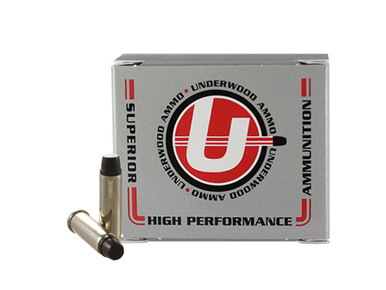
    It's so much easier to just get some Buffalo Bore or Underwood .38 Special + P hot loads.
    Looks like the selection is a little thin right now but the BB 158g at 1250 should suffice.
    Heavy 38 Special + P Field Proven pistol and handgun ammo. Maximum firepower ammunition. Best ammunition for pistols and handguns for sale. Buffalo Bore. Strictly big bore. Strictly Business.


    Underwood has one too plus other options:
    Underwood Ammo offers the most comprehensive and innovative Underwood Ammo™ Supersonic Handgun Ammo for personal defense & hunting. Shop now .38 Special +P Lead ammo with Hi-Tek Coated Hard Cast.


    If you really want .357 and .38 interchangeability, you need to get a revolver chambered in .357.

    Originally posted by Citadelgrad87
    I don't really care, I just like to argue.

    Comment

    • #3
      eaglemike
      CGN/CGSSA Contributor - Lifetime
      CGN Contributor - Lifetime
      • Jan 2008
      • 4002

      Pretty much as above, would not recommend reaming the cylinder to accept .357.
      Suggest finding 110 grain .38+p, or other lightweight +p stuff. There was some pretty serious CorBon stuff years ago that was nice. Looks like they are still in business. Use that if needed for defense. If you don't already reload, start to do that. Mild .38 stuff is great for practice, and IMHO it's the easiest cartridge to reload. Good luck!
      There are some people that it's just not worth engaging.

      It's a muzzle BRAKE, not a muzzle break. Or is your muzzle tired?

      Comment

      • #4
        slamfire1
        Banned
        • Aug 2015
        • 794

        Originally posted by ojisan
        You are probably not going to find a gunsmith who will ream your chambers because of liability reasons.
        That leaves you with buying a reamer and doing it yourself.

        S&W upgraded their cylinder and frame heat treat process in the mid 1950s.
        K frames made prior to that time should be used with standard pressure .38 Special.
        Made after then .38+P is OK.

        The question is, did S&W do anything different with their use of materials or heat treat when going from the Model 14 .38 to the Model 19 .357?
        I like your post, well though out. S&W won't tell, but there are differences in things that I did not think of, such as forcing cone angles.

        Many "proof" rounds for gun safety testing are double the standard pressure.
        The fact that your gun could withstand a proof level load or two does not mean it will do it forever.
        Proof testing is an archaic test method, might have made sense in the 1700's through 1850's, maybe even up to the 1920's. But no firearm should fail a 30% over test. But a 30% over test will not reveal latent defects that show up later, and continued cycling of over pressure rounds will cause fatigue fracturing, which will lead to fatigue failure. I am 100% certain that a cylinder built of materials safe for a 38 Special, and heat treated to an appropriate strength, for 38 Special pressures, will not survive many 357 loads. Heat treatment for toughness will give a longer service life, but the material will be softer and the yield strength will be less. Heat treatment for "strength" will make a harder cylinder with a lower fatigue lifetime. Only S&W knows the materials and heat treatments they use on their cylinders.


        You could probably sell your Smith and get a .357 Taurus instead if you really want the .357 round and safely.

        If you really want .357 and .38 interchangeability, you need to get a revolver chambered in .357.
        Good advice, the best way to go.

        Comment

        • #5
          splithoof
          Calguns Addict
          • May 2015
          • 6161

          No gunsmith worth talking to would agree to that modification.
          The liability alone makes that a definite NO.
          The manufacturer has clearly stated the limits of that model; going off the farm in that case is a bad plan.
          Member ojisan has summed up the technical issues very well in addition.

          Comment

          • #6
            P5Ret
            Calguns Addict
            • Oct 2010
            • 6406

            I'd suggest you stop looking at numbers, and work with what you have until funds free up to up your game. If the .38 is what you've got to work with for hiking in the woods I'd suggest these https://www.lehighdefense.com/ammo/3...tor-ammunition. They're a pricey and hard to find, but should do OK with most any threat in the woods of CA. Although 2 legged threats are going to to be much more common than the 4 legged variety.

            As everyone has said don't mod the gun to do something it's not supposed to do, if you can find someone willing to do it, the risk isn't worth the small gain.

            Comment

            • #7
              003
              Veteran Member
              • Jul 2010
              • 3436

              [QUOTE=JWil;25817577]"I have been carrying my 10-14 for hiking and camping since I've had it, and recently been looking at the power difference between 38spl and 357, or hell 38spl and 9mm.
              I picked up some 38 super +p, which runs the same or higher pressure than normal .357, and just got back from the range firing it, so I know it will handle it in an emergency "the chihuahua is biting me" situation."

              While it is not my intention to be critical, your information/conclusions are neither accurate or safe.

              .38 super +P is not the same as .38 special +P. .38 super is a pistol round, while .38 special is a revolver round, completely different. It appears you may have confused the two rounds in your research.

              .38 Special: 17,000 psi (std.); 20,000 psi (+P) = 17% increase in pressure
              9x19mm: 35,000 psi (std.); 38,500 psi (+P) = 10% increase in pressure
              .38 ACP/.38 Super: 26,500 psi (.38 ACP); 36,500 psi (.38 Super +P) = 38% increase in pressure
              .45 ACP: 21,000 psi (std.); 23,000 psi (+P) = 9.5% increase in pressure

              Click on the below link:


              An inquiry came recently asking about a toe-to-toe comparison between the hyper +P 38 Special and the 357 Magnum. One would initially think there is no reasonable comparison, but the investigation was worth the effort regardless. For cartridge nuts, it is always fun to roll the dice just to see what turns up. The old …


              There are some very effective .38 Special +P rounds on the market, that should meet your needs. Take at look at the 110 or 125 grain hollow point, very effective.
              Last edited by 003; 05-31-2021, 11:55 AM.

              Comment

              • #8
                BajaJames83
                Calguns Addict
                • Jun 2011
                • 6047

                You cant safely go from 38 special to 357mag the pressures are too high.
                NRA Endowment Life Member
                USMC 2001-2012

                Never make yourself too available or useful...... Semper Fidelis

                John Dickerson: What keeps you awake at night?
                James Mattis: Nothing, I keep other people awake at night.

                Comment

                • #9
                  McGuiver
                  Senior Member
                  • Feb 2016
                  • 1022

                  I've read elsewhere that some time in the recent past, Alliant recommended against using Blue Dot for 357 loads with the 125 gr. JHP. Apparently it can damage revolvers. I saw nothing on whether this only applied to maximum loads or the type of damage that occurred. I could not find this...


                  SAMI SPECS

                  38 Special - 17,500 PSI

                  38 Special + P - 20,000 PSI

                  357 MAG - 35,000 PSI

                  I think you will hand grenade that gun. Make sure you only shoot it from a Ransom rest...


                  So, what's the deal with 38 special vs. 357 mag chamber pressures? How come modern 38 special revolvers are rated (or are they??) for much lower pressure when a gun of the same vintage, with the same exact same frame size, and a cylinder of the same exact diameter and chamber-to-chamber web...


                  Sent from my iPhone using Tapatalk Pro
                  Last edited by McGuiver; 05-31-2021, 3:03 PM.

                  Comment

                  • #10
                    JWil
                    Member
                    • Nov 2020
                    • 340

                    So, re getting super and special confused - no, I have the box on my nightstand, it's magtech 130 grain 38 super plus p.

                    From what I've read it seems like 38 super runs at 36+K PSI (the modern plus p load not the older 38 auto load), 9mm runs at 34+K PSI, and 357 at 35+K PSI which is lower than the past 40K. So my confusion is - why are 9mm conversions popular and not in the danger zone of liability for k frame if you can reach similar pressure in a 9mm? Not saying I'm using this as a reason to go ahead and ream but I am curious about.

                    Buying a new gun won't be an option for the next 2 years as I got into a 2 year gunsmithing course which will cut down my hours at my part time, and what money I do make will go to procuring firearms for the class. With that said - since some have suggested selling the 10 and buying a 357 - does anyone want a basically new 10 - 14? Lol. It seems like I'm the only one dumb enough to actually pay new retail for a model 10. Granted it is a brand new gun, or was when I got it this year, but I mean I shouldn't think I'm going to recoup much on it.

                    Honestly if I could find the Lehigh rounds in stock anywhere I wouldn't even be talking about this conversion. I just got to the legal age to buy guns and the funds to do so right at the wrong time.

                    Comment

                    • #11
                      003
                      Veteran Member
                      • Jul 2010
                      • 3436

                      JWIL:

                      It is obvious you do not understand the difference between .38 super and .38 special. The .38 super is a semi rimmed cartridge that was designed to be fired from a semi automatic pistol, ie. the 1911. The .38 special is a fully rimmed cartridge designed to be fired from a revolver. Given that the .38 super is semi rimmed, as opposed to truly rimless like most pistol rounds does not mean it can be safely fired from a revolver designed for the pressure of a .38 special.

                      The .38 Super began life in 1900 as the .38 Automatic. In fact, the .38 Super is officially known as the .38 Super Automatic +P. The .38 Super is a powerful, high pressure-loaded version of the .38 Automatic. When John Browning designed the .38 Automatic, he gave it a small rim on which it headspaced—just like a revolver round. The rim stopped the round from going farther into the chamber.

                      I did log on to the Magtech web site, and I accept/believe that you do have a box of their .38 super ammunition on your night stand. Because you purchased and own a box of .38 super ammunition does not mean it is the correct round to be fired from a S&W model 10 revolver. Hence my comment on confusion.

                      Please understand, my only intention here is to help a fellow Calgunner. Do your own on line research, so that you understand the two rounds are completely different, not interchangeable and were designed for differ guns. One a semi automatic pistol and the other a revolver. Don't let the similar sounding name cloud your thinking.

                      Enough said.
                      Last edited by 003; 06-01-2021, 2:40 PM.

                      Comment

                      • #12
                        McGuiver
                        Senior Member
                        • Feb 2016
                        • 1022

                        Cylinder conversion service?

                        38 Super has a pressure of 26,500 PSI

                        38 Super +P 36,500 PSI pressure.

                        You could try these super heavy 38spl bullets.
                        230 grain in a model 10. They can be kept to 38 spl pressures.


                        They are used for the old bowling pin matches.

                        They hit like a ton of bricks.

                        Sent from my iPhone using Tapatalk Pro
                        Last edited by McGuiver; 06-01-2021, 11:34 AM.

                        Comment

                        • #13
                          JWil
                          Member
                          • Nov 2020
                          • 340

                          Okay, look. If I gave the wrong impression - than my bad, my apologies. However I fully understand and appreciate the difference between 38 spl and 38 super plus P. I understand that the 38 SPL is a revolver only cartridge, came out of the Moros not being stopped by the 38LC (or so the legend goes) and was the original "magnum" of it's caliber size. I know what the 38 super is, and some of it's history. I know it's an auto caliber. However, just like 32 ACP, it is like you say, semi rimmed. And in a quality revolver, just like most semi rimmed ammo it will chamber and fire into the longer revolver equivalent chamber. 38 super will chamber and fire in 38SPL revolvers. It will probably blow up older guns and probably ruin a scandium frame gun.

                          Comment

                          • #14
                            JWil
                            Member
                            • Nov 2020
                            • 340

                            Originally posted by McGuiver
                            38 Super has a pressure of 26,500 PSI

                            38 Super +P 36,500 PSI pressure.

                            You could try these super heavy 38spl bullets.
                            230 grain in a model 10. They can be kept to 38 spl pressures.


                            They are used for the old bowling pin matches.

                            They hit like a ton of bricks.

                            Sent from my iPhone using Tapatalk Pro
                            That's pretty much what I have been looking for, do you know where I can pick some up?

                            Comment

                            • #15
                              McGuiver
                              Senior Member
                              • Feb 2016
                              • 1022

                              Cylinder conversion service?

                              Originally posted by JWil
                              That's pretty much what I have been looking for, do you know where I can pick some up?


                              I would recommend against the all lead ones just because they will oxidize, but the polymer ones are good...


                              Sent from my iPhone using Tapatalk Pro
                              Last edited by McGuiver; 06-01-2021, 7:20 PM.

                              Comment

                              Working...
                              UA-8071174-1