

 Tweet
Tweet
Great write-up of your first day. Nice shoot'n. That's very good. As for practice strategy at the range: shoot ALL your shots through the SAME hole in the bullseye.
-
-
My first pistol to own and shoot was a Browning Buckmark. I still have it and always will. It is cheap to shoot (22lr) and practice the shooting skills.
Mine
Last edited by squeeze; 10-04-2020, 3:23 AM.Comment
-
9mm, FTW! Good job OP! You kinda sounded like you were a little ahead of the curve. So its no surprise you can control a 9mm. Looks like you should try a 4" .38 revolver. and a .40 and .45. THEN, go back to .22lr and you'll get a good idea of how to control a handgun. After that shoot what you like and will make you better. You are lucky enough to live in a time where the world is your oyster. The next gen wont be so fortunate.Last edited by Tere_Hanges; 12-22-2019, 10:41 AM.CRPA and NRA member.
Note that those who have repeatedly expressed enough vile and incoherent content as to render your views irrelevant, have been placed on my ignore list. Thank you for helping me improve my experience and direct my attention towards those who are worthy of it. God bless your toxic little souls.Comment
-
Sorry.... I disagree COMPLETELY with the thought that first should be a 22.
I see that you dove in with a great 9mm and that's awesome. 22, especially handguns can often times be finicky at best. Some ammo works, while others don't. Some mages work, others dont.
If your goal is to sometimes be disappointed with a trip to the range, start with a 22.
When my wife started to express interest in shooting, my first thought was a 22lr handgun. She is a dainty, little thing and I thought worst thing would be for her to overpowered by a heavier handgun and immediately lose interest. However, when we went to LGS, she wanted nothing to do with a polymer, absolutely preferred steel frame and ended up with a sig p229. She got it, she shot it, and she loves it. Ended up following up with a 22 handgun that proved nothing but challenges.Last edited by MrFeetZ; 12-22-2019, 3:05 AM.Comment
-
Congrats on your first class and first handgun!
RE: Training Strategy - Pasted in below is something I put together to share with new to intermediate shooters. It may not all be applicable to where you are currently at, but certainly some of it is. Just adjust the distances and/or times to suit your abilities:
Handgun Fundamentals
Fundamental Videos
Sight Alignment & Site Picture
Grip
Trigger Control
Stance
Flinching (how not to)
Speed Reload
How a Glock works (know your tools)
———————————————————————————————
Fundamental Dry-Fire Drill
DRY-FIRE WHITE WALL FUNDAMENTALS (spend 3-5 minutes on each variant)
(1) Draw from the holster, align your sites against a white or light colored wall, perform a perfect trigger press and break the shot while minimizing the movement of the sights. No time limit.
(2) Same as #1 but Strong Hand Only.
(3) Same as #2 but Other Strong Hand Only.
(4) Using a shot timer, add a par time to #1. Newbies should start at 2.5 seconds to see where they are at. Advanced shooters will be somewhere between 1 and 1.5 seconds.
This drill builds skills required to excel at every other drill: Drawing at speed, Consistently establishing the same grip upon drawing, having a grip that keeps the sights from moving, rapid sight acquisition, sight alignment, and having a trigger press that keeps the sights from moving. Beginners, initially, may find that they have to hunt for the front sight. If that's the case, keep in mind that the first step to success in this drill is establishing the correct grip before drawing. All other factors being equal, if you get the grip right you will, or soon will, see the front sight at extension without having to hunt for it.
Another plus to that drill (if you use a timer for #4) is that the timer will make you your own teacher. Your brain has an amazing capacity for adapting to stress, and the timer adds that stress -- your brain (with help from the timer and logical self-analysis) will -- over time -- sort out the fastest/most efficient way to get the gun from the holster to the target.
Two potential training scars with this drill are (1) developing a time-sucking wobble at the end of your presentation to the target because you are focusing on speed against a white wall, and (2) devolving into a stance that doesn't address recoil during live fire. The solution for the former is to add a 5th variant of the drill, the only difference being the addition of a small target instead of a blank wall so you can perceive any wobble. The counter to the latter would be occasional live fire to verify that you are doing everything in dry fire the way you do live.
———————————————————————————————
Dry-Fire Tips
For quality dry-fire training you MUST treat every rep as if you are shooting live-fire. In other words, if you start relaxing, not driving the gun, not maintaining an intense mindset, you will be wasting time on bad reps and giving yourself training scars. Be intense in dry-fire! (Note: For this reason most people should limit dry-fire sessions to 15-30 minutes to reduce the chance of getting sloppy as they lose intensity).
Some of the dry-fire reference books suggest doing X repetitions of each drill. More recent theory advises to forget the number of reps and set a time, say 5-10 minutes for a particular drill, and then do however many reps fit into that time.
It’s better to get a lot of reps on one or two particular drills per session versus trying less reps spread across more drills per session. Current theory is that intense repetition of one skill per session results in faster gains than lower repetition sessions spread out over time.
Whatever dry-fire drills you are doing, almost all of your sessions should focus on accuracy and clean technique before speed. You should strive to become faster, but not at the expense of accuracy when you break the shot. That said, it is sometimes helpful to dedicate a session to speed over accuracy. At my level (intermediate) I occasionally do one session with speed that exceeds my competence. At least one high-level (International) USPSA champion I know, dedicates four continuous weeks each year to dry- and live-fire sessions wherein he pushes his speed past the level he would shoot matches at, and past the speed that he can consistently be accurate at. He does that at he beginning of his off-season to achieve gains in speed, but then spends the rest of the off-season refocusing on accuracy. His theory, proven in competition, is that sometimes you have to go faster to stimulate myelination. This is a higher-level training tip and training past the point of control is something I only do every 10 dry fire sessions or so.
Pros I have talked to recommend dry-firing more than live firing. Rob Vogel (IDPA/USPSA National Champion) recommends a 10:1 ratio. Dry-fire is where you build marksmanship skills and fast movement, live fire is where you validate that you are doing your dry-fire correctly. The exception to this would be rapid-fire shooting and “shot calling” where you need to experience recoil to make gains.
———————————————————————————————
Indoor Range-Friendly Handgun Drills
Many indoor ranges require at least a one second interval between shots, the drills below allow skill development within those constraints:
--------------------
Dot Torture - start at three yards and move it to five yards when you can consistently shoot it clean: http://pistol-training.com/drills/dot-torture
--------------------
50/50 - Load one round, remove magazine, draw (or present, if drawing is not allowed), fire the shot and dry-fire the follow up. Forces you to see any wobble/mis-alignment during the second (dry) shot, and to evaluate your grip and recoil control. If you push on the gun to keep the muzzle down (anticipation) it will be painfully obvious on the second (dry) shot.
Also, put some focus into getting your trigger finger back quickly after reset. That doesn’t mean returning exactly at the moment you feel the reset (there is a benefit to letting the trigger return PAST the reset point) its just means to not take your time in resetting and pulling back to the “wall”. Engraining this habit will pay off later during rapid fire.
--------------------
25-Yard Slow Fire on B-8 - 10 rounds, no time limit, freestyle (two-hand grip) the goal is to keep all 10 rounds in the “black” of an NRA B-8 target. The black is 5-5/8” across and and keeping all 10 rounds in is a challenge but doable with most stock, modern pistols.
--------------------
25-Yard Slow Fire on B-8, SHO - Just like the previous drill but this time using your Strong Hand Only (if you are right handed, that’s your “Strong Hand”). Goal is 10 rounds in the black.
--------------------
25-Yard Slow Fire on B-8, OSHO - Just like the previous drill but this time using your Other Strong Hand Only (if you are right handed your “Other Strong Hand” would be your left hand). Goal is 10 rounds in the black.
--------------------
STG 200 (Sayoc Tactical Group) - 25 yds on a B-8 - 10 rds freestyle, 5 rds right hand only, 5 rds left hand only, no time limit. Total possible points = 200, minimum passing score = 150, bragging rights start at 170. Once you achieve a 170 or better score, add a par time of 60 seconds and start whittling it down.
--------------------
Defoor Performance Hat Qualifier (until you get below 1 second per shot you should be able to practice this at most indoor ranges that do not allow rapid fire) - You can look up Kyle Defoor and find videos of this drill on youtube. It’s 10 rounds on a B-8 at 25 yards, from concealment in 20 seconds or less, with a score of 90 or better to pass. If you are starting out on this one you should extend the time from 20 seconds to 30. I use a shot timer and have had no complaints from indoor range staff. I also start (since my range does not allow drawing from the holster) with my offhand against my solar plexus, and the pistol butt above the tray but close to my waist. This allows a close enough simulation of drawing from the holster (which you can practice at home anyway). If you can do this in 18 seconds with a passing score, you can do it in 20 from a holster. This drill does translate to rapid fire drills even though the shots are .5 to one second apart. It’s good for shot calling practice as well. https://youtu.be/NVFDlnv_7Fs
--------------------
No Fail Shot Drill - Developed by Chuck Pressburg of Presscheck Consulting - 25 yards on a B-8 freestyle. 10 individual shots from the holster (or the tray depending on range limitations). 3.5 second par time allowed for each shot. Any round that does not land in the 9, 10, or X rings counts as a miss, and the drill is failed. To do the drill as Chuck intended, it can only be done cold, once per day, and you are only allowed to exceed the par time on one of the 10 shots.
If your indoor range doesn’t go out to 25 yards, simply adjust the accuracy requirements on any of these drills up or the par times down.
———————————————————————————————
Links to Gear and Reference Resources:
Dry Fire Books:

Esoteric Shooting Classic
Shot Timers
NRA B-8 25-yard Target
Target Pasters
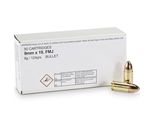
Ammunition (where to buy it in bulk)
———————————————————————————————Last edited by Stumpfenhammer; 12-31-2019, 2:00 PM.FOR SALE - Orange CountyComment
-
As noted above, the first gun for all beginners should be a .22 rifle, one of the best of the market is the Ruger 10-22.
If you insist on a handgun, then a quality .22 pistol or revolver.
Then take a class, professionally taught by someone who really knows what they are talking about. Specifically not a friend or relative.
The real key to knowing if an instructor knows what he/she is doing is how much time you spend in a classroom setting prior to going to the range.
If your first meeting with an instructor is range time, run as fast as you can. Classroom time is critically important to properly understand all that is necessary when it comes to firearm safety and use.Last edited by 003; 12-31-2019, 2:29 PM.Comment
-
Start with a 22 lr. Then 9mm then 45 acp or a 40. If wheelgun then a .357 you can shoot .38 spl for practice.Comment
-
FWIW, this is my practice strategy:
100 rds of .22LR through my Ruger Mark III. This let's me "warm up" and pay attention to fundamentals. Plus its fun!
Then I shoot what I came to shoot. Usually 50 rds through 2 different pistols, I collect milsurps so its usually a pair of 9mm, but it could be something else - or 100 rds through 1 gun, etc. Doesn't really pay off for me (personally) to shoot more than about 100 rds at this stage - I start getting tired, my aim deteriorates, etc.
Then I cool down, relax, and have fun by shooting yet another 50 rds of .22lr through my Ruger Wrangler. Being a single action revolver with a loading gate, this is NOT something one can do in a hurry. This is a recent addition to my shooting regimen, and its just fun! I find that the enforced slower pace of single action revolver shooting is a good thing and adds to the fun quotient.
Usual disclaimers apply, Your Mileage May Vary, batteries not included, and all that. Take your time, make each shot count. I don't get these guys that come in, do a couple of "mag dumps", and leave. I often have 2 or 3 of those pass through an adjacent lane while I'm still there taking my time!Comment
-
9mm was a starter for my wife & i and she's been shooting it 'til present. i moved up to .40 pretty fast shortly after the basic pistol course.
we bought .22 later and have fun shooting it for couple of months. then we got bored and ended up selling it.Comment
-
I started shooting with BB guns, then by high school it was .22LR and shotgun for skeet shooting. Then a 9mm for my first carry permit (late 1970's nickel-plated Smith & Wesson Model 59) and a .38 Special revolver (Ruger SP101, first batch made!) A couple decades passed and I thought I was a pretty decent shooter. Then I took a 3-day course run by Bruce Gray. Over those three days, I learned that I had spent the previous 25 years throwing lead downrange without actually knowing how to shoot. That course wasn't cheap but it was by far the best money spent on my firearm interest. I've since taken a repeat as well as other courses.
The OP has had a lot of great advice sent her way. And (IMO) some not so great advice. What I've seen from watching and studying some extremely skilled shooters is that exactly WHAT firearm they're shooting isn't as important as them knowing the fundamentals and having trained their muscles to certain responses. (Muscle memory, look it up.) Repetition is king. That's one reason why a .22LR is often recommended as a first gun, because the ammo is cheap (relatively) so you can afford to shoot it A LOT. But just shooting it isn't everything. If you have bad technique, you can be creating some bad habits. Quality training is really important.
Another oddity is that the firearm one most enjoys shooting isn't necessarily going to be the one that person shoots with the most accuracy. And, when push comes to shove, accuracy is the ultimate criterium. First concentrate on learning the proper form, getting brain and muscles working as one. That builds accuracy, getting those rounds on target. Then you can work on speed. John Wick didn't just wake up one day being THAT John Wick. Lots and lots of practice that nobody will ever see is what makes it all seem so natural.
My best advice is to continue with a lot of what the OP has already been doing. Don't be in a rush to buy products. Learn the basics first. Learn proper safety practices. Understand WHAT features you want in a firearm before you go shopping. There's a lot of "Ford versus Chevy" arguing out there so feel free to turn a deaf ear to that. Stay true to the fundamentals and build on those as you feel comfortable.Last edited by Rivers; 01-01-2020, 5:05 PM.NRA Certified Instructor: Basic Pistol ShootingComment


There are currently 12639 users online. 108 members and 12531 guests.
Most users ever online was 239,041 at 10:39 PM on 02-14-2026.


Comment