Unconfigured Ad Widget

Collapse

Parkerizing / Oil / & Rust

Collapse
X
 
  • Time
  • Show
Clear All
new posts
  • billt
    Senior Member
    • Jan 2012
    • 1179

    Parkerizing / Oil / & Rust

    While Parkerizing has been around a lot longer than many of the newer, more modern firearms finishes, a lot of younger shooters might not understand how it "works" so to speak. Parkerizing is different than most all of the newer, more modern firearms finishes on the market today, in that it offers very little protection on it's own.

    Parkerizing itself is only a media for holding oil near the steel itself. Thereby allowing the oil to protect the firearm steel from rust. Parkerizing left dry and free from oil offers almost no protection in the way of rustproofing. It requires oil to be effective. The question then becomes how much, and how often?

    This is a matter of personal preference and location. Also if the gun is carried in a leather holster or not. If the gun is exposed to high levels of rain or humidity, or stored in a leather holster, it will require more and heavier oiling than if it's contained in a Nylon type of holster in a dry, desert climate.

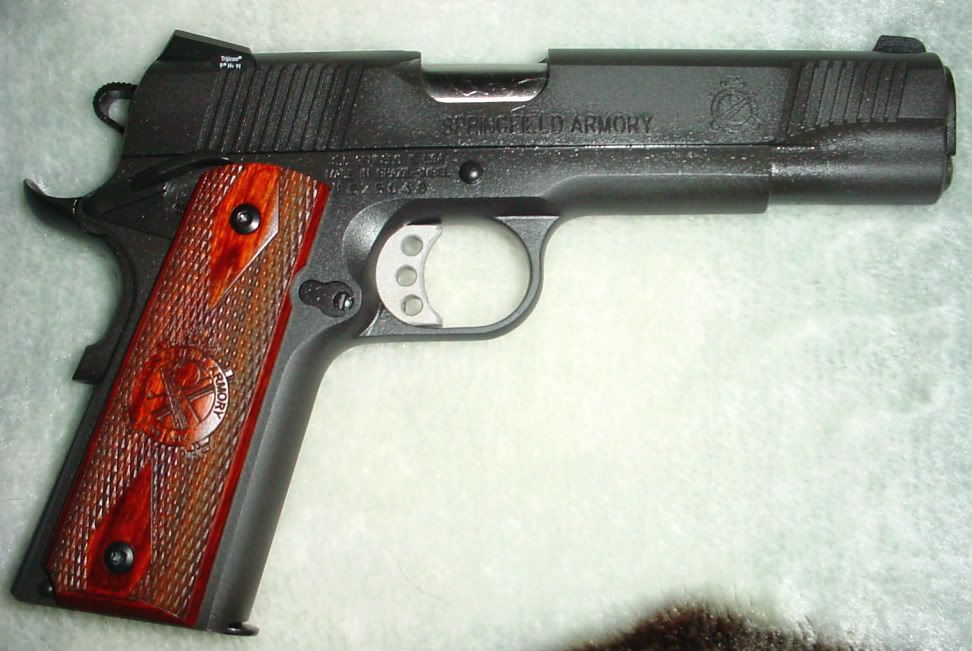
    Through the years I have found the best way to initially treat Parkerizing, is to oil it very heavily, and allow it to "soak in" overnight. Then, with a absorbent cloth, or a paper towel, blot up as much of the excess oil as possible. Don't wipe or scrub the surface because it will transfer lint like crazy, because of the Parkerizing's naturally rough surface. If you live in a humid climate you will want to repeat this process often to be sure the surface of the Parkerizing itself has oil contained in it. Oil saturated Parkerizing has a darker color to it. Dry Parkerizing has a more greyish cast. Below is a picture of my Springfield Loaded Parkerized 1911 pistol. You can clearly see the surface is wet with oil. A Parkerized firearm in this condition will all but never rust.

    Parkerizing requires more maintenance, but properly cared for it will serve it's purpose well.
    If common sense was so common, why don't liberals possess any?
  • #2
    sealocan
    Calguns Addict
    • Mar 2012
    • 9954

    I know this is an oversimplification but it was explained to me years ago that Parkerizing is just putting lots and lots of little holes in the surface of the steel to hold in the oil.

    Technology has moved along and although I do like the look when it was done (or if you're trying to re-create that old-school look) there are so many more practical, useful in preventing rust finishes out there now.

    Comment

    • #3
      Bainter1212
      Calguns Addict
      • Feb 2013
      • 5936

      I agree, with the exception that nowadays there are products that work much better than plain oil on parkerization.

      I have used Hornady One Shot dry lube (very pricey), and now I am using WD-40 Specialist Corrosion Protection, which I am impressed with. It sticks to metal like glue.
      I have also used a light grease like white Lithium grease, to good effect.

      You have to understand that parkerization IS a rust in itself, only instead if oxygen being the catalyst, it is a different chemical.

      Bluing is also a controlled rust process that yields a different surface reaction.

      Parkerization does a poor job with rust prevention, but it is excellent at resisting abrasion.

      Comment

      • #4
        The Gleam
        I need a LIFE!!
        • Feb 2011
        • 13141

        However, I love the look of gray and olive tinted parkerizing, like the silvery-gray you see on old AR-180s or the olive olive color on old Remington built 1903-A3s. Add a bit of Zinc to your solution and you'll achieve that look.

        If you look up some Parkerizing tips there are a few things to add to the solution to influence the color.

        Some guns simply look better Parkerized.
        -----------------------------------------------
        Originally posted by Librarian
        What compelling interest has any level of government in knowing what guns are owned by civilians? (Those owned by government should be inventoried and tracked, for exactly the same reasons computers and desks and chairs are tracked: responsible care of public property.)

        If some level of government had that information, what would they do with it? How would having that info benefit public safety? How would it benefit law enforcement?

        Comment

        • #5
          The Gleam
          I need a LIFE!!
          • Feb 2011
          • 13141

          Originally posted by Bainter1212
          I have used Hornady One Shot dry lube (very pricey), and now I am using WD-40 Specialist Corrosion Protection, which I am impressed with. It sticks to metal like glue.
          CLP's "Collector" gun oil works much better and has no smell or aerosol contributions that due to expanding gasses when sprayed, can introduce water along with the oil. It's been well-tested by many including military applications.

          It's the only preservation oil I use and I have never had a gun exhibit any sign of corrosion because of it; and it cleans off easy, even though you really don't need to clean it off at all when going to the range. It won't "bake" or caramelize on the gun if it gets hot like some preservation oils.
          -----------------------------------------------
          Originally posted by Librarian
          What compelling interest has any level of government in knowing what guns are owned by civilians? (Those owned by government should be inventoried and tracked, for exactly the same reasons computers and desks and chairs are tracked: responsible care of public property.)

          If some level of government had that information, what would they do with it? How would having that info benefit public safety? How would it benefit law enforcement?

          Comment

          • #6
            Bainter1212
            Calguns Addict
            • Feb 2013
            • 5936

            Originally posted by The Gleam
            CLP's "Collector" gun oil works much better and has no smell or aerosol contributions that due to expanding gasses when sprayed, can introduce water along with the oil. It's been well-tested by many including military applications.

            It's the only preservation oil I use and I have never had a gun exhibit any sign of corrosion because of it; and it cleans off easy, even though you really don't need to clean it off at all when going to the range. It won't "bake" or caramelize on the gun if it gets hot like some preservation oils.
            Really?...never heard of this. I use CLP as a normal gun oil and love it. Where do you get the "collector" stuff?

            Comment

            • #7
              The Gleam
              I need a LIFE!!
              • Feb 2011
              • 13141

              Originally posted by Bainter1212
              Really?...never heard of this. I use CLP as a normal gun oil and love it. Where do you get the "collector" stuff?
              Most guns stores carry it; Turners usually has it, RifleGear, others, but you might not find it in general stores like WalMart or Big5, Dick's, etc.

              It literally says CO in big letters (rather than CLP) and "Collector" oil on the bottle; it's black and looks the same as CLP, but the oil is thicker and really stays where you put it.

              Great stuff, and it's usually the same price as CLP.

              -----------------------------------------------
              Originally posted by Librarian
              What compelling interest has any level of government in knowing what guns are owned by civilians? (Those owned by government should be inventoried and tracked, for exactly the same reasons computers and desks and chairs are tracked: responsible care of public property.)

              If some level of government had that information, what would they do with it? How would having that info benefit public safety? How would it benefit law enforcement?

              Comment

              Working...
              UA-8071174-1