
-
-
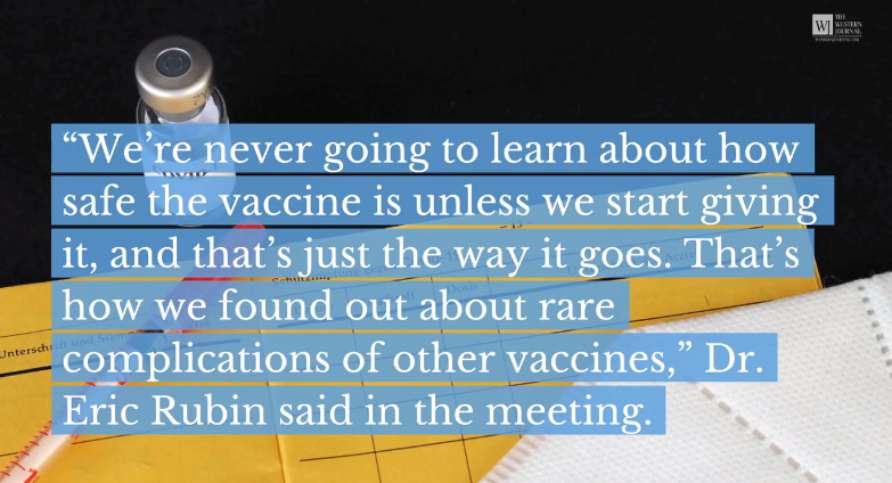
This may or may not be the quote verbatim, but it is essentially what I heard when I was listening to the live stream.
They actually said that we need to start giving an essentially untested vaccine in the general population so that we can see if there are side effects. I thought that was what the studies were supposed to be about, but allowing only those willing to take the risk to serve as the guinea pigs rather than forcing the general population into that role?"What is a moderate interpretation of the text? Halfway between what it really means and what you'd like it to mean?"
-Antonin Scalia, Supreme Court Justice
"Know guns, know peace, know safety. No guns, no peace, no safety.
I like my guns like the left likes their voters-"undocumented".Comment
-
Doesn't matter what their thoughts are as they only think what CNN tells them to think.
What is important is what physicians think. My sons' pediatrician thinks that the vaccines are "proven safe and effective" (even before this meeting and the "evidence" presented) and that myocarditis is "mild and self-limiting". Our local cardiologists actually used the word "scary" and said that it's imperative that we see at least 5 year data before we know how this is going to evolve.
If I have to take one specialty's interpretation over another, I'm going with the one that actually treats the complication. In my opinion, these vaccines are UNSAFE for males under age 30 until they are ACTUALLY PROVEN SAFE, and with large, long-term (at LEAST 5 year) studies."What is a moderate interpretation of the text? Halfway between what it really means and what you'd like it to mean?"
-Antonin Scalia, Supreme Court Justice
"Know guns, know peace, know safety. No guns, no peace, no safety.
I like my guns like the left likes their voters-"undocumented".Comment
-
Rocketman somehow believes Pfizer and the FDA have a time machine that allows them to look ten years into the future and study long-term side effects.Comment
-
And you have faith the data is accurate, there's your problem. As for the mandates, just look around and see how many people have to choose between their career and the vaccine. The government is saying that, since it considers these vaccines to be safe, there is no good reason for one not to get jabbed. Armed with that, government is using its power to coerce the population to get vaccinated, through direct and indirect action. Fortunately, some courts have questioned the constitutionality of that activity.
Much of the economics fallout from this disease have been self-inflicted. Now, we have leftist politicians who have been drunk with power and they don't want to sober up.
Mojave Lever Crew Member
"It is time for us to do what we have been doing and that time is every day. Every day it is time for us to agree that there are things and tools that are available to us to slow this thing down." - Kamala "Heels Up" HarrisComment
-
He's just not very skeptical.
- Is he a teacher? I don't know, don't care, don't see how it matters
- Blindly trusts the data provided in a study.
- Assumes those running the study are simply doing 'science'
- Doesn't bring in outside factors (eg. that FDA is pushing "Horse Paste" conspiracies at the same time as ostensibly providing 100% valid studies )
)
But I get it. He started a thread on the child vax study and wants to limit talk to that topic. He's assuming the FDA can be trusted on this matter - and maybe they can for purposes of the discussion.
I'm interested in the raw data used in this study, presumably it will show how many of the purported covid 'cases' were from among the 20% Obese & Sick kids group. I'd be surprised if the vax offers any measurable benefit for healthy kids, yet they're all being painted with the same brush - just as they're doing for adults.Comment
-
You can't use a highly generalized and inclusive definition of product optimization and then focus on some of the irrelevant facets to try to prove a point. Optimization means altering design to maximize performance against selected metrics, no more and no less -- and we can choose individual metrics, like safety for a single individual, or we can choose metrics against a population of arbitrary complexity.
The initial development was optimized for working-class adults. This did come up: There was some criticism of the Pfizer initial Phase III study pool for being a little bit less "diverse" than it could have been. That's all fair. But it's also fair to say the product had only been through a single optimization cycle.
What we're seeing now is a reoptimization against a different population, and as we're in Cycle II only a single design element has changed (so far as we know), namely payload.
It's not misleading. This is a very vanilla engineering optimization process. So I wouldn't characterize it as an experiment, but then, with a suitably broad definition, every action and observation is an experiment. Hence, not much value in all-inclusive definitions.
I guess in terms of finding a more nuanced boundary between experimental phase and refinement phase, we could start talking about maturity metrics such as TRL and EDL... There is much to be learned, but obviously this vaccine is far more advanced than something like Inova's DNA vaccine candidate, and yet less mature than, say, TDAP. I think we can all agree on that much.
You develop a vaccine and see how it does. We do not follow different dev paths to optimize for protection vs. full immunity. Maybe the science will get to that point in the future, but we're not there yet.
"Vaccines are never 100% effective" is not dismissal or obfuscation, it's just reality.
I'll insist on specifics if you're going to claim data corruption or falsification. It is not enough to say things are "questionable" and then move on. What is questionable, and why?
Study protocols make their definition of "Severe COVID" very clear -- so clear that typically there are two competing standards.
As for failure, vaccine failure is the converse of efficacy -- what the newspaper refers to, somewhat inaccurately, as "breakthrough cases." We can further specify whether we're talking about failure of sterilizing, symptomatic, or protective immunity as suits the problem at hand. My point is that all vaccines experience failures of this type, we are simply dealing with an unsophisticated community that believes traditional vaccines never fail. Normalization bias is real.
Sure. Most of those objections are grey-scale, though. I don't consider any of them useful unless they provide some kind of satisfiable criterion. Simply saying "we need to wait 5 / 15 / 20 years" is not interesting -- more useful would be expressing a level of confidence in detection of rare events, or demonstrating particular events fell below a chosen threshold. We can disagree about those thresholds but at least we'd be speaking a common language.
So help me get the lay community to understand.
It can be done. I knew much less about immunology two years ago than I do now. There is plenty I still have to learn. A little knowledge goes a long way, though.
That's an individual decision. The basic metric of success is to show a positive net benefit -- you may recall the initial FDA guidelines calling for minimum efficacy before they'd consider a license. Obviously we should try to do a bit better than that, but how much better depends.
Leaning on my background in reliability, I tend to think in terms of decades. If we can show a factor of ten advantage, I'd call that a marginal success point. Two decades and I start to be comfortable, three and I can turn my attention to other problems. That's just me, you don't have to follow my numbers.
In terms of this study, the net benefit on an individual level, considering only mortality, looks to be about 80% efficacy x 0.01% mortality rate vs. (worst case) 0.01% myocarditis x < 1% and potentially << 1% mortality as a result. So we are demonstrably at two decades, or "two nines" of benefit. If this holds up, this meets my seal of approval, but not my threshold considering it a solved problem.Riflemen Needed.
Ask me about Appleseed! Send a PM or see me in the Appleseed subforum.Comment
-
Where's the baseline testing data of the participants? Where's the testing after injection? No blood tests, no d-dimer tests, no scans, no immunity panel, no cognitive tests, etc. This study is complete caca.Comment
-
I think listening to physician's guidance is wise. In your shoes, however, I would push back a little -- why five years? What outcome would he like to see? What study result would have retired this risk?
Regarding "learning how safe the vaccines are," again, that refers to safety signals that are too small for this study to quantify. Myocarditis is one of these. You cannot construe this to mean we know nothing of safety. I am not saying that anything so far too small to sense is negligible, but it is bounded.
--
I don't have a problem here. My acceptance of the study results is based on evidence. The doubt is not.
I will probably stop reminding folks that I don't agree with the mandates either. Separate discussion.
--
Agree. The 20% with comorbidities is probably a large enough cohort to make some preliminary conclusions about relative risk and benefit, but we may run into study limitations. I am going to guess, though, we see no difference from the rest of the group. We'll see.Riflemen Needed.
Ask me about Appleseed! Send a PM or see me in the Appleseed subforum.Comment
-
Hey Rocketman........whats up?What do you call the people that abandoned the agenda of John Kennedy and adopted the agenda of Lee Oswald?
Pronouns: "Dude" and "Playa".
https://billstclair.com/Unintended-Consequences.pdf
I was born under a wandrin star.Comment
-
I have no influence over idiots on TV either, but these idiots on TV is the narrative being used for mandates. TO my point about Newsom and his mandate for children to get this vaccine, based off what data? They made this mandate before they even had the study completed.
And I've explained why I bring it up but you purposely ignore my explanation. I'm NOT comparing the datasets and not saying the JNJ efficacy rate applies to the childrens study (although I fully believe we'll see in 6 months a similar waning 'protection').Nobody cares about Janssen efficacy in Veterans Administration data in a thread about Pfizer efficacy in young children. I am annoyed that I have to explain this to you at all, let alone three times.
So let me say it one more time.
The low JNJ efficacy rate is in terms of lowering INFECTIONS. If we are discussing efficacy of vaccines in adults, we should discuss it in terms of INFECTIONS. WHY? because then when we discuss the efficacy of the vaccine in CHILDREN, we can ALSO discuss it in terms of INFECTIONS.
Alternatively, lets discuss the vaccine efficacy in reducing SEVERE COVID in Adults, then similarly discuss the vaccine efficacy in reducing SEVERE COVID in children.
Instead talking heads, articles, headlines and Branch Covidians are going to tout the vaccine efficacy in reducing INFECTIONS in children as being similar to the vaccine efficacy in reducing SEVERE COVID in adults.
Why does this matter? Because this state continually pumps the vaccines efficacy for adults and why we should all get the jab.
So while you want to discuss safety etc of the vaccine for children, what is the benefit? You say 'children also get severe covid and are hospitalized at a 1:250 rate'... if that's our metric then this vaccine has NOT proven to reduce that. It only reduces infection. So lets stick to the 'severe covid' metric as the primary outcome for determining the risk/benefit for vaccines in children OR adults.
There's zero chance the mob of vaccine devotees will read beyond a headline and be open to NOT vaccinating children ("because its 90.7% effective you grandma-killing anti-vaxxer!")
TL;DR version
Choose a consistent metric to compare efficacy of the vaccine in children vs vaccine in adults. Is our primary outcome reduction in infections or reduction in severe covid?
26M estimatedYour derivation is nonsense. If you want to estimate the percentage of child COVID-19 cases that result in hospitalization, you set up a simple counting experiment. First, you count the number of reported infections in children,
I(t) = 26M
H(t) = 209,264
ok technically its cumulative from Feb 2020 to May 2021 so little more than a year. But close enough for government work
209,264/26,838,244 = 0.78%
same time period Feb 20 to May 21
A(t) = 1.7% (~75M children under 18, = 1.3M) hospitalized for any cause (using 2018 data and assuming this is a stable background rate)
C(t) = ??? lets assume 209,264 (C(t) = H(t))), unless if children are being hospitalized FOR covid but either not reported or not tested, then this could be higher, but i'm going off CDC data here
209,264/1.3M = 16%
You seem to be implying i said this rate is predictive or something. I explained this in the earlier post and repeating myself below...
actually no, i was saying, 1.3M children were hospitalized in a normal (preCovid year). Of those ALREADY hospitalized, 16% tested positive for Covid. If children were being hospitalized FOR Covid, we'd expect to see the rate go from 1.3M children to 1.5M children hospitalized. I.e. the rate should increase from 1.7% (of the total population) to 2% of the total population.
In the same manner as thinking of 'excess deaths', there should be 'excess hospitalizations' in children (hospitalizations FOR Covid only).
Unfortunately any data out there has confounding factors, for example, with hospital closures and focus on covid, preventative treatments could have been ignored for 6+ months, implying when people started going back to see their doctors any disease that could have been identified and treated earlier would be in a more advanced stage.
The other confounder is how many children die because of medical mistakes once admitted to a hospital...
So this could imply the reduction in hospitalizations is because of that confounder and not indicative of a change in underlying rates.
Yes timeframe is different (Apr - Sep 2020), but going of what data i can find.
we just provided that number I(t) = 26.8M - 209,264 = 26,628,980
I(t) = 26.8M
it's not, A(t) = 1.3M, H(t) = 209k
well i don't have this data, but you seem to indicate you have it.
Total hospitalizations matter. If total hospitalizations are INCREASING ('excess hospitalizations') then it implies covid is increasing hospitalizations in children (excluding confounding factors, such as more severe disesae due to delay in diagnosing and treating). If its staying the same, then it implies merely that children being hospitalized are testing positive with Covid.
If total hospitalizations don't matter as a metric, then neither do total deaths. But total deaths DO matter, because we calculate excess deaths due to Covid (for the population as a whole). It's the most unbiased metric to prove the effect of this disease on the population (vs trying to determine who died WITH covid vs who died FROM covid).
So using total hospitalizations of children gives us a baseline to determine if covid is causing excess hospitalizations and thus having the 0.4% effect you're claiming.Comment
-
So I addressed this above, I'll do it again. It would be nice if we had a study that gave us good statistics on protective efficacy in children, but the size of that study would be prohibitive.
Instead, we use the most reliable signal we have, which is symptomatic efficacy. Now, previous studies did track this -- many of them, both RCTs and real world -- so your claim we have no basis for comparison is wrong.
We make the assumption that the rate of COVID-19 related hospitalization is a dependent function, perhaps even linearly dependent, on the rate of symptomatic infection. This is borne out in real world results, including results in children. If so, a reduction in symptomatic infection will produce a similar reduction in hospitalization.
Yes, that's an assumption, and it introduces uncertainties. But the uncertainties on efficacy are already kinda high. The 95% CI ranges all the way down to 67.7%, as I reported in the OP. It would take an extraordinary discovery for our assumption to be so wrong that it exceeds this level of uncertainty.
This is why I'm focusing on the safety data. This study says a lot more about them than it does about efficacy. The safety data are important, and worth the discussion.
You are wasting your time. This reasoning only holds if children's behaviors are the same during and previous to the pandemic. Obviously, that's crap. That systematic error will overwhelm your calculation. This kind of thinking could be used to "prove" that COVID-19 caused a rash of traffic fatalities and murders.
Experimental design is important, to limit these biases and errors. CDC has already done that for us: Hospitalization associated with COVID is already supposed to be because of, not with. Read the protocol on the CDC COVID Tracker project and see that this so. I accept there will be some level of sampling error, but there is frankly no reason to suspect our estimate of COVID-19-induced hospitalizations is being contaminated by other causes. That's a trope. It only applied prior to characterization, when COVID-19 fit into the broader bin of respiratory disease/distress, which is how it was originally scored. Those days are long done.Riflemen Needed.
Ask me about Appleseed! Send a PM or see me in the Appleseed subforum.Comment
-
For general interest
Some informed criticism of the study results, summarized here:
This analyzes the abstention from Dr. Michael Kurilla, who sat on the FDA panel and ultimately abstained.
These are good comments. I would remark that the 20% in the study who may have had prior infection are worth looking into, but his contention is wrong -- any unsuspected immunity in the sample makes vaccine performance look more random, and thus will artificially depress efficacy estimates. But overall, I think he's on the right track.
These comments almost entirely bear on efficacy, though. He doesn't have any real concerns on safety. I think that's the reason he abstained rather than voted against, noted in his comment that a lower-than-reported efficacy could lead to poor perception, but I'll not speak for him.Last edited by as_rocketman; 10-29-2021, 11:07 AM.Riflemen Needed.
Ask me about Appleseed! Send a PM or see me in the Appleseed subforum.Comment
-
I'd like to see the data the study 'conveniently' omitted. Anything that is this politicized is dirty. I don't trust any of the "data" or the "science" until it has been given sufficient time for all the BS to bubble to the top and be exposed. I'm sure there is plenty. Blindly trusting the "science" at this point of the process is reckless and naive. In the end I'll bet dollars to donuts it'll be another simple case of "follow the money" and those paying the ultimate price will get none of it.Comment

 Tweet
Tweet




There are currently 8580 users online. 121 members and 8459 guests.
Most users ever online was 239,041 at 10:39 PM on 02-14-2026.


Comment