

 Tweet
Tweet
I recently picked up the Dryfire simulator system and thought I'd post some pics and a mini-review of the system.
I attended a skeet clinic with Coach, aka Thefeeder and was immediately hooked on shooting clay sports. It's been a lot of fun, but unfortunately I find I just don't have the opportunity to go out and practice as much as I want to. Just to try to practice I'd swing the shotgun around in the garage, practicing form and concentrating on watching imaginary clays instead of the bead.
I stumbled upon a company in the UK making a clay target simulator. It seems this simulator has been through quite a few versions. The early versions was just a red laser dot that you tracked with your shotgun. Then to try and make it more realistic they sold fabric backgrounds so that it felt more realistic. However with version 4 they introduced the capability to connect it to a computer projector. I wrote to the company asking a few questions and the company rep let me know that they were just about to release version 4.5 which gives you the option of using projected clays instead of a laser dot.
that was enough for me, so I went ahead and ordered a unit. It was delivered early this week and I've had enough opportunity to put it through its paces.
The unit itself is rather small, about 8 inches by 5 inches. I bought the dual-head unit which allows for doubles. Each head as a laser emitter and a IR reader.

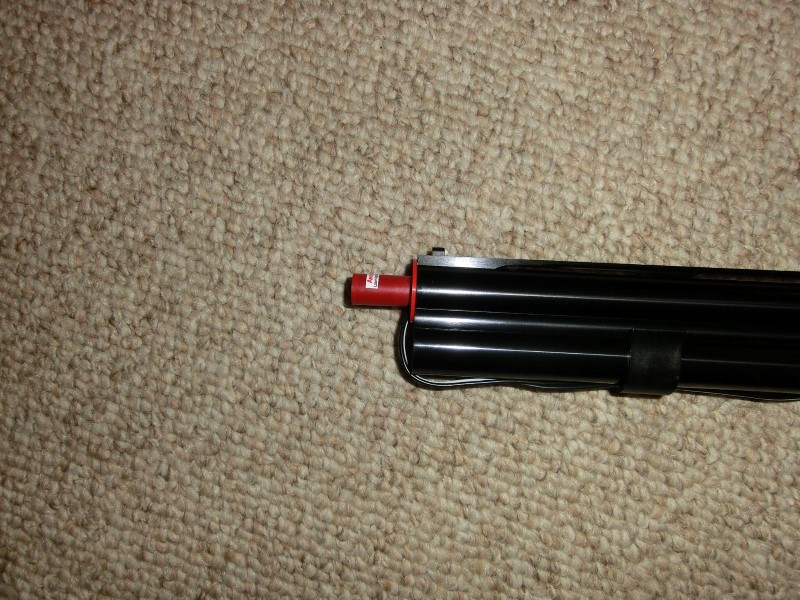
Next you install a laser emitter into your real shotgun (making sure it is unloaded of course). The emitter has a plastic loop which compresses to fit into the barrel. The emitter is kept in place by tension from this plastic loop. The directions state that it will fit nicely into 12, 20, or .410 gauge barrels.
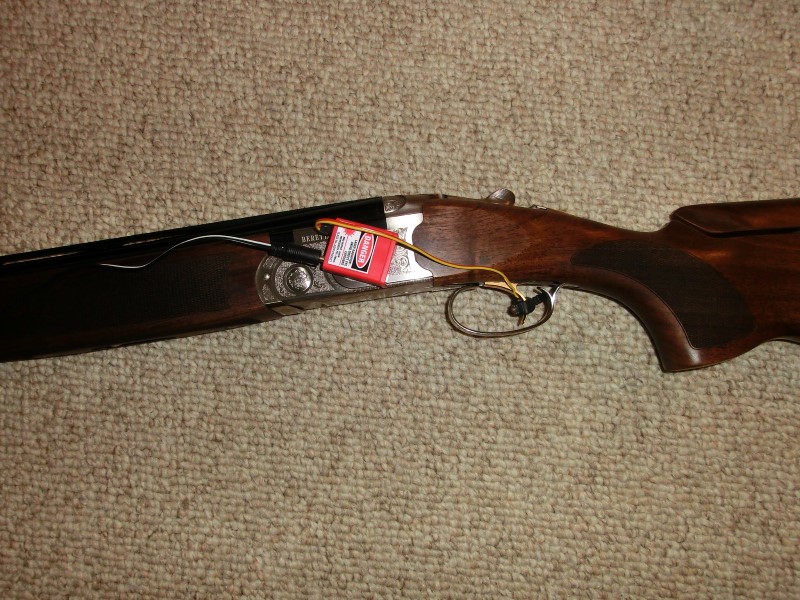
The emitter attaches via wire to battery pack. The battery pack has a small magnet which is used to hold it in place on your receiver. Then a small microswitch is attached to your trigger. To simulate firing you press the microswitch which has a nice tacticle click to it, so you know you've fired.
The Dryfire software is extremely powerful. It calculates how fast the clay is travelling, how far it has travelled, what gauge, shot size, and load of your shotgun -- and determines if you've broke the clay.
Note this is not a video game, it's a true simulator. That means you don't shoot directly at the target. To get a good hit you need to lead the target as appropriate. The software calculates all of this in real time and dynamically. For example, if you have a clay that is rising you need to shoot above it. However, as it reaches it's apex you should shoot directly at it. And as it falls you need to shoot below it. But not only that, as the clay falls the amount you need to lead it increases as the clay gains speed while coming down.
Why this is especially nice for beginners such as myself is that it gives you direct and immediate feedback of how you missed. As I used the simulator more I find myself calling out errors in how I shot ("low and to the right", etc).

I mentioned that the software is pretty powerful, but it also requires quite a bit of set up. Calibrating the projection screen is kind of a pain. Also since this was written in the UK, the metric system is the native measurement for the software. There is a option for imperial measurements, but it doesn't change all of the places (yet).
To really simulate your shotgun you are supposed to go and pattern it at various distances and then input that data into the system. However, the system has some generic settings that you can use until you tailor it more. I haven't done this yet, so for example I just leave it at 50/50 shot distribution instead of what my shotgun really shoots.
Before I got the simulator I was probably shooting in the 15-17 range for Trap (in other words a noob). I don't know if it's coincidence or not but I shot about the same the first several times with the simulator.
Here's a short video of how the system works.
Of course the nice thing about this is I can practice as much as I want to without huge ammo costs, and I can do it nightly in the house. My scores on the simulator have gone up, and I"ve moved on to practicing doubles and further back from the trap house. I haven't yet had the opportunity to shoot for real yet, but I'll report back if my scores have improved or not.
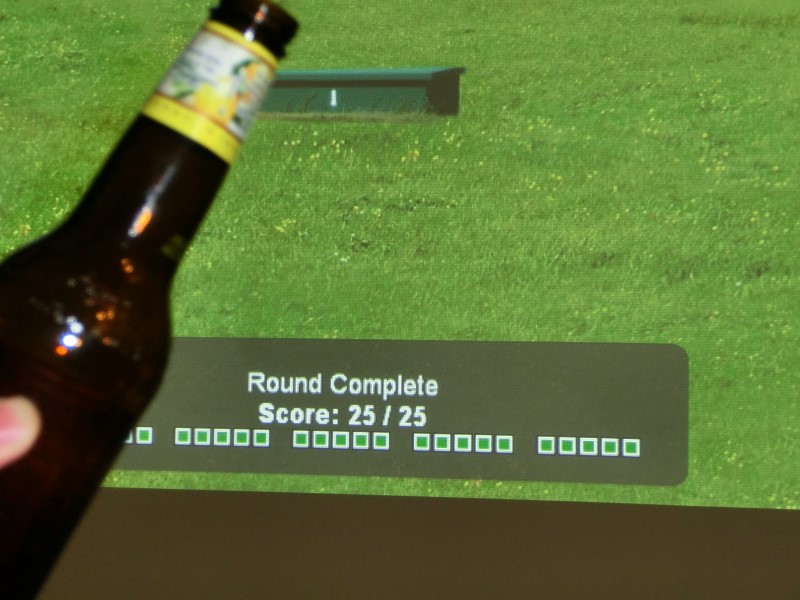
Oh, and the best thing about the simulator? I can reward myself for shooting a (virtual) perfect round.
The system isn't cheap -- starting at around $800 and going up depending on which options. But it's worth it for me because I can practice as much as I want, it's fun, and probably most importantly I plan on having my daughter's first exposure to clay shooting through this system. I figure I can fit that laser emitter into some kind of toy shotgun and she can start to learn to track targets and put in the appropriate lead.
Anyways, posting in case someone is curious about the Dryfire system. Happy to answer any questions.
I attended a skeet clinic with Coach, aka Thefeeder and was immediately hooked on shooting clay sports. It's been a lot of fun, but unfortunately I find I just don't have the opportunity to go out and practice as much as I want to. Just to try to practice I'd swing the shotgun around in the garage, practicing form and concentrating on watching imaginary clays instead of the bead.
I stumbled upon a company in the UK making a clay target simulator. It seems this simulator has been through quite a few versions. The early versions was just a red laser dot that you tracked with your shotgun. Then to try and make it more realistic they sold fabric backgrounds so that it felt more realistic. However with version 4 they introduced the capability to connect it to a computer projector. I wrote to the company asking a few questions and the company rep let me know that they were just about to release version 4.5 which gives you the option of using projected clays instead of a laser dot.
that was enough for me, so I went ahead and ordered a unit. It was delivered early this week and I've had enough opportunity to put it through its paces.
The unit itself is rather small, about 8 inches by 5 inches. I bought the dual-head unit which allows for doubles. Each head as a laser emitter and a IR reader.
Next you install a laser emitter into your real shotgun (making sure it is unloaded of course). The emitter has a plastic loop which compresses to fit into the barrel. The emitter is kept in place by tension from this plastic loop. The directions state that it will fit nicely into 12, 20, or .410 gauge barrels.
The emitter attaches via wire to battery pack. The battery pack has a small magnet which is used to hold it in place on your receiver. Then a small microswitch is attached to your trigger. To simulate firing you press the microswitch which has a nice tacticle click to it, so you know you've fired.
The Dryfire software is extremely powerful. It calculates how fast the clay is travelling, how far it has travelled, what gauge, shot size, and load of your shotgun -- and determines if you've broke the clay.
Note this is not a video game, it's a true simulator. That means you don't shoot directly at the target. To get a good hit you need to lead the target as appropriate. The software calculates all of this in real time and dynamically. For example, if you have a clay that is rising you need to shoot above it. However, as it reaches it's apex you should shoot directly at it. And as it falls you need to shoot below it. But not only that, as the clay falls the amount you need to lead it increases as the clay gains speed while coming down.
Why this is especially nice for beginners such as myself is that it gives you direct and immediate feedback of how you missed. As I used the simulator more I find myself calling out errors in how I shot ("low and to the right", etc).
I mentioned that the software is pretty powerful, but it also requires quite a bit of set up. Calibrating the projection screen is kind of a pain. Also since this was written in the UK, the metric system is the native measurement for the software. There is a option for imperial measurements, but it doesn't change all of the places (yet).
To really simulate your shotgun you are supposed to go and pattern it at various distances and then input that data into the system. However, the system has some generic settings that you can use until you tailor it more. I haven't done this yet, so for example I just leave it at 50/50 shot distribution instead of what my shotgun really shoots.
Before I got the simulator I was probably shooting in the 15-17 range for Trap (in other words a noob). I don't know if it's coincidence or not but I shot about the same the first several times with the simulator.
Here's a short video of how the system works.
Of course the nice thing about this is I can practice as much as I want to without huge ammo costs, and I can do it nightly in the house. My scores on the simulator have gone up, and I"ve moved on to practicing doubles and further back from the trap house. I haven't yet had the opportunity to shoot for real yet, but I'll report back if my scores have improved or not.
Oh, and the best thing about the simulator? I can reward myself for shooting a (virtual) perfect round.
The system isn't cheap -- starting at around $800 and going up depending on which options. But it's worth it for me because I can practice as much as I want, it's fun, and probably most importantly I plan on having my daughter's first exposure to clay shooting through this system. I figure I can fit that laser emitter into some kind of toy shotgun and she can start to learn to track targets and put in the appropriate lead.
Anyways, posting in case someone is curious about the Dryfire system. Happy to answer any questions.




Comment