Unconfigured Ad Widget

Collapse

How to Zero BUIS?

Collapse
X
 
  • Time
  • Show
Clear All
new posts
  • AngryPossum
    Senior Member
    • Aug 2009
    • 1414

    How to Zero BUIS?

    I've been searching online for over an hour and I can't find any good info on how to properly sight in BUIS.

    I'm having a hell of a time sighting in my troy folding sights. I'm an AR newbie and would really appreciate a "Sighting in BUIS for dummies" step by step instruction. If something Like this exists already on calguns I apologize, but I searched and couldn't find anything.

    I'll be shooting at 100 yrds mostly. I'm using Troy rear and front BUIS (HK style). Thanks.
  • #2
    tuna quesadilla
    Calguns Addict
    • Apr 2006
    • 5147

    Most people that I know zero their ARs at reduced range, i.e. 25m or 50m. This results in a zero at a farther distance as well as the reduced distance. Understand that bullets do not travel in a perfectly straight line; when fired, they first go UP in relation to the muzzle and then they go back DOWN after a certain distance. Imagine a rainbow. So when you zero at 25m, you're also zeroing for 300m. The bullet strikes the target on its way UP at 25m, and also on its way DOWN at 300m. I could be wrong but I think 50m is a 200m zero.

    For 100 yards I'm not really sure what the close-range equivalent would be. You might just want to do it at a straight 100 yards. With a 25/300 zero, or a 50/200 zero, you'll still hit the target at 100 yards but you'll be either a few inches too high or a few inches too low depending on the trajectory.

    If you're asking about the actual process of zeroing, it goes something like this:

    1. Acquire a stable position. You can use a benchrest, or if you're really skilled you can shoot while slung up in the prone position (that's how we zeroed at the Appleseed shoot I went to)

    2. Fire five shots on your target, taking into account the fundamentals of marksmanship and trigger control ("Six steps to firing a shot")

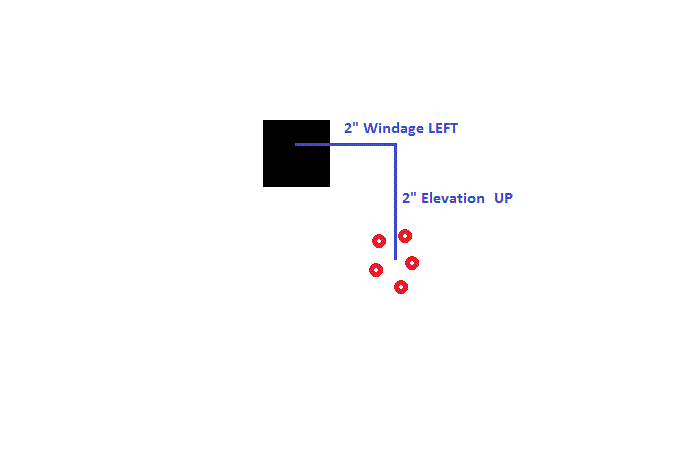
    3. Look at your target. If your marksmanship was good, you'll find a five-shot group. Now you make the adjustments. See the example below: You were aiming for the black square, and your 5-shot group is in red. You make your adjustments in straight lines: Windage is horizontal adjustment left and right, and Elevation is vertical adjustment up and down.


    In this example I drew up in MS Paint, your group was 2" low and right. The nice thing about zeroing at 100y is that most iron sights have 1 MOA per click of adjustment. 1 MOA is equal to 1 inch for every 100 yards. So 1 MOA at 200y would be 2"; 1 MOA at 300y would be 3", etc. So 1 MOA at 100y is 1 inch, and 1 inch at 100y is 1 MOA. Easy.

    So go to your rear sight (I'm assuming the front BUIS is not adjustable) and find the windage and elevation adjustments. First the windage: The adjustment dial should be marked as to which direction is left and which direction is right. On mine for example it says "L --->" meaning you rotate it that way to go left and the opposite way to go right. You need to move your group 2" to the left. Convert it to MOA, which since you're shooting at 100y is stupid easy. 2" at 100y is 2 MOA. And now we convert it from MOA to clicks, which again since you're using iron sights is easy peasy. 2 MOA is 2 clicks. So rotate your adjustment dial 2 clicks in whichever direction it indicates is Left.

    Repeat the process for elevation. Find the elevation dial/knob, and again rotate it however far you need (which in this case is 2" UP). 2" at 100y is 2 MOA which on iron sights is 2 clicks. Bam. You're zeroed.

    Shoot another 5 shots to see where your group lands. There is no guarantee that it will be dead on. Depending on your sight radius (the distance between the rear sight and the front sight) your adjustments might be thrown off a little bit. For example, I found out after a bit of frustration that my supposed "1 MOA" sights actually shift about 1.5 MOA per click. So just keep repeating the process. Shoot a group, measure how much it's off, convert inches to MOA to clicks, and keep working at it until you're centered.

    And get your butt to an Appleseed shoot ASAP. They'll teach you how to really shoot that rifle.

    ETA: So I just checked your Troy BUIS and the front sight IS adjustable. So you're going to want to do your elevation adjustments on the front sight. You have to take the tip of a bullet and press in a little detent, and then rotate the front sight pin in the correct direction. It'll make sense when you see it. Again it will be marked "U -->" or something like that to show you which way to turn it. One click (one quarter turn of the post) is 1 MOA.
    Last edited by tuna quesadilla; 04-23-2011, 1:50 PM.

    Comment

    • #3
      AngryPossum
      Senior Member
      • Aug 2009
      • 1414

      Thank you. This is the best response I've ever had. Can't wait to go back to range.

      Comment

      • #4
        zoglog
        Senior Member
        • Aug 2010
        • 1059

        thanks for the info
        More guns for followers of the FSM!

        Comment

        • #5
          Mr. Meeseeks
          Veteran Member
          • Jan 2008
          • 2951

          Wow Tuna, you really put in some work on that response. I applaud you sir, for the effort and info.

          The only time I ever see anyone type that much here these days is during a flame war. LOL

          Comment

          • #6
            Mr. Meeseeks
            Veteran Member
            • Jan 2008
            • 2951

            Wow Tuna, you really put in some work on that response. I applaud you sir, for the effort and info.

            The only time I ever see anyone type that much here these days is during a flame war. LOL

            Comment

            • #7
              negolien
              Veteran Member
              • Sep 2010
              • 4829

              Very nice helpful answer well done sir.
              "Men sleep peacefully in their beds at night because rough men stand ready to do violence on their behalf."

              George Orwell

              http://www.AnySoldier.com

              Comment

              • #8
                Sumo99
                Senior Member
                • Jan 2008
                • 781

                I use this target for my initial zeroing. http://www.bobdbob.com/~deneb/doc/ta...2-25m-zero.pdf
                I believe this target is for a 20" barrel and standard sights, but I used it for both a 14.5" and 16" barrel and it was pretty close. After I did the initial sight in at 25M, I then fine tuned my rifle at longer distances.

                Comment

                • #9
                  ebencikiv
                  Veteran Member
                  • Feb 2010
                  • 4527

                  Awesome thanks tuna!

                  Comment

                  • #10
                    calirc51
                    Junior Member
                    • Jan 2008
                    • 98

                    If you are zeroing for 100 yds, at 25 yards your hits should be 2.5 inches below your (X)target. Easier to zero at 25 yards.

                    Comment

                    • #11
                      richie3888
                      Senior Member
                      • Apr 2010
                      • 849

                      Originally posted by tuna quesadilla
                      Most people that I know zero their ARs at reduced range, i.e. 25m or 50m. This results in a zero at a farther distance as well as the reduced distance. Understand that bullets do not travel in a perfectly straight line; when fired, they first go UP in relation to the muzzle and then they go back DOWN after a certain distance. Imagine a rainbow. So when you zero at 25m, you're also zeroing for 300m. The bullet strikes the target on its way UP at 25m, and also on its way DOWN at 300m. I could be wrong but I think 50m is a 200m zero.

                      For 100 yards I'm not really sure what the close-range equivalent would be. You might just want to do it at a straight 100 yards. With a 25/300 zero, or a 50/200 zero, you'll still hit the target at 100 yards but you'll be either a few inches too high or a few inches too low depending on the trajectory.

                      If you're asking about the actual process of zeroing, it goes something like this:

                      1. Acquire a stable position. You can use a benchrest, or if you're really skilled you can shoot while slung up in the prone position (that's how we zeroed at the Appleseed shoot I went to)

                      2. Fire five shots on your target, taking into account the fundamentals of marksmanship and trigger control ("Six steps to firing a shot")

                      3. Look at your target. If your marksmanship was good, you'll find a five-shot group. Now you make the adjustments. See the example below: You were aiming for the black square, and your 5-shot group is in red. You make your adjustments in straight lines: Windage is horizontal adjustment left and right, and Elevation is vertical adjustment up and down.


                      In this example I drew up in MS Paint, your group was 2" low and right. The nice thing about zeroing at 100y is that most iron sights have 1 MOA per click of adjustment. 1 MOA is equal to 1 inch for every 100 yards. So 1 MOA at 200y would be 2"; 1 MOA at 300y would be 3", etc. So 1 MOA at 100y is 1 inch, and 1 inch at 100y is 1 MOA. Easy.

                      So go to your rear sight (I'm assuming the front BUIS is not adjustable) and find the windage and elevation adjustments. First the windage: The adjustment dial should be marked as to which direction is left and which direction is right. On mine for example it says "L --->" meaning you rotate it that way to go left and the opposite way to go right. You need to move your group 2" to the left. Convert it to MOA, which since you're shooting at 100y is stupid easy. 2" at 100y is 2 MOA. And now we convert it from MOA to clicks, which again since you're using iron sights is easy peasy. 2 MOA is 2 clicks. So rotate your adjustment dial 2 clicks in whichever direction it indicates is Left.

                      Repeat the process for elevation. Find the elevation dial/knob, and again rotate it however far you need (which in this case is 2" UP). 2" at 100y is 2 MOA which on iron sights is 2 clicks. Bam. You're zeroed.

                      Shoot another 5 shots to see where your group lands. There is no guarantee that it will be dead on. Depending on your sight radius (the distance between the rear sight and the front sight) your adjustments might be thrown off a little bit. For example, I found out after a bit of frustration that my supposed "1 MOA" sights actually shift about 1.5 MOA per click. So just keep repeating the process. Shoot a group, measure how much it's off, convert inches to MOA to clicks, and keep working at it until you're centered.

                      And get your butt to an Appleseed shoot ASAP. They'll teach you how to really shoot that rifle.

                      ETA: So I just checked your Troy BUIS and the front sight IS adjustable. So you're going to want to do your elevation adjustments on the front sight. You have to take the tip of a bullet and press in a little detent, and then rotate the front sight pin in the correct direction. It'll make sense when you see it. Again it will be marked "U -->" or something like that to show you which way to turn it. One click (one quarter turn of the post) is 1 MOA.
                      great info
                      WTB: Wilson Combat, Les Baer, and TRP with half light rail.

                      Comment

                      • #12
                        1lostinspace
                        Calguns Addict
                        • Oct 2006
                        • 7848

                        Originally posted by tuna quesadilla
                        Most people that I know zero their ARs at reduced range, i.e. 25m or 50m. This results in a zero at a farther distance as well as the reduced distance. Understand that bullets do not travel in a perfectly straight line; when fired, they first go UP in relation to the muzzle and then they go back DOWN after a certain distance. Imagine a rainbow. So when you zero at 25m, you're also zeroing for 300m. The bullet strikes the target on its way UP at 25m, and also on its way DOWN at 300m. I could be wrong but I think 50m is a 200m zero.

                        For 100 yards I'm not really sure what the close-range equivalent would be. You might just want to do it at a straight 100 yards. With a 25/300 zero, or a 50/200 zero, you'll still hit the target at 100 yards but you'll be either a few inches too high or a few inches too low depending on the trajectory.

                        If you're asking about the actual process of zeroing, it goes something like this:

                        1. Acquire a stable position. You can use a benchrest, or if you're really skilled you can shoot while slung up in the prone position (that's how we zeroed at the Appleseed shoot I went to)

                        2. Fire five shots on your target, taking into account the fundamentals of marksmanship and trigger control ("Six steps to firing a shot")

                        3. Look at your target. If your marksmanship was good, you'll find a five-shot group. Now you make the adjustments. See the example below: You were aiming for the black square, and your 5-shot group is in red. You make your adjustments in straight lines: Windage is horizontal adjustment left and right, and Elevation is vertical adjustment up and down.


                        In this example I drew up in MS Paint, your group was 2" low and right. The nice thing about zeroing at 100y is that most iron sights have 1 MOA per click of adjustment. 1 MOA is equal to 1 inch for every 100 yards. So 1 MOA at 200y would be 2"; 1 MOA at 300y would be 3", etc. So 1 MOA at 100y is 1 inch, and 1 inch at 100y is 1 MOA. Easy.

                        So go to your rear sight (I'm assuming the front BUIS is not adjustable) and find the windage and elevation adjustments. First the windage: The adjustment dial should be marked as to which direction is left and which direction is right. On mine for example it says "L --->" meaning you rotate it that way to go left and the opposite way to go right. You need to move your group 2" to the left. Convert it to MOA, which since you're shooting at 100y is stupid easy. 2" at 100y is 2 MOA. And now we convert it from MOA to clicks, which again since you're using iron sights is easy peasy. 2 MOA is 2 clicks. So rotate your adjustment dial 2 clicks in whichever direction it indicates is Left.

                        Repeat the process for elevation. Find the elevation dial/knob, and again rotate it however far you need (which in this case is 2" UP). 2" at 100y is 2 MOA which on iron sights is 2 clicks. Bam. You're zeroed.

                        Shoot another 5 shots to see where your group lands. There is no guarantee that it will be dead on. Depending on your sight radius (the distance between the rear sight and the front sight) your adjustments might be thrown off a little bit. For example, I found out after a bit of frustration that my supposed "1 MOA" sights actually shift about 1.5 MOA per click. So just keep repeating the process. Shoot a group, measure how much it's off, convert inches to MOA to clicks, and keep working at it until you're centered.

                        And get your butt to an Appleseed shoot ASAP. They'll teach you how to really shoot that rifle.

                        ETA: So I just checked your Troy BUIS and the front sight IS adjustable. So you're going to want to do your elevation adjustments on the front sight. You have to take the tip of a bullet and press in a little detent, and then rotate the front sight pin in the correct direction. It'll make sense when you see it. Again it will be marked "U -->" or something like that to show you which way to turn it. One click (one quarter turn of the post) is 1 MOA.
                        Spin drift lol JK
                        There are sniper everywhere and nowhere.....who knows what is out there.

                        PUREMMA
                        MIXED MARTIAL ARTS ACADEMY

                        Comment

                        • #13
                          huckberry668
                          Senior Member
                          • Feb 2007
                          • 1502

                          Since it's an AR, you can 'bore sight' it to on-target w/o firing 1 shot. Same procedure for zeroing scopes too. You can pre-bore-sight it at home before you hit the range too.

                          1. remove upper and BCG. Rest upper front and back on sandbags.
                          2. Look down the chamber end at your 100 yard bullseye target and place all 3 circles (chamber end, muzzle end and target) dead center of each other.
                          3. Look thru your BUIS and see where it's aiming at in relationship to the bullseye.
                          4. Move the bullseye to your sights - Adjust rear sight to the right if you want the target to move to the right. Adjust rear sight down if you want the target to come down.
                          5. Adjusting the front sight is just the opposite.
                          6. Once you have the sights lined up on target at 6 o'clock, fire a 2 or 3-shot group. Mark the group big so you can see it from 100 yards. repeat 3, 4 and 5 till the sights line up perfectly.

                          Edit: problem with shooting at a closer target for groups is time & ammo consuming, in some cases with open sights shooting by yourself, you can't tell where it's missing if it doesn't get on target. Bore sighting is easy to do and you can do it anywhere safely. I've seen too many wasted rounds down range during zero. if you can look down the chamber to the muzzle end you can bore sight it.
                          Last edited by huckberry668; 07-29-2011, 10:54 PM.
                          GCC
                          NRA Certified Pistol Instructor
                          Don't count your hits and congratulate yourself, count your misses and know why.

                          Comment

                          • #14
                            Bongos
                            Veteran Member
                            • Oct 2005
                            • 4095

                            here is what the military uses, works great.. you can print this at this link:


                            looks like this

                            Comment

                            • #15
                              mocos
                              Member
                              • Feb 2007
                              • 299

                              uh.....I set my back up sights to shoot to the same point of aim as my primary sights whether it be 25, 50 or 100 yards.....anything further is probably not practical. they are meant to function at the same settings as your primary sight if it should fail.......in other words...zero it the same way you zero your primary sights....not a good idea to have your backup sights zeroed at a different distance because if you have to employ them, you would have to make some kind of mental adjustment that it shoots some point other than where your primary sight is zeroed at....

                              Comment

                              Working...
                              UA-8071174-1