Unconfigured Ad Widget

Collapse

High End Scope Frustration

Collapse
X
 
  • Time
  • Show
Clear All
new posts
  • goodlookin1
    Veteran Member
    • Apr 2009
    • 2557

    High End Scope Frustration

    What's the love affair with 50mm objectives on a lot of high end scopes? For instance, Vortex originally went with a 50mm obj in their Gen 1 Razor HD line with a 20x max magnification. Then they did it right in their Gen II models with the 56mm obj. Then they scale it back down in their AMG line to 50mm objective!

    For those who dont know, the pupil of the human eye can only go down to about 3mm - 8mm on average. As you get older, things change...but let's just assume the ideals for the moment. Okay, so everyone knows that the iris contracts when there's more light and dilates when there's less light. But many people dont understand how a scope works:

    The higher the magnification, the smaller the exit pupil. The exit pupil is the width of the amount of light coming through the ocular lens of the scope. Think of it as a pipe of light, and the width of the pipe determines the amount of light coming through. As you increase magnification, the pipe size decreases, and the converse is true. The formula for determining exit pupil is thus:

    Objective size (mm) / Magnification level (x power) = exit pupil.

    Therefore, a scope with a 50mm objective and 24x power gives a 2.083mm exit pupil. That means that if you stand behind your scope, you will see a tube of light coming through the scope that is 2.083mm in width.

    Bringing this all back to my original complaint, if you buy a scope with the specs in the above example, and you go to use it at dusk, lets say your eye's pupil is 7mm...almost all the way open...your eye is open wider than your scope's exit pupil, resulting in a severely diminished image (it's dark and grayed out, difficult to see detail). My question is this: Why on earth would a scope manufacturer decrease the size of the objective in such a highly magnified scope? Surely they understand that this is a physics problem that cannot be overcome by mere coatings or glass quality? Why not just increase the objective size to the most common long range objective size, 56mm, and scale back the magnification? It's only going to help with the light issue at higher magnification levels. .

    I dont understand the thinking.

    I had a Vortex Razor HD Gen I that I just sold. I found the eyebox unyielding and just overall difficult to use when I turned it up to 20x. I didnt like anything above 16x because the image just dimmed out too much and loses the ability to see as clearly. My thinking is that it would be better to have a 56mm objective and go with a max 18x magnification because at least the smallest the exit pupil will be will match my eye's pupil, resulting in less/no image degradation.

    Can anyone explain why manufacturers make highly magnified scopes without correspondingly large objectives?
    www.FirearmReviews.net
  • #2
    waawaaweenie
    CGN/CGSSA Contributor
    • Apr 2008
    • 659

    maybe they don't understand what you just posted and are making and selling them based on price points and what the top reviewers say people want

    they may know nothing but the mechanical aspects of making a scope

    Comment

    • #3
      Merc1138
      I need a LIFE!!
      • Feb 2009
      • 19742

      It's probably more complicated than simply not wanting to do it. Increasing the objective lens size increases the scope size and weight, and likely cost as well, and who knows what else that the manufacturers may have noticed from a technical perspective or based off of feedback.

      Comment

      • #4
        HK Dave
        Calguns Addict
        • Oct 2008
        • 5737

        Can you even imagine a S&B with 72mm or 85mm objective? LOL

        Outside of the ridiculous size... i bet it would cost like $20K.

        As glass size increases, price increases exponentially...

        Comment

        • #5
          ExtremeX
          Calguns Addict
          • Sep 2010
          • 7160

          Originally posted by HK Dave
          Can you even imagine a S&B with 72mm or 85mm objective? LOL

          Outside of the ridiculous size... i bet it would cost like $20K.

          As glass size increases, price increases exponentially...
          Highlighted for truth. Bigger the objective, bigger your wallet (or credit line) needs to be.

          With regards to high magnification optics, even with physical size, weight, and price considered, sometimes it doesn't make sense to design a wide magnification range variable scope around the assumption the user will only be using it at the highest setting all the time. If all cars were built that way, we would all be driving around F1 cars or trophy trucks.

          Most tactical scopes need to preserve balance for their applications. Generally the highest power settings are used for information gathering, like ranging. But most of the actual operations would be at the mid magnification levels for wider field of view.

          Contrast that with the Trijicon Accupoint TR22... its a 2.5-10x56. 56mm objective on a 10x is insane. I think its pretty obvious what they were trying to accomplish... uncompromised low light performance for hunting applications.

          Vortex, Trijicon, and others know just fine how to design a scope... but they still need to engineer stuff for reasonable applications, at price points people will actually pay. If there is a market for it great, but these big companies are also looking at the user base. It needs to make business sense. I bet the Trijicon ACOG probably would not exist today if it wasn't for the US military needs... couldn't imagine them spending that type on money on R&D to make a very small part of the consumer base happy.

          You can find the odd ball scope here and there for that niche application, but you end up paying for it... one way or another you pay. There is no free lunch in optics.
          Last edited by ExtremeX; 08-15-2016, 7:39 PM.
          ExtremeX

          Comment

          • #6
            Horrendo Revolver
            Senior Member
            • May 2015
            • 1013

            Fads, that's all it is.

            Comment

            • #7
              ElvenSoul
              I need a LIFE!!
              • Apr 2008
              • 17431

              Don't forget a lot of scope makers cheat. Ie Nikon swearing up and down it is 40mm. When they knew it was 42mm.
              sigpic

              Comment

              • #8
                Bete Noire
                Senior Member
                • Apr 2008
                • 578

                Can you imagine the size of the rings that would be necessary too, not to mention the giant cheek comb you'd need. It is also preferable to keep the glass close to the bore to minimize the problems of rifle cant or an unleveled reticle.


                Sent from my iPad using Tapatalk HD

                Comment

                • #9
                  vospertw
                  Senior Member
                  • Apr 2012
                  • 791

                  From Leupold's site below - I think the point is that the user has to figure out the adequate exit pupil Vs. magnification required for his shooting objectives. So like the OP said, 24X at dusk with a 50mm objective lens may be worthless, but 6-8X works fine.

                  I'm working through the selection process right now for a build in another thread. Maybe the way to look at this is to first think about magnification required in low light and figure out the objective size to get the required exit pupil, and then using that objective size, you could come up with your max practical magnification in daylight.

                  Exit Pupil

                  Variable-power scopes also offer a light management advantage over fixed power scopes. As you change magnification, you also change the exit pupil, a measure of the light passing through the scope to your eye. Exit pupil is derived by dividing the diameter of the objective lens by the magnification of the optical device. The human eye can dilate from about 7mm for a young person in total darkness to 2mm in bright sunlight. Ideally, the exit pupil of the scope should match or slightly exceed the dilation of the eye’s pupil so that the eye receives as much light as possible.

                  An example of exit pupil: if a hunter goes out with a 3.5-10x40mm scope early in the morning, he can dial his scope down to 5x, and he will receive an 8mm exit pupil (40mm divided by 5x equals 8mm exit pupil). Later, when the sun is high and bright, he can turn his scope up to 10x and still receive a 4mm exit pupil (40mm divided by 10x equals a 4mm exit pupil), which is excellent for bright conditions. As evening approaches, he can turn the scope back down to 8x or so to receive a 5mm exit pupil (40mm divided by 8x equals a 5mm exit pupil) and still have plenty of light to make a shot at the end of legal shooting hours.

                  Objective Lens Diameter

                  Obviously, exit pupil depends on magnification and objective lens diameter. If magnification is increased, exit pupil will decrease, unless the objective lens diameter increases proportionally. 50mm-objective riflescopes will deliver a larger exit pupil and a brighter image in poor light than a similarly powered scope with a smaller objective. Of course, there are tradeoffs with a 50mm scope: higher mounting, greater weight and bulk, and a higher line of sight in relation to the bore line. All of these factors must be considered when deciding on a scope for your style of shooting. In most cases, a scope that delivers a 3.5-5mm exit pupil at a comfortable magnification will be more than adequate for most hunts.
                  Jesus Saves!

                  Comment

                  • #10
                    PolishMike
                    Calguns Addict
                    • Nov 2007
                    • 6034

                    Probably because it would be near impossible to get a cheek weld on anything bigger and that is way more important to hit your target than the exit pupil.
                    Artist formally known as CEO of Tracy Rifle and Pistol

                    Comment

                    • #11
                      EastCoaster
                      Member
                      • Oct 2015
                      • 329

                      Sometimes a bigger objective is compensated by other technology with fully multi-coated optical system that provide effective light transmission, with a cost under $1500.

                      5 great light-gathering riflescopes

                      Consider the major disadvantage to a 50mm or larger. These large objectives forces the shooter's head up so high on a standard stock, it lacks a reasonable or repeatable cheek weld. This isn't acceptable on any firearm required for accurate shooting.

                      Your best accuracy is found by mounting the scope as low as possible to the axis of the bore.
                      Last edited by EastCoaster; 08-16-2016, 7:44 AM.
                      sigpic

                      Comment

                      • #12
                        FourT6and2
                        Senior Member
                        • Dec 2012
                        • 1928

                        Originally posted by EastCoaster
                        Consider the major disadvantage to a 50mm or larger. These large objectives forces the shooter's head up so high on a standard stock, it lacks a reasonable or repeatable cheek weld. This isn't acceptable on any firearm required for accurate shooting.

                        Your best accuracy is found by mounting the scope as low as possible to the axis of the bore.
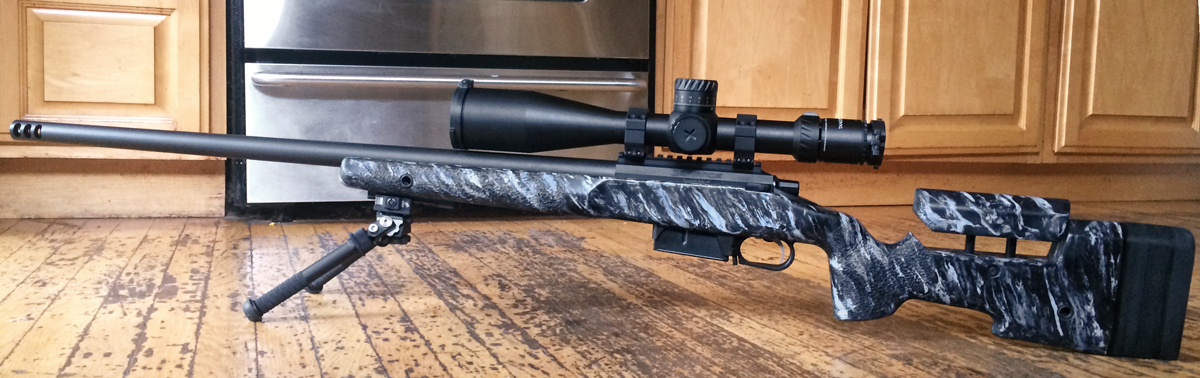
                        That's what adjustable cheekpieces are for. I don't see too many people shooting precision matches with non-adjustable stocks. My scope has a 65mm objective bell diameter (56mm objective lens). And it's mounted fairly low, I'd say. Just a touch of daylight between it an the barrel. And the rifle shoots just fine. I think I have the cheekpiece a touch lower now, compared to this photo. But it gives you an idea.

                        Last edited by FourT6and2; 08-16-2016, 10:19 PM.

                        Comment

                        • #13
                          MarikinaMan
                          Veteran Member
                          • Nov 2015
                          • 4864

                          Larger objectives collect more light and will actually look sharper. Will the average joe notice? I dont know. I do know that consumers look at marketing blurbs and spec numbers. As long as companies can squeeze marginal improvements, consumers will buy. You are frustrated because the numbers and the marketing are screwingg with your brain. If you dismiss them and just buy what you think is right for u, youll sleep better.

                          So many have bought cars based on one being .3 seconds faster than another from 0-60 mph. Im not surprised. Personally I look for cup holders.
                          Last edited by MarikinaMan; 08-16-2016, 10:46 PM.

                          Comment

                          • #14
                            JMP
                            Internet Warrior
                            CGN Contributor - Lifetime
                            • Feb 2012
                            • 17056

                            These are on close out--the old Hensoldt 72mm scopes:

                            OP, that's plenty of exit pupil for you.

                            Comment

                            • #15
                              EastCoaster
                              Member
                              • Oct 2015
                              • 329

                              Originally posted by FourT6and2
                              That's what adjustable cheekpieces are for. I don't see too many people shooting precision matches with non-adjustable stocks. My scope has a 65mm objective bell diameter (56mm objective lens). And it's mounted fairly low, I'd say. Just a touch of daylight between it an the barrel. And the rifle shoots just fine. I think I have the cheekpiece a touch lower now, compared to this photo. But it gives you an idea.
                              Not all of us that shoot longer distances, shoot precision matches. Cheek risers are impractical in some circumstances, necessitating a simpler approach.
                              sigpic

                              Comment

                              Working...
                              UA-8071174-1