

 Tweet
Tweet
Got some of the gear in that I won at auction (WW1 Tank Corps gear), which I specifically bought to use as props for photos. Time for a photoshoot!!!!
When Colt won the contract to supply pistols to the US government, the agreed upon price was approximately $14 a pistol. The government (as it always does) thought it could produce the pistols faster and cheaper than Colt. So written into the contract was that Colt would allow the US Government to start co-producing the pistol after a certain number had been supplied by Colt. It instructed Colt to deliver blueprints and tooling to the national armory at Springfield, Massachusetts.
The aresnal at Springfield was established in 1777 to manufacture weapons for the Revolutionary War. George Washington selected the site of the armory himself. Throughout the history of the US until it's closing in 1968, Springfield was the primary center of manufacturing for US firearms.
Anyways, as I was saying Springfield thought it could do it better, faster, and cheaper than Colt. It actually took a couple of years for Springfield to get production going. But after it did, it turned out that the government arsenal could neither make them faster, nor cheaper than Colt. In fact, 1911 pistols manufactured by Springfield were over 30% more expensive. To make matters worse, the parts from a Springfield 1911 could not reliably interchange with parts from a Colt.
Springfield made the pistol from 1914 until about 1917, when the US entry into WW1 forced Springfield to focus on making the Springfield 1903 rifle.
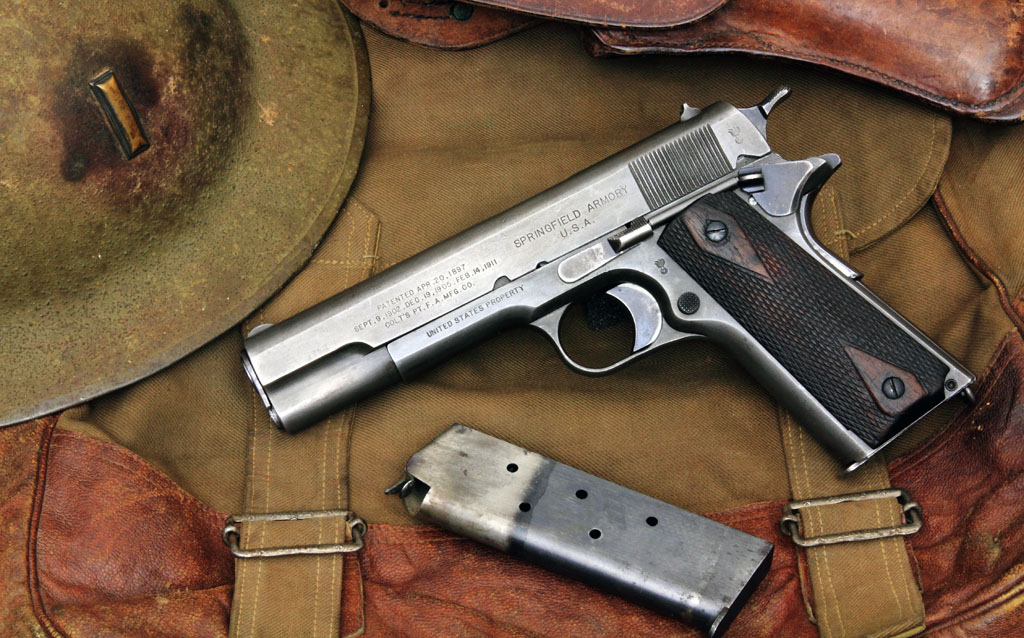
Here is my Springfield 1911, manufactured in 1915 along with a selection of gear from Lt. G.G. MacDonald (US Tank Corps, WW1). A couple of interesting observations about the Springfield 1911. First, there's the large Springfield Armory and U.S.A markings. There's the reference to Colt's patent. Finally, there is the US Arsenal flaming bomb.
On the right side I particularly like the American eagle stamp.
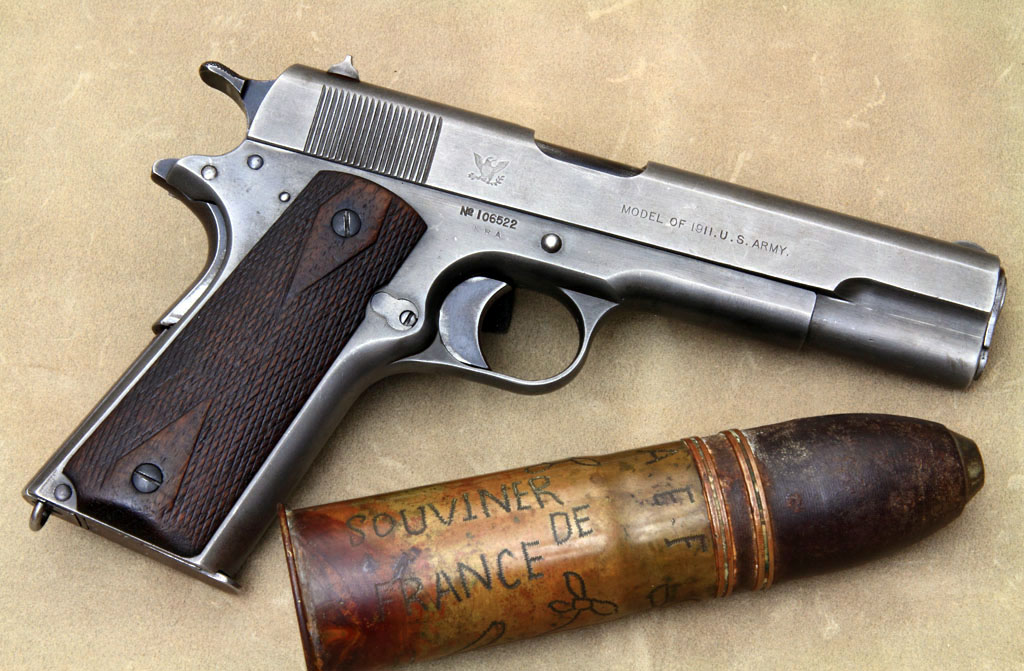
Notice the "NRA" mark underneath the serial number. Around this time (before and after WW1), the "National Matches" were gaining in popularity. One of the most popular categories was the "service category" in which competitors used the pistols and rifles of the armed services. In other words 1911 pistols and 1903 rifles. But Colt had a hard time keeping up with its military orders, so there were very few commercial 1911 models available. The NRA worked with the government to make available 1911 pistols from the government arsenal. Pistols sold through this program were marked "NRA" to signify that they were not stolen from the government.
My example is one of approximately 100 NRA marked Springfield 1911s that experts believe to exist. This makes it collectible even if most of the bluing is gone.
Underneath the pistol is a deactivated 37mm round. A great example of "trench art". This one has some floral designs and is inscribed with the words "Souviner de France, AEF, and 1918". AEF stands for American Expeditionary Forces the name of the US Troops who served in Europe in WW1.
I'm experimenting with a new lighting technique for the photos. I like the results better than with the light tent I was previously using. What do you think?
P.S. Note that the Springfield Armory of today (makers of the XD line of pistols) has NOTHING to do with the former US Arsenal, which closed in 1968. The commerical entity today cleverly bought the rights to use the Springfield name. Although they do make pretty good 1911s....
When Colt won the contract to supply pistols to the US government, the agreed upon price was approximately $14 a pistol. The government (as it always does) thought it could produce the pistols faster and cheaper than Colt. So written into the contract was that Colt would allow the US Government to start co-producing the pistol after a certain number had been supplied by Colt. It instructed Colt to deliver blueprints and tooling to the national armory at Springfield, Massachusetts.
The aresnal at Springfield was established in 1777 to manufacture weapons for the Revolutionary War. George Washington selected the site of the armory himself. Throughout the history of the US until it's closing in 1968, Springfield was the primary center of manufacturing for US firearms.
Anyways, as I was saying Springfield thought it could do it better, faster, and cheaper than Colt. It actually took a couple of years for Springfield to get production going. But after it did, it turned out that the government arsenal could neither make them faster, nor cheaper than Colt. In fact, 1911 pistols manufactured by Springfield were over 30% more expensive. To make matters worse, the parts from a Springfield 1911 could not reliably interchange with parts from a Colt.
Springfield made the pistol from 1914 until about 1917, when the US entry into WW1 forced Springfield to focus on making the Springfield 1903 rifle.
Here is my Springfield 1911, manufactured in 1915 along with a selection of gear from Lt. G.G. MacDonald (US Tank Corps, WW1). A couple of interesting observations about the Springfield 1911. First, there's the large Springfield Armory and U.S.A markings. There's the reference to Colt's patent. Finally, there is the US Arsenal flaming bomb.
On the right side I particularly like the American eagle stamp.
Notice the "NRA" mark underneath the serial number. Around this time (before and after WW1), the "National Matches" were gaining in popularity. One of the most popular categories was the "service category" in which competitors used the pistols and rifles of the armed services. In other words 1911 pistols and 1903 rifles. But Colt had a hard time keeping up with its military orders, so there were very few commercial 1911 models available. The NRA worked with the government to make available 1911 pistols from the government arsenal. Pistols sold through this program were marked "NRA" to signify that they were not stolen from the government.
My example is one of approximately 100 NRA marked Springfield 1911s that experts believe to exist. This makes it collectible even if most of the bluing is gone.
Underneath the pistol is a deactivated 37mm round. A great example of "trench art". This one has some floral designs and is inscribed with the words "Souviner de France, AEF, and 1918". AEF stands for American Expeditionary Forces the name of the US Troops who served in Europe in WW1.
I'm experimenting with a new lighting technique for the photos. I like the results better than with the light tent I was previously using. What do you think?
P.S. Note that the Springfield Armory of today (makers of the XD line of pistols) has NOTHING to do with the former US Arsenal, which closed in 1968. The commerical entity today cleverly bought the rights to use the Springfield name. Although they do make pretty good 1911s....


Comment