Unconfigured Ad Widget

Collapse

Early black powder.

Collapse
X
 
  • Time
  • Show
Clear All
new posts
  • #16
    Wheellock
    Senior Member
    • Dec 2019
    • 1112

    Originally posted by gun toting monkeyboy
    I'm going to go with "No" here. I don't know where you got your information on this one, but it is wrong. And just mixing the three ingredients together will not get you a worthwhile black powder. It will get you serpentine powder, which is garbage, and only useful for cheap firecrackers. They are NOT the same. It is not a viable propellant. I literally spent years researching this for the 1632 series of novels. I have actually made black powder from scratch. Making real black powder was a closely guarded state secret for centuries. And the hardware/process for making it is not something people would or could do at home. How well the different ingredients are mixed effects the final product. How you combine the ingredients matters. Whether you use a wet or dry process matters. How you grind or shape the grains matters. Tossing it all in a bag and shaking it just won't work.

    -Mb
    I have read (actual books, not the internet) that serpentine powder was mixed close to the battlefield in the very early days. So maybe the OP is not so much wrong about the concept, but the details.

    I have also seen a test (this was on the internet, so questionable) that serpentine powder works better in guns with sub-caliber powder chambers, like the Tannenberg Gonne, and is probably the reason they have powder chambers.

    I'm always keen to know more, though. Any book recommendations for early gunpowder history?

    Comment

    • #17
      19K
      Veteran Member
      • Aug 2013
      • 3621

      Originally posted by RNE228
      The change with the Minie ball was two fold. The rate of fire was higher because the design of the bullet allowed faster firing even with fouled bores; something you could not do with patched ball without brushing frequently.

      It was deadly compared to round ball; The higher velocity and mass caused more devastating wounds than round ball.

      Henry Burton really improved the Minie, making it a more devastating bullet.

      Comment

      • #18
        19K
        Veteran Member
        • Aug 2013
        • 3621

        I feel like people assume reloading a Brown Bess type rifle was like this.


        When In actuality it was more like this.

        Comment

        • #19
          RNE228
          Senior Member
          • Oct 2013
          • 2458

          The percussion cap is a good point.

          Have loaded and shot Revolutionary era rifles at Appleseed events. Have also been dinking around with replica '61 Springfield. Made the templates and tie jig for rolling Civil War spec paper cartridges with Minie ball for the '61 Springfield; that is fun.

          Comment

          • #20
            IrishJoe3
            Veteran Member
            • Feb 2009
            • 3804

            Originally posted by 19K
            I think the percussion cap has more to do with the increased rate of fire over the minie ball.

            Muskets during the revolution used a round ball that was .06in under bore diameter.

            The rifles that fired minie balls tended to be .58in firing a bullet with a diameter of .575-.578 so .005 to .002 diameter undersized.

            It’s a modern practice to use .72 round balls with a patch that makes it .75 for maximum accuracy, which in turn makes the use of ball starters relevant which slow down reloading even more when the musket is fouled.

            Shoving a round ball that’s .06 under barrel diameter will go down easier than one that’s only .005 under.
            Ooh. Getting into my niche interest. I've spent a silly amount of time researching and recreating paper cartridges for a few of my Civil War era firearms. Which includes my Model 1842 .69 caliber smooth bore musket. That cartridge, from the arsenal, had three .31 caliber buckshot on top of a round .65 caliber ball within a paper cartridge. The ball had to be so undersized otherwise fouling would prevent reloading within just a couple shots. So for the sake of speed they sacrificed accuracy.

            M1842 .69 Buck and Ball cartridge.
            1 .65 round ball, 3 .31 caliber buckshot and 110 grains of black powder.


            I can easily fire three aimed shots within a minute with this cartridge. "Aimed" doesn't do much good with an unpatched .65 ball in a .69 bore. In fact the M1842 doesn't even have a rear sight. The M1842 and buck and ball cartridge is virtually useless beyond 100 yards. It is absolutely devastating on anything less then 100 yards, especially when an infantry regiment of 700-1000 soldiers is firing volleys. In theory, a full infantry regiment would be firing 12,000 projectiles a minute and would have the capability of sweeping the field with lead. Quite literally 'accuracy through volume'.

            This picture is 10 aimed shots using military issued paper cartridges at a target set at 50 yards. Point of aim was the yellow circle on the center target. Red dots mark a hit from the .650 round ball. The yellow circles mark a hit by the .31 buckshot.

            Out of 10 .650 round balls at 50 yards - 10 hits
            Out of 30 .310 round balls at 50 yards - 25 hits


            The rifled musket cartridges I've researched and tested are the (US) M1855 and (US) M1862 cartridge and the British Pritchett cartridge.

            With the Pritchett I could meet the 3 aimed shots a minute, and be able to get accuracy in the ballpark of pie plate or better at 100 yards, and reasonable accuracy out to at leastbabfew hundred yards. The P1853 rifle musket had a rear sight calibrated to 900 yards. The Pritchett cartridge was the most advanced cartridge of the time and is a joy to shoot. It shoots a .550 hollow base conical bullet (not a minie). This bullet is in the base of the paper tube point up and has a boxwood plug in the hollow base (on firing this plug is forced into the conical base forcing the skirt to expand into the rifling). The bullet is paper patched and dipped into lube. The soldier tears open the opposite end of the cartridge exposing powder. He pours the powder down the muzzle, inverts the cartridge and inserts the bullet end into the muzzle. He then snaps off the excess tube leaving a lubricated and paper patched bullet in the crown. This is easily slid down with the ramrod. This system allowed ease of loading without compromising accuracy due to fouling.

            Pritchett Cartridge construction, used by the British military 1853 to 1867(?) And the confederacy during the American Civil War


            The US M1855 (and simplified and cheaper to make version the M1862) cartridge had the bullet in the end of the paper tube pointing outward. The bullet was a minie ball (Burton ball). The ball itself was greased, and the ball sized to fit easily in the .580 US rifle muskets and the .577 contract purchased British rifle muskets. To fire the soldier would tear open the powder end, and pour the charge down the muzzle. He would then unwrap the bullet and place the naked bullet in the muzzle and ram home. Also straight forward, slightly slower then the Pritchett, slightly less accurate and tended to foul easier. However perfectly functional and killed hundreds of thousands 1861-1865.
            Last edited by IrishJoe3; 04-18-2022, 3:13 PM.
            Urban legends are a poor basis for making public policy.

            Comment

            • #21
              Spyder
              CGN Contributor
              • Mar 2008
              • 16998

              ^ powder nerd.

              Comment

              • #22
                RNE228
                Senior Member
                • Oct 2013
                • 2458

                What paper do you use? I tried regular printer paper; it seem too thick.

                I used these for resources for 1862 type cartridge.

                A series of trials culminated in a new standard caliber of .58 and the selection of the refined Burton Expanding Ball as the projectile of choice for the US Army at the time of the Civil War.


                Originally posted by IrishJoe3
                Ooh. Getting into my niche interest. I've spent a silly amount of time researching and recreating paper cartridges for a few of my Civil War era firearms.

                The US M1855 (and simplified and cheaper to make version the M1862) cartridge had the bullet in the end of the paper tube pointing outward. The bullet was a minie ball (Burton ball). The ball itself was greased, and the ball sized to fit easily in the .580 US rifle muskets and the .577 contract purchased British rifle muskets. To fire the soldier would tear open the powder end, and pour the charge down the muzzle. He would then unwrap the bullet and place the naked bullet in the muzzle and ram home. Also straight forward, slightly slower then the Pritchett, slightly less accurate and tended to foul easier. However perfectly functional and killed hundreds of thousands 1861-1865.

                Comment

                • #23
                  IrishJoe3
                  Veteran Member
                  • Feb 2009
                  • 3804

                  Originally posted by RNE228
                  What paper do you use? I tried regular printer paper; it seem too thick.

                  I used these for resources for 1862 type cartridge.

                  A series of trials culminated in a new standard caliber of .58 and the selection of the refined Burton Expanding Ball as the projectile of choice for the US Army at the time of the Civil War.


                  Yeah printer paper is too thick and doesn't fold well. Newsprint is too thin and fragile. I use hardware store masking paper, a brown roll of I think 60 yards costs a few bucks, the paper folds great, is durable, and chokes well. Give it a shot.

                  For the Pritchett I use three different types of paper. The inner powder cylinder is made of a stiff almost cardstock. It's only purposes to form a cup to hold the powder to make it easier to pour from. The card stock is held in place by the inner wrapper which is made from the masking paper from the hardware store, (those two together are that brown cup in my above picture). The white outer wrapper has to be a lot more specific, it acts as a paper patch for the bullet and has to be durable, easy to tear and thin, So I use a cotton rag vellum type paper.

                  Here are a couple finished cartridges;
                  M1842 buck and ball, M1862 and Pritchett cartridge.

                  Last edited by IrishJoe3; 04-18-2022, 6:03 PM.
                  Urban legends are a poor basis for making public policy.

                  Comment

                  • #24
                    IrishJoe3
                    Veteran Member
                    • Feb 2009
                    • 3804

                    Originally posted by Spyder
                    ^ powder nerd.
                    Totally

                    Hey. At least I haven't bought a cannon. Yet.
                    Urban legends are a poor basis for making public policy.

                    Comment

                    • #25
                      RNE228
                      Senior Member
                      • Oct 2013
                      • 2458

                      Thanks for the info; I'll look this weekend. I know the paper your mentioning.

                      I just shoot at the range, so don't need to make cartridges. But, I reload for all my other stuff; I thought it would be interesting to try. Since doing the first batch, I'd like to continue.

                      Originally posted by IrishJoe3
                      Yeah printer paper is too thick and doesn't fold well. Newsprint is too thin and fragile. I use hardware store masking paper, a brown roll of I think 60 yards costs a few bucks, the paper folds great, is durable, and chokes well. Give it a shot.

                      For the Pritchett I use three different types of paper. The inner powder cylinder is made of a stiff almost cardstock. It's only purposes to form a cup to hold the powder to make it easier to pour from. The card stock is held in place by the inner wrapper which is made from the masking paper from the hardware store, (those two together are that brown cup in my above picture). The white outer wrapper has to be a lot more specific, it acts as a paper patch for the bullet and has to be durable, easy to tear and thin, So I use a cotton rag vellum type paper.

                      Here are a couple finished cartridges;
                      M1842 buck and ball, M1862 and Pritchett cartridge.

                      Comment

                      • #26
                        19K
                        Veteran Member
                        • Aug 2013
                        • 3621

                        Originally posted by IrishJoe3
                        Yeah printer paper is too thick and doesn't fold well. Newsprint is too thin and fragile. I use hardware store masking paper, a brown roll of I think 60 yards costs a few bucks, the paper folds great, is durable, and chokes well. Give it a shot.

                        For the Pritchett I use three different types of paper. The inner powder cylinder is made of a stiff almost cardstock. It's only purposes to form a cup to hold the powder to make it easier to pour from. The card stock is held in place by the inner wrapper which is made from the masking paper from the hardware store, (those two together are that brown cup in my above picture). The white outer wrapper has to be a lot more specific, it acts as a paper patch for the bullet and has to be durable, easy to tear and thin, So I use a cotton rag vellum type paper.

                        Here are a couple finished cartridges;
                        M1842 buck and ball, M1862 and Pritchett cartridge.


                        I started to form some Pritchett cartridges, what size bullet do you use? Do you buy them or have mould?

                        Comment

                        • #27
                          IrishJoe3
                          Veteran Member
                          • Feb 2009
                          • 3804

                          Originally posted by 19K
                          I started to form some Pritchett cartridges, what size bullet do you use? Do you buy them or have mould?
                          I've used both .568 and .550.

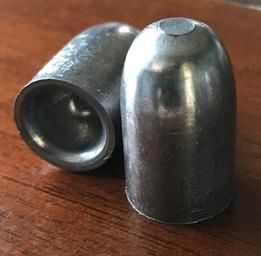
                          Here are some (pricey) .568s that I've tried
                          The iconic, original.568 Pritchett for the P/53 Enfield, compression swaged, 530 grains. This is an exact reproduction of the famous original, first made in 1852 by Robert Taylor Pritchett and William Metford, and ultimately selected by the Board of Ordnance to be used in the Pattern 1853 Enfield.. Just like the originals, these are formed by hydraulically compressing cold pieces of lead in dies, and not cast. Historically, they used a paper patch of very thin paper. I recommend "onion skin" paper (sold by Buffalo Arms for paper patching).


                          And I do have a NOE Pritchett mold for the .550
                          Urban legends are a poor basis for making public policy.

                          Comment

                          Working...
                          UA-8071174-1