

 Tweet
Tweet
How to make a Extractor for the German Gew. 88.

Tools required;
Small flat hand files
Vise
bench grinder
Rotary dremel tool with cut off disks and round grinding stone
Hack saw
Pliers
Propane torch
Micro caliper in MM"s
Safety glasses
marker or scribe
Motor oil
Beer of your choice
Disclaimer: I am not a machinist or an expert gunsmith. Nor do I have experience explaining how to make stuff over the interwebs. So please bare with me. But I have known a few Oakies and I can make things in my garage. I am doing this to help others with what worked for me. I am using photos of my own and ones I stole from the web. This is a skill level three job for garage do-it-yourselfers. Go slow. Measure twice and cut once. Only remove what you don't need as you go. I hope I have been helpful and not to vague in my directions. Good luck.
1. Find a peace of soft scrape metal (steal) that is about the same thickness as the extractor. By soft metal I mean metal used for things like hinges, brackets, and clasps. Tool steel is ideal and can be bought from most hardware stores. Don't use hardened steal from files or bolts, or any other metal like cast iron. You can use most anything that is laying around that looks right. I used a old hinge.
If you have a extractor already you can use it as a guide to help. If not here is a diagram I made with exact dimensions in MM's.
[IMG][url=https://flic.kr/p/2akTxgL]
2. Measure out a peace on the side of your scrap metal or metal stock that is the same length and width as the extractor. Over estimate a couple of MM's. It is easier to take off than to put back. Add one inch to the end length for something to hold on to while working on your new extractor. This will be cut off after you finish your cutting and sanding. Then cut this piece out with a hack saw.

3. Now you have a rough over sized piece of metal the size of a extractor. Put the front tip in your vise about 1/4 of an inch. Measure carefully the top to 7.56 mm's and cut to about the 2.96 mm with the dremel and the cutting wheel. Remove the excess metal to the tail end of the extractor using the dremel grinding stone or a bench grinder. The thin tail of the extractor is about 1.20 mm thick and is rounded at the edges to match the bolt head.

4. Now turn the piece around and work on the front part of the extractor. This is the delicate part because you are making the claw part of the extractor. Start a cut at the 4.66 mm point about 1.20 mm's deep and work to the front claw. Remove the excess metal. The claw is about 1 mm thick and 2 mm's high. Using the dremel make the claw and bevel it to about 45% and round it on the inside. The dremel works great for this. See the pictures and make it look like that.

5. You will notice that the bottom leading edge of the extractor is rounded and matches that of the Bolt head. Use a hand file to round this part to fit the bolt head. Once this is done and you are happy with the fit so far you can cut the excess length off of the end. Then check the fit of the extractor in the bolt head. lightly file were needed to make it fit properly.

6. Now you may have noticed that at the half mark of the extractor their is a small bend. You need to bend your extractor slightly so it will act like a spring. You can do that with the vise and the pliers. Now use your dremel to clean up your work. A sanding tip works good.
7. Last you will need to harden your new extractor. This will keep it from wearing out and make it spring like. Using the pliers and Propane torch heat up your extractor until it is glowing cherry red. and then drop it in to the motor oil. This heat treats and hardens the metal. After it has cooled you can assemble your bolt and enjoy.
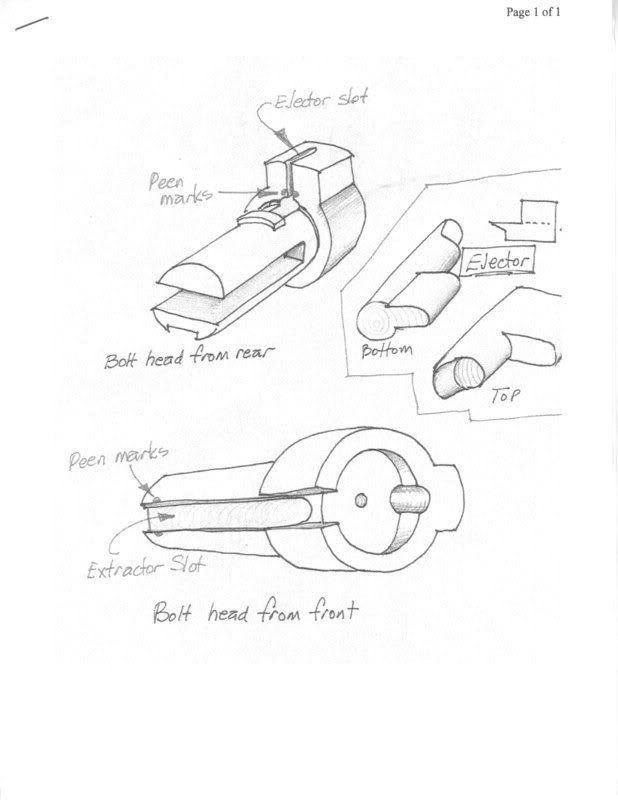
You can peen the edges of the bolt head so you do not lose your extractor and ejector or you can just let it be. You only need to peen it if you are afraid you may lose them in the field.
Tools required;
Small flat hand files
Vise
bench grinder
Rotary dremel tool with cut off disks and round grinding stone
Hack saw
Pliers
Propane torch
Micro caliper in MM"s
Safety glasses
marker or scribe
Motor oil
Beer of your choice
Disclaimer: I am not a machinist or an expert gunsmith. Nor do I have experience explaining how to make stuff over the interwebs. So please bare with me. But I have known a few Oakies and I can make things in my garage. I am doing this to help others with what worked for me. I am using photos of my own and ones I stole from the web. This is a skill level three job for garage do-it-yourselfers. Go slow. Measure twice and cut once. Only remove what you don't need as you go. I hope I have been helpful and not to vague in my directions. Good luck.
1. Find a peace of soft scrape metal (steal) that is about the same thickness as the extractor. By soft metal I mean metal used for things like hinges, brackets, and clasps. Tool steel is ideal and can be bought from most hardware stores. Don't use hardened steal from files or bolts, or any other metal like cast iron. You can use most anything that is laying around that looks right. I used a old hinge.
If you have a extractor already you can use it as a guide to help. If not here is a diagram I made with exact dimensions in MM's.
[IMG][url=https://flic.kr/p/2akTxgL]
2. Measure out a peace on the side of your scrap metal or metal stock that is the same length and width as the extractor. Over estimate a couple of MM's. It is easier to take off than to put back. Add one inch to the end length for something to hold on to while working on your new extractor. This will be cut off after you finish your cutting and sanding. Then cut this piece out with a hack saw.
3. Now you have a rough over sized piece of metal the size of a extractor. Put the front tip in your vise about 1/4 of an inch. Measure carefully the top to 7.56 mm's and cut to about the 2.96 mm with the dremel and the cutting wheel. Remove the excess metal to the tail end of the extractor using the dremel grinding stone or a bench grinder. The thin tail of the extractor is about 1.20 mm thick and is rounded at the edges to match the bolt head.
4. Now turn the piece around and work on the front part of the extractor. This is the delicate part because you are making the claw part of the extractor. Start a cut at the 4.66 mm point about 1.20 mm's deep and work to the front claw. Remove the excess metal. The claw is about 1 mm thick and 2 mm's high. Using the dremel make the claw and bevel it to about 45% and round it on the inside. The dremel works great for this. See the pictures and make it look like that.
5. You will notice that the bottom leading edge of the extractor is rounded and matches that of the Bolt head. Use a hand file to round this part to fit the bolt head. Once this is done and you are happy with the fit so far you can cut the excess length off of the end. Then check the fit of the extractor in the bolt head. lightly file were needed to make it fit properly.
6. Now you may have noticed that at the half mark of the extractor their is a small bend. You need to bend your extractor slightly so it will act like a spring. You can do that with the vise and the pliers. Now use your dremel to clean up your work. A sanding tip works good.
7. Last you will need to harden your new extractor. This will keep it from wearing out and make it spring like. Using the pliers and Propane torch heat up your extractor until it is glowing cherry red. and then drop it in to the motor oil. This heat treats and hardens the metal. After it has cooled you can assemble your bolt and enjoy.
You can peen the edges of the bolt head so you do not lose your extractor and ejector or you can just let it be. You only need to peen it if you are afraid you may lose them in the field.


